

Punjab government says Lahore air quality improves as wind disperses smog

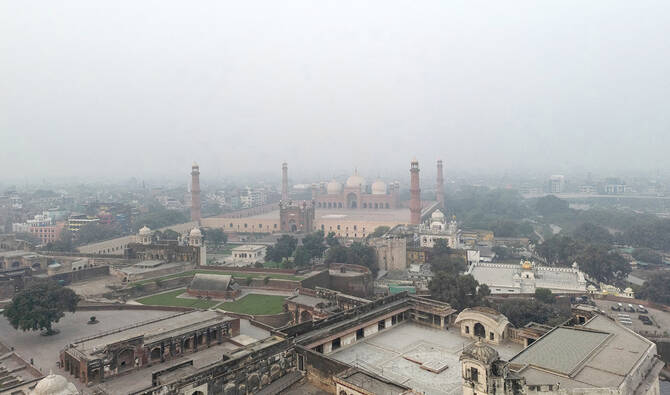
An aerial view shows the Badshahi Mosque engulfed in dense smog in Lahore on November 4, 2025. (AFP/ file)
Short Url
Updated 05 November 2025
Follow

Punjab government says Lahore air quality improves as wind disperses smog

  • Lahore ranked sixth among the world’s most polluted major cities on Wednesday, with an AQI of 158
  • Officials credit stronger wind speeds and anti-smog measures for gradual improvement in air quality

ISLAMABAD: Air quality in Lahore improved on Wednesday morning as wind speeds helped disperse pollutants that had shrouded Pakistan’s second-largest city in thick smog for days, the Punjab government said.

The Swiss-based air monitoring agency IQAir recorded Lahore’s Air Quality Index (AQI) at 158 at 10:53 a.m. local time, placing it sixth on the list of the world’s most polluted major cities, behind Kolkata and Delhi in India, Beijing, Dubai and Cairo.

Punjab province, and its capital Lahore, face a recurring “smog season” from October to February, driven by crop-residue burning, vehicular and industrial emissions, and stagnant winter weather conditions. The hazy blanket has previously pushed the AQI into hazardous levels of above 300 in Lahore in November 2024, forcing school and office closures and reduced construction activity.

“The current wind speed of about 11 kilometers per hour is helping disperse pollution particles, leading to gradual improvement in Lahore’s air quality,” the Punjab administration’s official statement said.

Senior Punjab Minister Maryam Aurangzeb said there was “a marked improvement … being seen in the AQI,” and urged residents to avoid unnecessary travel and refrain from burning waste despite the recent relief.

Punjab has begun targeted “anti-smog gun” operations this season after trial runs, part of a wider push that includes new enforcement rules and traffic measures to cut emissions in the provincial capital.

The smog crisis in Lahore, similar to conditions in India’s capital Delhi, tends to worsen during cooler months as temperature inversion traps pollutants close to the ground.


Pakistan, global crypto exchange discuss modernizing digital payments, creating job prospects 

Updated 05 December 2025
Follow

Pakistan, global crypto exchange discuss modernizing digital payments, creating job prospects 

  • Pakistani officials, Binance team discuss coordination between Islamabad, local banks and global exchanges
  • Pakistan has attempted to tap into growing crypto market to curb illicit transactions, improve oversight

ISLAMABAD: Pakistan’s finance officials and the team of a global cryptocurrency exchange on Friday held discussions aimed at modernizing the country’s digital payments system and building local talent pipelines to meet rising demand for blockchain and Web3 skills, the finance ministry said.

The development took place during a high-level meeting between Finance Minister Muhammad Aurangzeb, Pakistan Virtual Assets Regulatory Authority (PVARA) Chairman Bilal bin Saqib, domestic bank presidents and a Binance team led by Global CEO Richard Teng. The meeting was held to advance work on Pakistan’s National Digital Asset Framework, a regulatory setup to govern Pakistan’s digital assets.

Pakistan has been moving to regulate its fast-growing crypto and digital assets market by bringing virtual asset service providers (VASPs) under a formal licensing regime. Officials say the push is aimed at curbing illicit transactions, improving oversight, and encouraging innovation in blockchain-based financial services.

“Participants reviewed opportunities to modernize Pakistan’s digital payments landscape, noting that blockchain-based systems could significantly reduce costs from the country’s $38 billion annual remittance flows,” the finance ministry said in a statement. 

“Discussions also emphasized building local talent pipelines to meet rising global demand for blockchain and Web3 skills, creating high-value employment prospects for Pakistani youth.”

Blockchain is a type of digital database that is shared, transparent and tamper-resistant. Instead of being stored on one computer, the data is kept on a distributed network of computers, making it very hard to alter or hack.

Web3 refers to the next generation of the Internet built using blockchain, focusing on giving users more control over their data, identity and digital assets rather than big tech companies controlling it.

Participants of the meeting also discussed sovereign debt tokenization, which is the process of converting a country’s debt such as government bonds, into digital tokens on a blockchain, the ministry said. 

Aurangzeb called for close coordination between the government, domestic banks and global exchanges to modernize Pakistan’s payment landscape.

Participants of the meeting also discussed considering a “time-bound amnesty” to encourage users to move assets onto regulated platforms, stressing the need for stronger verifications and a risk-mitigation system.

Pakistan has attempted in recent months to tap into the country’s growing crypto market, crack down on money laundering and terror financing, and promote responsible innovation — a move analysts say could bring an estimated $25 billion in virtual assets into the tax net.

In September, Islamabad invited international crypto exchanges and other VASPs to apply for licenses to operate in the country, a step aimed at formalizing and regulating its fast-growing digital market.