

Pakistan raises Indus treaty concern at Doha summit, warns India against ‘weaponizing water’

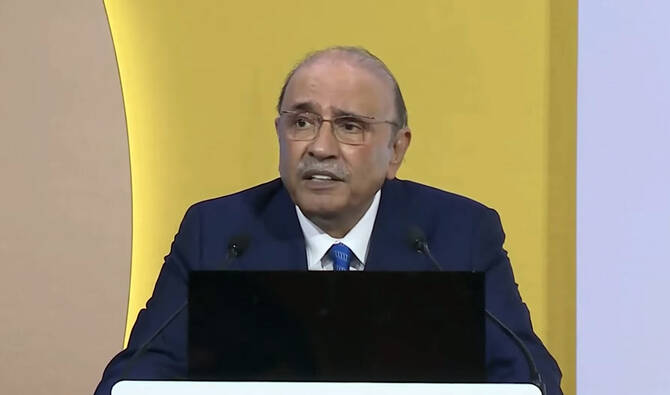
Pakistan President Asif Ali Zardari addresses the World Summit for Social Development in Doha, Qatar, on November 4, 2025. (Screengrab/DRM News)
Short Url
Updated 04 November 2025
Follow

Pakistan raises Indus treaty concern at Doha summit, warns India against ‘weaponizing water’

  • Pakistani president says threat to cut off its water supply violates Indus Waters Treaty
  • Zardari urges global solidarity for social justice, poverty eradication, sustainable growth

ISLAMABAD: President Asif Ali Zardari said on Tuesday Pakistan faced a “new threat in the form of the weaponization of water,” accusing India of violating the Indus Waters Treaty during his address to the World Summit for Social Development in Doha.

The 1960 treaty, brokered by the World Bank, divides the waters of the Indus River system between India and Pakistan and has long been regarded as one of the world’s most durable water-sharing agreements. It allocates the three western rivers — Indus, Jhelum and Chenab — to Pakistan, and the eastern rivers — Ravi, Beas and Sutlej — to India.

Tensions over water have intensified in recent years as India expanded hydropower projects on western-river tributaries. Pakistan has repeatedly voiced concern that such developments could reduce downstream flows, while New Delhi maintains they remain within treaty limits.

In April 2025, following a militant attack in India-administered Kashmir that New Delhi blamed on Pakistan, India announced it was placing the Indus Waters Treaty in abeyance. The treaty had never before been suspended despite decades of conflict. Pakistan has said any attempt to stop its share of waters will be considered an “act of war.”

“We have been threatened from across the border with a new threat in the form of weaponization of water, violation of the Indus Water Treaty,” Zardari said at the UN summit. 

“This was a serious threat to the cut of water off for 240 million Pakistanis. Such tactics cannot and will not succeed.”

Zardari also endorsed the Doha Political Declaration, the outcome document of this year’s UN summit that renews global commitments to eradicate poverty, promote full and productive employment, and strengthen social inclusion. He urged nations to unite around “equality, dignity and solidarity” and called for reforms in global finance to ensure fair development funding through debt relief, equitable taxation and affordable social investment.

The president highlighted Pakistan’s Benazir Income Support Programme (BISP), the country’s flagship cash-transfer initiative launched in 2008 to assist low-income households, which Zardari said had empowered more than nine million families through income assistance, health care and education support. He also announced plans to raise literacy to 90 percent within five years and expand climate-resilient programs such as the Green Pakistan Initiative and mangrove restoration.

Zardari also used the summit to condemn the humanitarian crisis in Gaza, calling for a lasting peace in the Middle East and denouncing what he described as “genocide, apartheid and mass starvation” against Palestinians. He reaffirmed Pakistan’s long-standing support for the “right to self-determination” of both Palestinians and Kashmiris, saying their struggles were “two sides of the same coin.” 

Pakistan does not have diplomatic ties with Israel and has consistently backed UN resolutions calling for an independent Palestinian state, while it also supports the implementation of UN resolutions on Kashmir, a disputed Himalayan region claimed by both Pakistan and India.


‘Fully stand with Bangladesh’: Pakistan PM backs decision to boycott India match

Updated 04 February 2026
Follow

‘Fully stand with Bangladesh’: Pakistan PM backs decision to boycott India match

  • Pakistan’s government have not allowed the national cricket team to play its World Cup match against India on Feb. 15
  • Pakistan has accused India of influencing ICC decisions, criticized global cricket body for replacing Bangladesh in World Cup

ISLAMABAD: Prime Minister Shehbaz Sharif on Wednesday backed his government’s decision to bar the national men’s cricket team from playing against India in the upcoming T20 World Cup tournament, reaffirming support for Bangladesh. 

Pakistan’s government announced on social media platform X last week that it has allowed its national team to travel to Sri Lanka for the World Cup. However, it said the Green Shirts will not take the field against India on their scheduled match on Feb. 15. 

Pakistan’s participation in the tournament was thrown into doubt after Pakistan Cricket Board (PCB) Chairman Mohsin Naqvi criticized the International Cricket Council (ICC) for replacing Bangladesh with Scotland. The decision was taken after Bangladesh said it would not let its team travel to India out of security concerns. 

During a meeting of the federal cabinet, Sharif highlighted that Pakistan has said that politics should be kept away from sports. 

“We have taken this stand after careful consideration and in this regard, we should stand fully with Bangladesh,” Sharif said in televised remarks. 

“And I believe this is a very reasonable decision.”

Pakistan has blamed India for influencing the ICC’s decisions. The global cricket governing body is currently led by Jay Shah, the head of the Board of Control for Cricket in India. Shah is the son of Indian Home Minister Amit Shah. 

Pakistan’s boycott announcement has triggered media frenzy worldwide, with several Indian cricket experts and analysts criticizing Islamabad for the decision. An India-Pakistan cricket contest is by far the most lucrative and eagerly watched match of any ICC tournament. 

The ICC has ensured that the two rivals and Asian cricket giants are always in the same group of any ICC event since 2012 to capitalize on the high-stakes game. 

The two teams have played each other at neutral venues over the past several years, as bilateral cricket remains suspended between them since 2013 due to political tensions. 

Those tensions have persisted since the two nuclear-armed nations engaged in the worst fighting between them since 1999 in May 2025, after India blamed Pakistan for an attack in Indian-administered Kashmir that killed tourists. 

Pakistan denied India’s allegations that it was involved in the attack, calling for a credible probe into the incident.