

Pakistan’s Sindh invites Saudi Arabia to invest in transport, infrastructure sectors

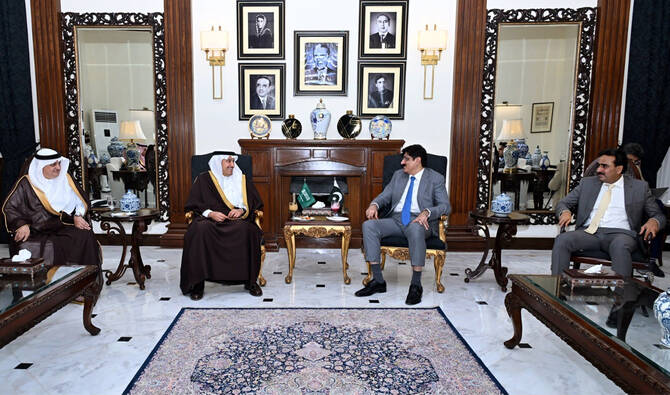
Chief minister of Pakistan’s Sindh province, Syed Murad Ali Shah (second right), meets Saudi Arabia’s Transport Minister Saleh bin Nasser Al-Jasser (second left) and Kingdom’s Ambassador to Pakistan Nawaf bin Said Al-Malki (left) at the Chief Minister’s House in Karachi, Pakistan, on October 11, 2025. (Sindh Chief Minister House)
Short Url
Updated 04 November 2025
Follow

Pakistan’s Sindh invites Saudi Arabia to invest in transport, infrastructure sectors

  • Sindh Chief Minister Murad Ali Shah meets high-level Saudi delegation to discuss investment opportunities
  • Both sides agreed to establish joint working group to review progress on agreed projects, says Sindh government

ISLAMABAD: The chief minister of Pakistan’s southern Sindh province, Syed Murad Ali Shah, this week invited Saudi Arabia to invest in its transport and infrastructure sectors, as both sides discussed expanding bilateral cooperation and investment opportunities. 

The statement from the provincial government was issued after Shah met Saudi Arabia’s Transport Minister Saleh bin Nasser Al-Jasser at the Chief Minister’s House in Karachi on Monday. Al-Jasser is in Karachi to attend the Nov. 3-6 Pakistan International Maritime Expo and Conference (PIMEC). 

Shah and other Sindh government officials met Al-Jasser and a high-level Saudi delegation which included the Kingdom’s Ambassador to Pakistan Nawaf bin Said Al-Malki and senior officials from the Saudi transport ministry. Both sides discussed strengthening bilateral ties, facilitating Hajj pilgrims and enhancing Saudi investment in Sindh’s transport and infrastructure sectors. 

“Chief Minister Murad Ali Shah welcomed the Saudi delegation and said that Sindh offers vast investment opportunities, particularly in transport, logistics, and road infrastructure,” a statement from the chief minister’s media coordinator said on Monday. 

“He invited Saudi investors to participate in Karachi’s ongoing and upcoming major transport projects, including rapid transit and light rail systems.”

Shah said Sindh’s growing urban centers and increasing connectivity create significant potential for public-private partnerships (PPP). He said the Sindh government is committed to ensuring transparent procedures and a conducive business environment for foreign investors.

The statement said both sides also agreed on launching direct flights between Karachi and Madinah to strengthen trade, tourism and people-to-people ties between Pakistan and Saudi Arabia. 

“Both parties also agreed to expand cooperation in the maritime and port sectors to further enhance the historical seaborne links between Karachi and Saudi ports,” the statement said. 

Al-Jasser expressed his resolve to further strengthen Pakistan-Saudi Arabia’s bilateral partnership, the provincial government said. 

“Saudi Arabia and Pakistan are entering a new era of partnership and cooperation,” Al-Jasser was quoted as saying by the Sindh government. “Under the vision of our leadership, we aim to work together for Pakistan’s development and to further strengthen the relations between our two brotherly nations.”

It said both sides agreed to establish a joint working group to review progress on agreed projects and explore new opportunities within the Pakistan–Saudi Arabia partnership framework.


Pakistan raises India's suspension of water-sharing treaty with UNGA president, seeks action

Updated 7 sec ago
Follow

Pakistan raises India's suspension of water-sharing treaty with UNGA president, seeks action

  • New Delhi said in April last year it was holding the treaty in abeyance after a gun attack in Indian-administered Kashmir
  • Official says such actions threaten lives of 240 million Pakistanis, particularly at a time of climate stress, water scarcity

ISLAMABAD: Pakistan has taken up India’s suspension of a decades-old water-sharing treaty with the president of the United Nations General Assembly (UNGA), urging action over the move that Islamabad said sets "dangerous precedents."

The Indus Waters Treaty (IWT) divides control of the Indus basin rivers between the two nuclear-armed neighbors. India said in April last year it would hold the treaty “in abeyance” after a gun attack in Indian-administered Kashmir killed more than 26 tourists. New Delhi blamed the assault on Pakistan, Islamabad denied it.

The attack led to a four-day military conflict between the neighbors last May that say them attack each other with fighter jets, missiles, drones and artillery before the United States-brokered a ceasefire. Tensions have remained high between the nuclear-armed neighbors.

During a meeting on the sidelines of the Inter-Parliamentary Union (IPU) annual hearing, Pakistan Senate Chairman Yusuf Raza Gilani told UNGA President Annalena Baerbock that India's unlawful action constituted a blatant violation of the treaty’s provisions and principles of customary international law.

"Such actions threaten the lives and livelihoods of over 240 million Pakistanis and set dangerous precedents, particularly at a time when climate stress and water scarcity demand cooperation and strict respect for international agreements," he was quoted as saying by the Pakistani information ministry.

The treaty, mediated by the World Bank, grants Pakistan rights to the Indus basin’s western rivers — Indus, Jhelum, and Chenab — for irrigation, drinking, and non-consumptive uses like hydropower, while India controls the eastern rivers — Ravi, Beas, and Sutlej — for unrestricted use but must not significantly alter their flow.

Highlighting the adverse impacts of climate change, Gilani said countries like Pakistan remain among the most severely affected and underscored the urgency of collective action, climate justice and strengthened international cooperation.

"The United Nations provides an indispensable platform for addressing these interconnected challenges," he said at the meeting.

Gilani, who was leading a six-member parliamentary delegation, this week delivered the national statement at the IPU annual hearing at the UN headquarters, calling for democratic, transparent, and accountable decision-making in order to enhance the UN’s credibility, according to the Senate of Pakistan.

“Parliaments are indispensable partners in ensuring national ownership of international commitments,” he was quoted as saying by the Senate. “Reform is essential. But it must be ‘Reform for All, Privilege for None’.”

The Senate chairman highlighted the continuing importance of the United Nations as the cornerstone of multilateral cooperation, stressing that the organization’s universal membership and Charter-based mandate remain central to promoting global peace and security.