How Israeli raids uprooted lives in the West Bank’s Tulkarem refugee camp

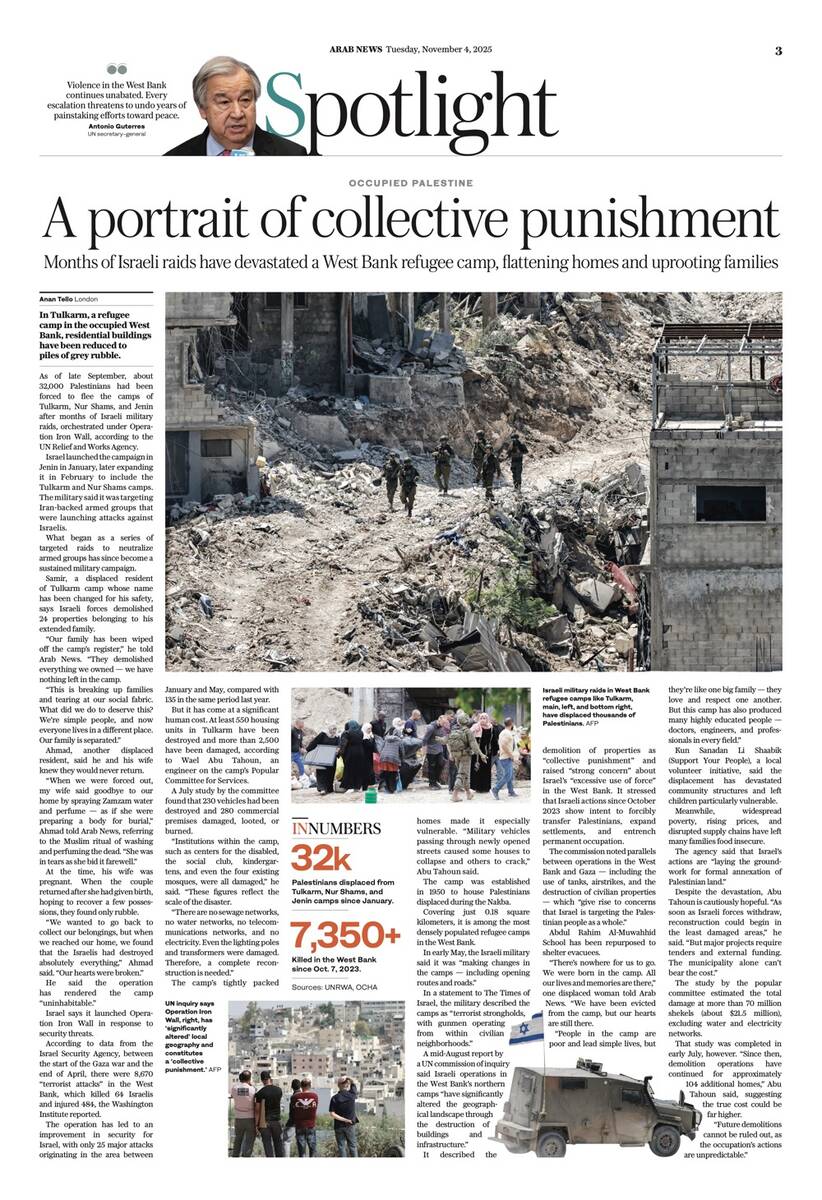
Israeli military raids in West Bank refugee camps like Tulkarm, main, left, and bottom right, have displaced thousands of Palestinians. (AFP)
Short Url
Updated 03 November 2025
Follow

How Israeli raids uprooted lives in the West Bank’s Tulkarem refugee camp

  • Israeli operations in three Palestinian refugee camps displaced more than 32,000 people, says UNRWA
  • UN inquiry says Operation Iron Wall has “significantly altered” local geography and constitutes a “collective punishment”

LONDON: In Tulkarem, a refugee camp in the occupied West Bank, residential buildings have been reduced to piles of grey rubble, the facades of shuttered businesses blackened by soot. Damaged vehicles jut from the wreckage, and the surrounding streets are eerily quiet.

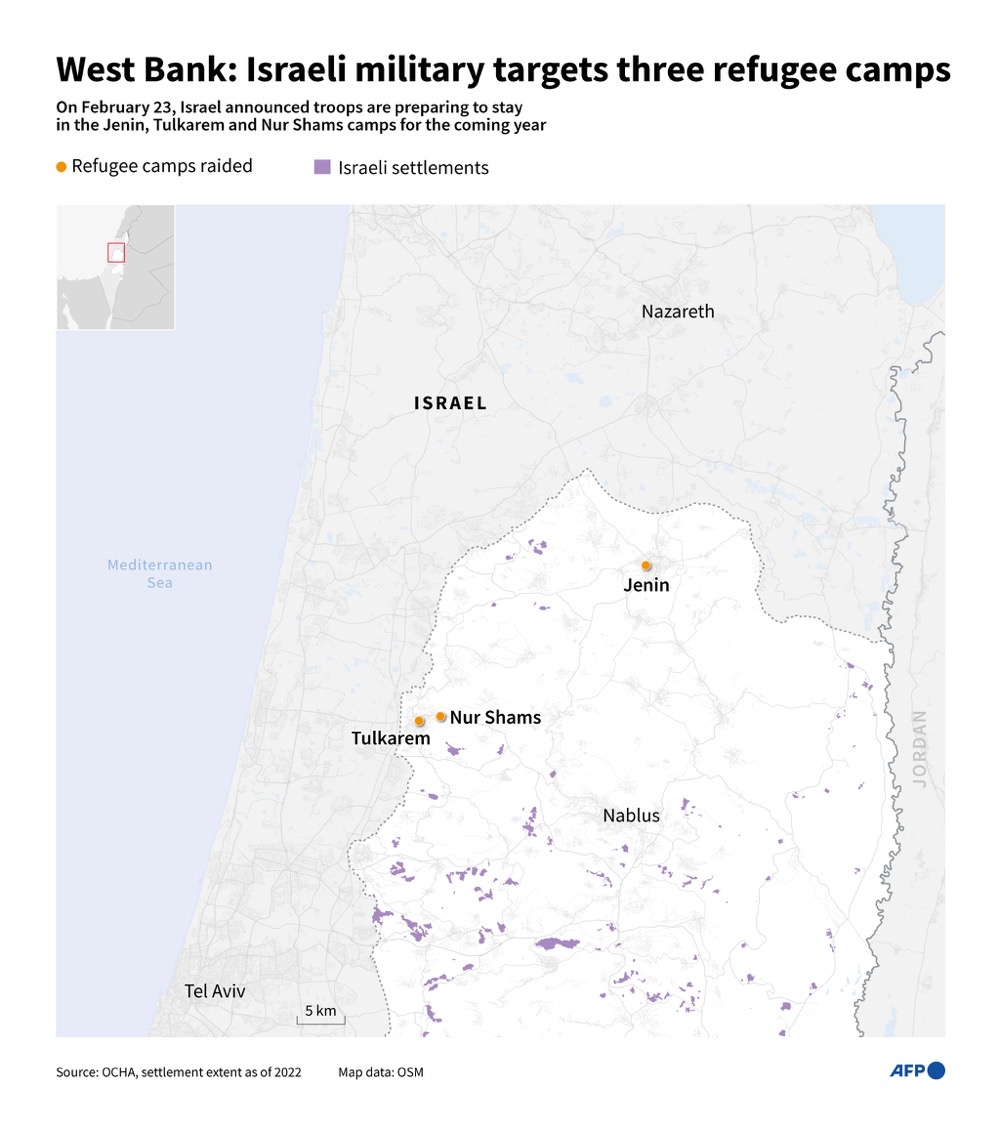
As of late September, about 32,000 Palestinians had been forced to flee the camps of Tulkarem, Nur Shams, and Jenin after months of Israeli military raids, orchestrated under Operation Iron Wall, according to the UN Relief and Works Agency.

Israel launched the campaign in Jenin in January, later expanding it in February to include the Tulkarem and Nur Shams camps. The military said it was targeting Iran-backed armed groups that had grown stronger in the camps and were launching attacks against Israelis.

What began as a series of targeted raids to neutralize Palestinian armed groups and protect Israeli settlements, has since become a sustained military campaign that has displaced thousands and reshaped life in the northern West Bank.


About 32,000 Palestinians had been forced to flee the camps of Tulkarem, Nur Shams, and Jenin after months of Israeli military raids. (AFP/File)

Samir, a displaced resident of Tulkarem camp whose name has been changed for his safety, says Israeli forces have demolished 24 properties belonging to his extended family over the past nine months. Each four-story building, he said, housed an average of five people.

“Our family has been wiped off the camp’s register,” he told Arab News. “They demolished everything we owned — we have nothing left in the camp.

“This is breaking up families and tearing at our social fabric. What did we do to deserve this? We’re simple people, and now everyone lives in a different place. Our family is separated.”

Ahmad, another displaced resident, said he and his wife knew they would never return when soldiers forced them from their home.

“When we were forced out, my wife said goodbye to our home by spraying Zamzam water and perfume — as if she were preparing a body for burial,” Ahmad told Arab News, referring to the Muslim ritual of washing and perfuming the dead. “She was in tears as she bid it farewell.”


What began as a series of targeted raids to neutralize Palestinian armed groups and protect Israeli settlements, has since become a sustained military campaign that has displaced thousands. (AFP/File)

At the time, his wife was pregnant with their third child. When the couple returned after she had given birth, hoping to recover a few possessions, he said they found only rubble and splintered wood.

“We wanted to go back to collect our belongings, but when we reached our home, we found that the Israelis had destroyed absolutely everything,” Ahmad said. “Our hearts were broken.”

He said the camp’s condition “is beyond description” and that the operation has rendered it “inhabitable.”

“We deserve to live with dignity, like everyone else in the world. Why must we endure so much injustice?”

Israel says it launched Operation Iron Wall in response to security threats.

According to data from the Israel Security Agency, between the start of the Gaza war and the end of April, there were 8,670 “terrorist attacks” in the West Bank, which killed 64 Israelis and injured 484, the Washington Institute reported.

Since January, the operation has sought to restrict the freedom of action of militants, especially in refugee camps that, according to Israel, had become launchpads for attacks and havens for armed groups organized in battalions.


 Families displaced from Tulkarem camp are dispersed among schools, mosques, and temporary shelters. (AFP/File)

The operation has led to a significant improvement in security for Israel, with only 25 major attacks originating in the area between January and May, compared with 135 in the same period last year.

But it has come at a significant human cost. Since the start of the operation, at least 550 housing units in Tulkarem have been destroyed and more than 2,500 have been damaged, according to Wael Abu Tahoun, an engineer on the camp’s Popular Committee for Services.

A July study by the committee found that 230 vehicles had been destroyed and 280 commercial premises damaged, looted, or burned.

“Institutions within the camp, such as centers for the disabled, the social club, kindergartens, and even the four existing mosques, were all damaged,” he said. “These figures reflect the scale of the disaster.”

Infrastructure in six main streets — Al-Awdeh, Al-Balawneh, Al-Khadamat, Qaqun, Okasha, and the street next to Al-Awdeh Hall — was also destroyed.

“There are no sewage networks, no water networks, no telecommunications networks, and no electricity,” Abu Tahoun said. “Even the lighting poles and transformers were damaged. Therefore, a complete reconstruction is needed, with new studies and planning.”


Violence has escalated in the West Bank since the Oct. 7, 2023, Hamas-led attack on southern Israel, which triggered Israel’s military campaign in Gaza. (AFP/File)

The camp’s narrow alleys and tightly packed homes made it especially vulnerable. “Military vehicles passing through newly opened streets caused some houses to collapse and others to crack,” Abu Tahoun said.

The camp, in the city of Tulkarem in the West Bank’s northwest, was established in 1950 to house Palestinians displaced during the Nakba — the mass expulsion that accompanied Israel’s creation in 1948.

Covering just 0.18 square kilometers, it is among the most densely populated refugee camps in the West Bank, according to UNRWA.

In early May, the Israeli military said it was “making changes in the camps — including opening routes and roads — to allow freedom of movement and operational capability (for Israel’s military forces).”

In a separate statement to The Times of Israel, the military described the camps as “terrorist strongholds, with gunmen operating from within civilian neighborhoods.”

It also said demolitions were part of efforts to “prevent the return and entrenchment of gunmen” and to “reshape and stabilize the region.”

Violence has escalated in the West Bank since the Oct. 7, 2023, Hamas-led attack on southern Israel, which triggered Israel’s military campaign in Gaza.

On Oct. 3, 2024, an Israeli strike on a residential building in Tulkarem camp killed at least 18 people, including Hamas commander Zahi Yaser Abd Al-Razeq Oufi, the Palestinian Authority-run Wafa news agency reported.

The UN Human Rights Office said most of those killed were civilians, including three children and two women — many in their homes or on the surrounding streets.


Repeated Israeli operations since 2023 “destroyed nearly everything that remained”. (AFP/File)

A mid-August report by the UN Independent International Commission of Inquiry on the Occupied Palestinian Territory, including East Jerusalem, and Israel, said Israeli operations in the West Bank’s northern camps “have significantly altered the geographical landscape through the destruction of buildings and infrastructure.”

It described the demolition of properties as “collective punishment” and raised “strong concern” about Israel’s “excessive use of force” in the West Bank. It stressed that Israeli actions since October 2023 show intent to forcibly transfer Palestinians, expand settlements, and entrench permanent occupation.

The commission noted parallels between operations in the West Bank and Gaza — including the use of tanks, airstrikes, and the destruction of civilian properties — which “give rise to concerns that Israel is targeting the Palestinian people as a whole.”

Since Oct. 7, 2023, Israel’s campaign in Gaza has killed at least 68,530 Palestinians, according to local health authorities, while more than 7,350 have been killed in the West Bank, including East Jerusalem, the UN Office for the Coordination of Humanitarian Affairs reported.

In Gaza, more than 90 percent of housing units have been destroyed and 1.9 million Palestinians displaced.

INNUMBERS

• 32k+ Palestinians displaced from Tulkarem, Nur Shams, and Jenin camps since January.

• 7,350+ killed in the West Bank since Oct. 7, 2023.

(Source: UNRWA, OCHA)

Abu Tahoun said the Tulkarem camp had been deteriorating long before the raids began in late 2023.

“The water network, built in 1960, had not been upgraded since,” he said. “Sewage and rainwater systems were inadequate, and electricity lines were worn out.

“Most of the repairs carried out in the camp (before the operation) were temporary. Works were executed partially and quickly because the occupation forces would return after short periods and destroy what had been repaired.”

Repeated Israeli operations since 2023 “destroyed nearly everything that remained,” he added. “The most recent incursion was the most severe, leaving almost no infrastructure intact.”

Families displaced from Tulkarem camp are dispersed among schools, mosques, and temporary shelters.

Abdul Rahim Al-Muwahhid School, a newly built facility, is among the schools repurposed to shelter evacuees instead of welcoming pupils for the new academic year.

“There’s nowhere for us to go. We were born in the camp. All our lives and memories are there,” one displaced woman told Arab News. “We have been evicted from the camp, but our hearts are still there.

“People in the camp are poor and lead simple lives, but they’re like one big family — they love and respect one another. But this camp has also produced many highly educated people — doctors, engineers, and professionals in every field.”
Kun Sanadan Li Shaabik (Support Your People), a local volunteer initiative, said the displacement has devastated community structures and left children particularly vulnerable. Many have dropped out of school, it said, while others show signs of trauma and anxiety.

UNRWA has described the situation as a “cyclical displacement crisis” driven by military incursions, settler violence, and the expansion of illegal Israeli settlements.

More than 4,000 children have been forced from classrooms and now rely on remote or temporary education, UNRWA said on Oct. 22.

Meanwhile, widespread poverty, rising prices, and disrupted supply chains have left many families food insecure, some reducing meals or borrowing money to survive.

The agency said that Israel’s actions are “laying the groundwork for formal annexation of Palestinian land.”


The camp, in the city of Tulkarem in the West Bank’s northwest, was established in 1950 to house Palestinians displaced during the Nakba. (AFP/File)

Despite the devastation, Abu Tahoun is cautiously hopeful. “As soon as Israeli forces withdraw, reconstruction could begin in the least damaged areas,” he said. “But major projects require tenders and external funding. The municipality alone can’t bear the cost.”

The study by the popular committee estimated the total damage at more than 70 million shekels (about $21.5 million), excluding water and electricity networks.

That study was completed in early July, however. “Since then, demolition operations have continued for approximately 104 additional homes,” Abu Tahoun said, suggesting the true cost could be far higher.

“Future demolitions cannot be ruled out, as the occupation’s actions are unpredictable.” 


Sudan defense minister: Militia backed by foreign forces is failing

Updated 4 sec ago
Follow

Sudan defense minister: Militia backed by foreign forces is failing

  • General Hassan Kabroun tells Arab News SAF has regained momentum against RSF, whose “approaching defeat will open the door to political transition”
  • Says RSF no longer sustained by local fighters but increasingly dependent on foreign mercenaries, calls for international effort to stop support for RSF

RIYADH: Nearly three years after an outbreak of violence plunged Sudan into one of the world’s worst humanitarian disasters, the Sudanese military has regained momentum against the rebels, who are on the verge of defeat, according to Sudanese Defense Minister Hassan Kabroun.

Speaking exclusively with Arab News in Riyadh, he said the Sudanese Armed Forces was now on the offensive. “I am pleased, and fully confident, to convey good news to the entire world,” he said.

“SAF, with their proud history, and with the support of friendly states, are advancing at a rapid pace toward eliminating the rebellion, now reeling and confined to a limited number of remaining strongholds.”

Kabroun said the Rapid Support Forces’ approaching defeat would open the door to a political transition.

“This will allow Sudan’s state leadership to begin the process of peaceful democratic transition during a transitional phase led by a civilian government safeguarded by SAF,” he said, adding that the process would culminate in “free, fair, and transparent general elections acceptable to the Sudanese people.”

Sudan’s conflict erupted on April 15, 2023, amid a power struggle between the SAF, led by General Abdel Fattah Al-Burhan, and the RSF, commanded by General Mohamed Hamdan Dagalo, known as Hemedti.

The RSF, which evolved from the Janjaweed militias implicated in atrocities in Darfur in the early 2000s, launched coordinated attacks on army bases in Khartoum and elsewhere, rapidly seizing territory with the backing of foreign powers, including the UAE.

The fighting has killed tens of thousands and displaced more than 14 million people, with entire cities reduced to ruins and famine spreading across large parts of the country.

Kabroun rejected descriptions of the conflict as a clash between rival generals. “I would like to emphasize and firmly establish that what has occurred is a rebellion against SAF and against the Sudanese state, carried out by a faction that was formerly part of it,” he said.

“Therefore, there is no basis for describing the situation as a war between two generals, since SAF have a single commander, and whoever rebels against him is, by definition, a rebel.”

Recent months have seen the SAF claim gains in several strategic areas, including the lifting of sieges imposed by the RSF on key towns such as Kadugli in South Kordofan, restoring supply routes and allowing some displaced civilians to return.

Kabroun contrasted these advances with what he described as systematic crimes by the RSF, particularly in Darfur, where international organizations have documented mass killings, sexual violence, and forced displacement.

“We are very frank about what has happened in Sudan,” he said. “What happened in Al-Fashir constitutes a grave and blatant violation of international law.”

“These violations were not limited to military targets but also affected civilians — elderly people, women, and children. Some were even buried alive, as occurred and was documented since the beginning of the war in Al-Junaynah and in Al-Fashir.”

Human-rights groups say RSF fighters and allied militias have targeted non-Arab communities in Darfur. In North Darfur’s Zamzam displacement camp, one of the largest in the country, RSF assaults in 2025 displaced hundreds of thousands more civilians.

“There has been systematic and deliberate genocide against the people of the Darfur region,” Kabroun said. “It now appears that foreign individuals are being settled in place of citizens, enabling them to take over the lands of those who were killed, destroyed, and displaced.”

He accused unnamed regional actors of backing the RSF with weapons, logistics and fighters.

“We affirm that this war involves regional and international parties providing logistical support, weapons, intelligence, and even fighters,” he said, citing reports of foreign nationals participating in the conflict.

“Ending the war in Sudan begins with stopping this support from the state of evil,” he said. “Ending the war begins with stopping this support. This is when the war will end.”

Kabroun said the shifting balance on the battlefield reflected what he described as a deeper collapse within the RSF itself, arguing that the militia was no longer sustained by local fighters but increasingly dependent on foreign mercenaries.

“First, the RSF now relies on foreign mercenaries, including mercenaries from West African countries, Colombia, Ethiopia, and South Sudan,” he said. “This means that the core fighting force of this militia has collapsed.”

According to Kabroun, the RSF’s social and tribal support base has been hollowed out by heavy losses over the course of the war, with long-term consequences for communities that once supplied its ranks.

“The militia’s support bases and supporting tribes have been depleted,” he said. “Each tribe has lost between 20,000 and 30,000 young fighters. These young fighters embodied reconstruction, protection, economic support, and the hope of the future.”

He argued that replacing those losses with mercenaries was itself evidence of strategic failure. “Replacing young fighters with mercenaries means that they are either killed or maimed,” Kabroun said, framing the shift as both a military and social collapse.

Kabroun pointed to recent SAF gains across Kordofan as further proof that the RSF was losing cohesion and territory.

“Our victories in Kordofan, including in the North, South, and West Kordofan, have led to a clear decline in militia activity, marked by retreat and withdrawal,” he said.

“This is strong evidence of their collapse and the beginning of a genuine victory for both the SAF and the Sudanese people.”

He also accused the RSF of turning to increasingly indiscriminate tactics as it lost ground, particularly the use of drones against civilian targets.

“The militia’s use of strategic drones to target armed forces inside cities, as well as civilians and displaced people, reflects a state of complete and true bankruptcy on the part of this militia,” he said.

Kabroun said international awareness of RSF abuses was now translating into internal fractures within the group.

“Friendly states, major powers, and countries that operate transparently are now fully aware of the grave and appalling violations committed by the RSF,” he said, adding that condemnation of those abuses had contributed to “the collapse of their leadership and a breakdown of trust among their fighters.”

He said this erosion was visible on the ground. “There have also been numerous surrenders by members of the RSF in areas controlled by government forces,” Kabroun said, arguing that this trend underscored what he called the militia’s “inevitable defeat.”

By contrast, he said, morale among civilians aligned with the state was rising, particularly among young people.

“The determination of the Sudanese people, especially Sudanese youth, to mobilize, be recruited, train, and be ready to join the frontlines at any moment, has significantly raised national morale while weakening the morale of the rebels,” he said.

“This alone is sufficient proof that the militia is faltering.”

Kabroun accused the RSF and its backers of using calls for ceasefires tactically rather than in pursuit of peace.

“Whenever the army advances and mercenary forces suffer decisive blows, the traitors and bandits resort to steadfastness and reinforcement from supporting states and the state of evil to call for truce, not to stop the fighting, but to resupply their fighters,” he said.

“This is something the entire world now understands.”

Despite his combative tone, Kabroun insisted that the SAF’s objective remained peace under state authority. “We are advocates of peace and seek what is best for our people,” he said. “But when it comes to defending the nation, no one will stop us.”

“The battlefield is in our hands, peace is in our hands, and everything is in our hands, by the will of God,” Kabroun added. “We will continue forward until every inch of Sudanese land is liberated from the hand of the traitors and bandits.”

International condemnation, he argued, has so far failed to halt the violence. “Condemnation alone will not achieve anything,” Kabroun said, referring to recent RSF attacks on humanitarian convoys and aid facilities.

“What is needed is concrete and decisive action, as has been taken before in other countries, to put an end to whatever threatens citizens’ security.”

International organizations have repeatedly condemned RSF attacks on civilians and aid workers, including strikes on a military hospital, a World Food Programme convoy, and buses carrying displaced people, calling them violations of international humanitarian law and the Jeddah Declaration on the Protection of Civilians in Sudan.

Looking ahead to forthcoming debates at the UN Security Council, Kabroun said only firm measures would end the war.

“If the convening of the UN Security Council does not result in strict decisions and strong interventions to first stop the support, and to hold accountable all those involved in supporting this rebellion … we see that there is no determination from the Security Council and the international community to stop the war,” he said.

According to Kabroun, Saudi Arabia’s mediation, Red Sea security role, and backing of Sudan’s state institutions have been central to efforts to end Sudan’s devastating civil war.

He placed Saudi Arabia at the heart of Sudan’s diplomatic, security and humanitarian landscape since fighting erupted in April 2023, arguing that Riyadh’s engagement has been both consistent and decisive.

“Certainly, the Kingdom of Saudi Arabia has played an effective role,” he said. “Since the outbreak of the war, it started with the Jeddah Peace Talks and these efforts have continued to this day.

“The Kingdom of Saudi Arabia has been a strong and vocal advocate for Sudan’s stability and for finding solutions that are acceptable to the Sudanese people in this regard.”

Kabroun,  who is attending the World Defense Show in Riyadh, said Saudi engagement reached the highest levels of international diplomacy when Crown Prince Mohammed bin Salman raised the situation in Sudan with US President Donald Trump at the White House in November.

“These Saudi efforts reached their peak when the Crown Prince met with President Trump and discussed the situation in Sudan and what is required to ensure the country’s safety and territorial stability,” he said.

Despite the devastation inflicted on Sudan, Kabroun struck an optimistic note, returning to the theme of reconstruction.

 “We affirm to the world, God willing, that what we are living now in Sudan is better and is going toward what is better, and very soon, God willing,” he said.

“What the war has destroyed will, God willing, be rebuilt, by Sudanese, by supporters, and by friends.”

Kabroun also singled out Arab News for praise, thanking the newspaper for giving Sudanese officials a platform to address an international audience.

“Our sincere thanks to this newspaper, Arab News, based in Saudi Arabia, on its 50th anniversary,” he said. “We thank them for choosing and hosting us in the Kingdom of Saudi Arabia to present our vision to the entire world.”

He added that he hoped the coming period would bring “positive news about Sudan, reported through this major media platform.”