

Pakistan’s competition watchdog urges creation of steel ministry to reform struggling sector

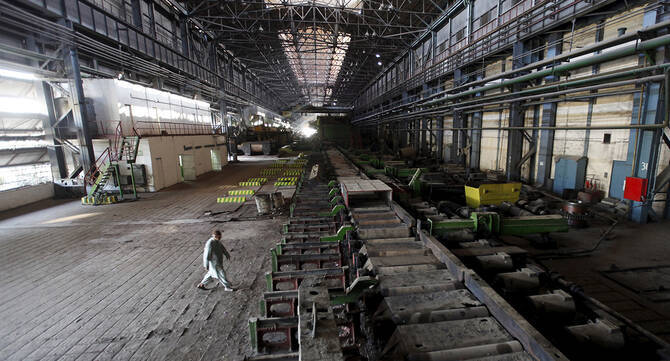
A man walks past machines at the hot strip mill department of the Pakistan Steel Mills (PSM) on the outskirts of Karachi, Pakistan February 8, 2016. (AFP/File)
Short Url
Updated 03 November 2025
Follow

Pakistan’s competition watchdog urges creation of steel ministry to reform struggling sector

  • CCP cites lack of national policy, weak regulation and tax exemptions hurting competitiveness
  • Recommends new ministry, formalization of undocumented units, adoption of green technologies

KARACHI: The Competition Commission of Pakistan (CCP) has called for the establishment of a dedicated steel ministry and the formulation of a national policy to address long-standing distortions in the country’s steel industry, which it says faces weak regulation, unfair tax exemptions and heavy import dependence.

The steel sector remains central to Pakistan’s manufacturing base, contributing significantly to exports and employment but struggling with fragmentation and policy neglect. Large Scale Manufacturing accounts for more than 69 percent of total manufacturing and 8.2 percent of GDP, yet per capita steel consumption is only 47 kilograms, far below regional averages. The industry depends heavily on imported scrap, faces chronic energy shortages and produces nearly 60 percent of its output below standard due to weak enforcement and regulatory oversight.

In light of these challenges, the Competition Commission of Pakistan on Sunday released a report titled “Competition Assessment Study of the Steel Sector in Pakistan,” identifying competition-related bottlenecks and recommending reforms to promote fair market conditions and long-term sustainability.

“The study underscores the absence of a national steel policy and recommends the establishment of a dedicated Steel Ministry, citing successful models from China and India,” the CCP said in the statement.

According to the report, Pakistan’s manufacturing sector contributes 71 percent of total exports and employs around 15 percent of the workforce. In FY24, local steel production reached 8.4 million metric tons (MT), including 4.9 million MT of long steel and 3.5 million MT of flat steel, while imports of steel scrap totaled 2.7 million MT, underscoring the sector’s reliance on imported raw material.

The report said Pakistan Steel Mills (PSM), once a strategic national asset with a 1.1 million-ton annual capacity, has been non-operational since 2015 due to mounting losses and outdated technology, leaving liabilities of Rs400 billion ($1.4 billion). In contrast, countries such as China, India, and Russia advanced through targeted state support, investment in technology, and efficient resource management.

The CCP cited multiple institutional weaknesses, including an Ease of Doing Business Committee that lacks industry expertise and frequent changes in SROs that create policy uncertainty. It noted that tax exemptions in ex-FATA/PATA regions allow 1.5 million tons of untaxed steel to enter settled markets annually, resulting in revenue losses of about Rs40 billion ($144 million).

The commission proposed developing a comprehensive national steel policy, rationalizing taxes and ensuring stable regulatory frameworks. It also recommended expanding the Ease of Doing Business Committee to include industry experts and CCP representation, strengthening the Ministries of Industries and Commerce, and accelerating National Tariff Commission (NTC) processes.

The CCP urged enforcement of quality standards, formalization of undocumented producers, removal of tax distortions, and incentives for Direct Reduced Iron (DRI) technology, green production methods and local iron ore mining.

“The CCP will continue working with all the stakeholders to develop pro-competition reforms to promote competition and long-term sustainability in the steel sector, much in line with the international best practices,” the statement added.


Pakistan stocks recover as oil supply fears ease after Islamabad seeks Red Sea route— analyst

Updated 05 March 2026
Follow

Pakistan stocks recover as oil supply fears ease after Islamabad seeks Red Sea route— analyst

  • Pakistan has sought Saudi help to secure oil supplies via Red Sea port after Iran’s closure of Strait if Hormuz
  • Analyst says higher crude oil prices, expectations of IMF releasing next loan tranche also triggered bullish activity

ISLAMABAD: Pakistani stocks marked a sharp recovery when trading closed on Thursday, as institutional activity increased following Islamabad’s move to seek crude oil supplies through the Red Sea port eased oil supply fears, a financial analyst said. 

Pakistani stocks have recorded a sharp decline this week, with the benchmark KSE-100 index recording its largest-ever single-day decline on Monday when it plunged 16,089 points. Escalating conflict in the Middle East triggered panic selling at the Pakistani bourse, forcing a temporary trading halt on Monday. 

The KSE-100 index, however, gained 3.49 percent or 5,433.46 points to close at 161,210.67 when trading ended on Thursday, up from the previous close of 155,777.21 points, according to Pakistan Stock Exchange’s (PSX) data.

Pakistan’s Petroleum Minister Ali Pervaiz Malik met Saudi Ambassador Nawaf bin Said Al-Malki on Wednesday to discuss Iran’s closure of the key Strait of Hormuz, which has threatened Pakistan’s energy supply. Roughly 20 percent of the global oil and gas supply passes through the route. Saudi Arabia indicated it could facilitate shipments through the Red Sea port of Yanbu, offering an alternative route if Gulf shipping lanes remain disrupted, the petroleum ministry said on Wednesday. 

“Stocks staged a sharp recovery at PSX amid institutional activity on easing fuel supply fears after KSA [Kingdom of Saudi Arabia] commits oil supplies through the Red Sea port,” Ahsan Mehanti, chief executive officer at Arif Habib Commodities, told Arab News.

He said higher global crude oil prices and expectations of the International Monetary Fund releasing its next tranche of the $7 billion loan for Pakistan also helped bullish activity at the PSX.

An IMF mission was in Pakistan to hold talks on the third review of a $7 billion Extended Fund Facility multi-year program, and for the second review of the $1.4 billion Resilience and Sustainability Facility this week.

However, the delegation left for Türkiye amid tensions in the Gulf. Pakistani officials have said talks are likely to continue virtually in the coming days. 

Pakistani brokerage Topline Securities said in its daily market review report that strong institutional buying “turned the tide” on Thursday after the market’s recent overreaction to regional issues.

The report added that Hub Power Company (HUBC), Oil & Gas Development Company (OGDC), Fauji Fertilizer Company (FFC), Engro Corporation (ENGROH), and Meezan Bank Limited (MEBL) collectively contributed 2,197 points to the KSE benchmark’s gain.

Topline Securities said 723 million shares were traded on Thursday, with K-Electric Limited (KEL) stealing the spotlight as more than 1.17 billion shares changed hands.

Pakistani investors are closely monitoring developments in the Gulf, particularly around energy routes and further retaliatory actions, as the conflict’s trajectory remains uncertain.