

Pakistan arrests fisherman it says was forced to smuggle military uniforms, mobile SIMs to India

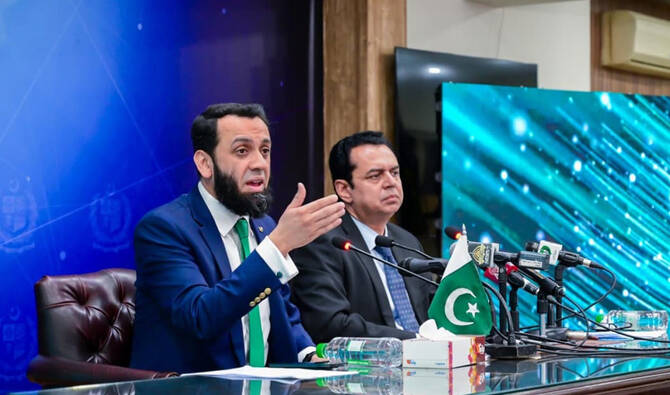
Federal Information Minister, Attaullah Tarar (left) and State Minister for Interior, Talal Chaudhry, addressing a press conference in Islamabad, Pakistan, on November 1, 2025. (PID)
Short Url
Updated 01 November 2025
Follow

Pakistan arrests fisherman it says was forced to smuggle military uniforms, mobile SIMs to India

  • Attaullah Tarar says Indian intelligence arrested the fisherman in September, coerced him to procure the items for propaganda
  • Indian Home Minister Amit Shah told parliament in July some slain militants were found with Pakistani voter IDs and chocolates

ISLAMABAD: Pakistan said on Saturday it had arrested a local fisherman allegedly coerced by Indian intelligence to work for them and carry propaganda material to the neighboring state, including military uniforms, local currency, mobile SIMs of a Chinese company and other items.

Earlier this year in July, Indian Home Minister Amit Shah told parliament that his country's forces had recovered Pakistani voter identity cards and chocolates from a group of slain militants whom he said were also involved in a gun attack in the tourist resort of Pahalgam in Indian-administered Kashmir that took place in April.

New Delhi had blamed Pakistan for the assault, an allegation denied by Islamabad which called for an impartial international probe. The incident led to an intense four-day military conflict between the nuclear-armed neighbors in May before US President Donald Trump announced a ceasefire.

“Recently, we had a big success in which Pakistani law enforcement agencies have apprehended a common fisherman by the name of Ijaz Mallah, who used to go fishing in the high seas,” Federal Information Minister Attaullah Tarar told a news conference in Islamabad. “In September this year, when he was out fishing, he was arrested by the Indian Coast Guard and after this arrest, he was taken to an undisclosed location where he was coerced and forced to do some tasks for the Indian intelligence agency.”

Tarar said Mallah was promised compensation but also threatened with imprisonment if he refused.

“The fisherman was tasked to procure uniforms of the Pakistan Navy, Army and Sindh Rangers with certain name tags and measurements,” he said. “He was also asked to get Pakistani currency, cigarettes, matchboxes, lighters and specifically Zong SIM cards for mobile phones.”

“He procured all these items and he was on his way to India when law enforcement agencies apprehended him from the sea, arrested him and took these items into custody,” Tarar added. “This is part of a greater plan of India to malign Pakistan through propaganda, disinformation and misinformation.”

The minister showed what he described as a confession video of Mallah, in which the fisherman said he was detained by India’s Coast Guard while fishing, pressured by an intelligence agency to collect military uniforms and other items and later apprehended again by Pakistani authorities.

Tarar said the case illustrated India’s “nefarious designs” and alleged the operation might be linked to ongoing Indian naval exercises in the Gujarat area.

“We are placing this evidence before the entire world so India’s conspiracies can be exposed,” he said.

Fishermen from India and Pakistan are frequently detained by the authorities of the other country after crossing maritime boundaries, often without realizing it, turning routine fishing trips into ordeals that can last months or even years.

While most such crossings are inadvertent, both sides often treat them as breaches of sovereignty, leading to arrests and prolonged detentions.


Islamic military coalition, Pakistan to deepen cooperation to combat ‘terrorism’ — Pakistani military

Updated 02 February 2026
Follow

Islamic military coalition, Pakistan to deepen cooperation to combat ‘terrorism’ — Pakistani military

  • Islamic Military Counter Terrorism Coalition is a 43-member alliance that includes Pakistan, Saudi Arabia, Egypt, Jordan, UAE and other nations
  • The Pakistani military statement comes after a meeting between IMCTC secretary-general and the chief of Pakistani defense forces in Rawalpindi

ISLAMABAD: Pakistan and the Islamic Military Counter Terrorism Coalition (IMCTC) have reaffirmed their commitment to deepening cooperation, including intelligence sharing and capacity building, to jointly combat “terrorism” and “extremism,” the Pakistani military said on Monday.

The IMCTC is a 43-member military alliance that was formed on Saudi Arabia’s initiative in Dec. 2015 to consolidate Muslim countries’ efforts in countering “terrorism.”

A 17-member IMCTC delegation is visiting Pakistan from Feb. 2-6 to conduct a training at National University of Sciences and Technology on “Re-integration and Rehabilitation of Extremist Elements,” according to the Pakistani military.

On Monday, IMCTC Secretary-General Maj. Gen. Mohammed bin Saeed Al-Moghedi held a meeting with Chief of Pakistani Defense Forces Field Marshal Asim Munir to discuss cooperation among IMCTC member states.

“During the meeting, matters of mutual interest were discussed, with particular emphasis on regional security dynamics and enhanced cooperation in counter-terrorism efforts,” the Inter-Services Public Relations (ISPR), the Pakistani military’s media wing, said in a statement.

“Both sides reaffirmed their shared commitment to combating terrorism and extremism through collaborative strategies, intelligence sharing, and capacity building among member states.”

The IMCTC features Pakistan, Saudi Arabia, Türkiye, Afghanistan, Egypt, Jordan, Qatar, Palestine, UAE, Bangladesh and other nations. In 2017, Pakistan’s former army chief Gen. (retd) Raheel Sharif was appointed as the IMCTC commander-in-chief.

During discussions with Major General Al-Moghedi, Field Marshal Munir appreciated the role of IMCTC in fostering stability and promoting coordinated counterterrorism initiatives across the Islamic world, according to the ISPR.

The IMCTC secretary-general acknowledged Pakistan’s significant contributions and sacrifices in the fight against militancy and lauded the professionalism of Pakistan’s armed forces.

“The meeting underscored the resolve of both sides to further strengthen institutional collaboration for peace, stability, and security in the region,” the ISPR added.

Pakistan enjoys cordial ties with most Muslim countries around the world, particularly Gulf Cooperation Council countries. In Sept. 2025, Pakistan signed a landmark defense pact with Saudi Arabia according to which an act of aggression against one country will be treated as an act of aggression against both.