

Kuwait to provide $25 million loan tranche to Pakistan for Mohmand Dam project

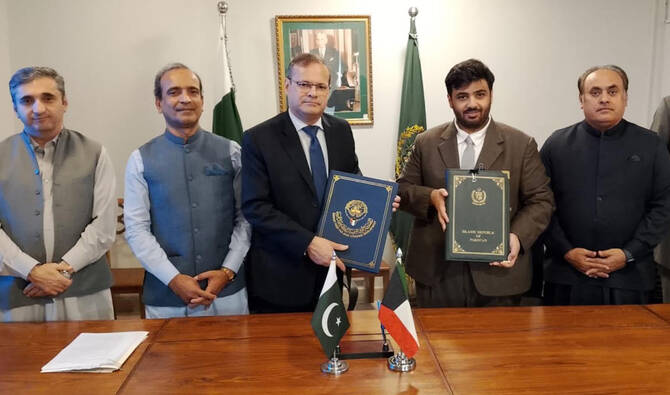
Secretary Pakistani Economic Affairs Ministry, Muhammad Humair Karim (second right), Kuwait’s Deputy Head of Mission, Fahad Hesham (center), and other officials posing for a group photograph after exchanging notes of the second loan agreement for the Mohmand Dam hydropower project, in Islamabad, Pakistan, on October 31, 2025. (PID)
Short Url
Updated 01 November 2025
Follow

Kuwait to provide $25 million loan tranche to Pakistan for Mohmand Dam project

  • In May 2024, Pakistan had requested the Kuwaiti Fund for early signing of a $100 million financing agreement for the project
  • The project is progressing smoothly and disbursement under the second loan will further accelerate construction, official says

ISLAMABAD: Pakistan and Kuwait on Friday signed a second loan agreement for the Mohmand Dam hydropower project in Pakistan’s northwestern Khyber Pakhtunkhwa (KP) province, Pakistan’s Press Information Department said.

Pakistan’s strategy to enhance its energy infrastructure includes a move toward constructing hydropower facilities, supported by multiple international agreements to address the country’s energy requirements.

Many of these small-scale projects have been facilitated under the multibillion-dollar China-Pakistan Economic Corridor (CPEC), part of President Xi Jinping’s Belt and Road Initiative.

On Friday, Pakistan and the Kuwait Fund for Arab Economic Development (KFAED) signed the agreement at the Pakistani economic affairs ministry to formalize the loan amounting to 7.5 million Kuwaiti dinar ($25 million).

“This concessional financing reflects the brotherly relations and enduring partnership between Pakistan and Kuwait,” said Muhammad Humair Karim, secretary of the Pakistani economic affairs ministry.

Mohmand Dam is a comprehensive infrastructure project designed to generate approximately 2,862 GWH [gigawatt hours] of electricity annually with an installed capacity of 800 MW [megawatts], significantly reducing the existing energy supply gap, according to Pakistani state media.

Additionally, the dam will create an active storage reservoir with a capacity of about 1,594 million cubic meters, ensuring a reliable and sustained supply of irrigation water. The 213-meter structure will also play a critical role in flood control and provide essential flood protection.

Karim appreciated the Kuwaiti Fund’s financial assistance in energy, water, and social sector projects, which have been “contributing significantly to Pakistan’s socio-economic development.”

During the 5th session of the Pakistan-Kuwait Joint Ministerial Commission in May 2024, Pakistan had requested the Kuwaiti Fund for early signing of financing agreement for a total of 30 million Kuwaiti dinars ($100 million) for the Mohmand Dam project, which were to be released in four equal tranches. Following the signing of the first loan agreement in June 2024, Friday’s signing marked the second phase of this commitment.

“The project is progressing smoothly and that the disbursement under the second loan will further accelerate construction activities on this strategically important project, which aims to enhance water storage capacity, generate clean energy, drinking water supply to Peshawar city and strengthen flood control in Pakistan,” Karim said.


Islamic military coalition, Pakistan to deepen cooperation to combat ‘terrorism’ — Pakistani military

Updated 02 February 2026
Follow

Islamic military coalition, Pakistan to deepen cooperation to combat ‘terrorism’ — Pakistani military

  • Islamic Military Counter Terrorism Coalition is a 43-member alliance that includes Pakistan, Saudi Arabia, Egypt, Jordan, UAE and other nations
  • The Pakistani military statement comes after a meeting between IMCTC secretary-general and the chief of Pakistani defense forces in Rawalpindi

ISLAMABAD: Pakistan and the Islamic Military Counter Terrorism Coalition (IMCTC) have reaffirmed their commitment to deepening cooperation, including intelligence sharing and capacity building, to jointly combat “terrorism” and “extremism,” the Pakistani military said on Monday.

The IMCTC is a 43-member military alliance that was formed on Saudi Arabia’s initiative in Dec. 2015 to consolidate Muslim countries’ efforts in countering “terrorism.”

A 17-member IMCTC delegation is visiting Pakistan from Feb. 2-6 to conduct a training at National University of Sciences and Technology on “Re-integration and Rehabilitation of Extremist Elements,” according to the Pakistani military.

On Monday, IMCTC Secretary-General Maj. Gen. Mohammed bin Saeed Al-Moghedi held a meeting with Chief of Pakistani Defense Forces Field Marshal Asim Munir to discuss cooperation among IMCTC member states.

“During the meeting, matters of mutual interest were discussed, with particular emphasis on regional security dynamics and enhanced cooperation in counter-terrorism efforts,” the Inter-Services Public Relations (ISPR), the Pakistani military’s media wing, said in a statement.

“Both sides reaffirmed their shared commitment to combating terrorism and extremism through collaborative strategies, intelligence sharing, and capacity building among member states.”

The IMCTC features Pakistan, Saudi Arabia, Türkiye, Afghanistan, Egypt, Jordan, Qatar, Palestine, UAE, Bangladesh and other nations. In 2017, Pakistan’s former army chief Gen. (retd) Raheel Sharif was appointed as the IMCTC commander-in-chief.

During discussions with Major General Al-Moghedi, Field Marshal Munir appreciated the role of IMCTC in fostering stability and promoting coordinated counterterrorism initiatives across the Islamic world, according to the ISPR.

The IMCTC secretary-general acknowledged Pakistan’s significant contributions and sacrifices in the fight against militancy and lauded the professionalism of Pakistan’s armed forces.

“The meeting underscored the resolve of both sides to further strengthen institutional collaboration for peace, stability, and security in the region,” the ISPR added.

Pakistan enjoys cordial ties with most Muslim countries around the world, particularly Gulf Cooperation Council countries. In Sept. 2025, Pakistan signed a landmark defense pact with Saudi Arabia according to which an act of aggression against one country will be treated as an act of aggression against both.