

Pakistan awards 23 offshore exploration blocks in first bidding round in nearly two decades

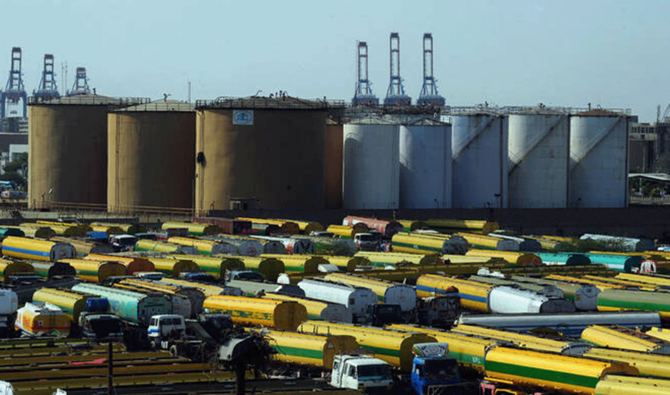
A general view of a local refinery shows tankers parked outside in Pakistan's port city of Karachi on February 22, 2011. (Reuters/File)
Short Url
Updated 31 October 2025
Follow

Pakistan awards 23 offshore exploration blocks in first bidding round in nearly two decades

  • Turkiye’s TPAO among foreign partners as Pakistan revives offshore oil exploration after 18 years
  • US firm study points to ‘significant yet-to-find potential’ in Pakistan’s Indus, Makran offshore basins

ISLAMABAD: Pakistan on Friday announced the results of its first offshore bidding round in nearly two decades, awarding 23 exploration blocks to four consortiums led by local energy companies in a renewed push to unlock the country’s untapped hydrocarbon reserves.

The Offshore Bid Round 2025, launched in January after an 18-year gap, attracted bids covering about 53,500 square kilometers of Pakistan’s offshore zone.

The Ministry of Energy said the outcome reflected “strong investor confidence” in the upstream sector following new production-sharing agreements and regulatory reforms designed to ensure transparency and competitiveness.

“A recent basin study conducted by the US firm DeGolyer and MacNaughton (D&M) has indicated a significant yet-to-find potential of hydrocarbons in Pakistan’s offshore basins,” the ministry said in a statement in which it announced receiving bids “for twenty-three (23) offshore blocks.”

The government said the round offered blocks across the Indus and Makran basins, aiming to spur systematic exploration after years of limited drilling activity.

Among the successful bidders are state-run Oil and Gas Development Co. Ltd. (OGDCL), Pakistan Petroleum Ltd. (PPL), MariEnergies, and privately owned Prime Energy, backed by Hub Power Company (Hubco).

Foreign and private-sector partners include Turkiye’s national oil company TPAO, Hong Kong-based United Energy Group, Orient Petroleum, and Fatima Petroleum, part of Pakistan’s Fatima Group conglomerate.

The winning consortiums collectively pledged about $80 million in exploration work over the first three years, with total investment potentially rising to $750 million to $1 billion if drilling proceeds, the ministry said.

Pakistan’s 300,000-square-kilometer offshore zone, bordering Oman, the United Arab Emirates and Iran, has seen just 18 wells drilled since independence, too few to fully assess its hydrocarbon potential.

The ministry added that once geological and geophysical studies are completed, Pakistan will invite global oil majors to participate in the next phase of offshore exploration.

Prime Minister Shehbaz Sharif welcomed the participation of international and local companies, calling it a step toward strengthening Pakistan’s energy security and reducing import dependence.

With input from Reuters.


Pakistan destroyed seven TTP camps in Afghanistan strikes, 80 militants killed — official

Updated 5 sec ago
Follow

Pakistan destroyed seven TTP camps in Afghanistan strikes, 80 militants killed — official

  • Saturday’s airstrikes followed a series of attacks inside Pakistan amid a surge in militancy
  • The Afghan Taliban authorities accuse Pakistani forces of killing civilians in the airstrikes

ISLAMABAD: Pakistan’s airstrikes in Afghanistan destroyed seven Tehreek-e-Taliban Pakistan (TTP) camps and killed over 80 militants, a Pakistani security official said on Sunday, with the Afghan Taliban accusing Pakistani forces of killing civilians in the assault.

Saturday’s airstrikes followed a series of attacks inside Pakistan amid a surge in militancy. Authorities say the attacks, particularly in Khyber Pakhtunkhwa province and the Pakistani capital of Islamabad, were carried out by the TTP and allied groups that Islamabad alleges are operating from sanctuaries in Afghanistan. Kabul denies this.

According to Pakistan’s information ministry, recent incidents included a suicide bombing at a Shiite mosque in Islamabad, separate attacks in Bajaur and Bannu, and another recent incident in Bannu during the holy month of Ramadan, which started earlier this week. The government said it had “conclusive evidence” linking the attacks to militants directed by leadership based in Afghanistan.

“Last night, Pakistan’s intelligence-based air strikes destroyed seven centers of Fitna Al-Khawarij TTP in three provinces of Nangarhar, Paktika and Khost, in which more than eighty Khawarij (TTP militants) have been confirmed killed, while more are expected,” a Pakistani security official, who spoke on condition of anonymity, told Arab News.

An earlier statement from Pakistan’s information ministry said the targets included a camp of a Daesh regional affiliate, the Islamic State Khorasan Province (ISKP), which claimed a suicide bombing at an Islamabad Shiite mosque that killed 32 people this month.

In an X post, Afghan government spokesperson Zabihullah Mujahid said Pakistani forces had violated Afghan territory.

“Pakistani special military circles have once again trespassed into Afghan territory,” Mujahid said. “Last night, they bombed our civilian compatriots in Nangarhar and Paktika provinces, martyring and wounding dozens of people, including women and children.”
 
The Afghan Taliban’s claims of civilian casualties could not be independently verified. Pakistan did not immediately comment on the allegation that civilians had been killed in the strikes.

In a post on X, Afghanistan’s foreign ministry said it had summoned Pakistan’s charge d’affaires to Afghanistan Ubaid-ur-Rehman Nizamani and lodged protest through a formal démarche in response to the Pakistani military strikes.

“IEA-MoFA (The Islamic Emirate of Afghanistan’s Ministry of Foreign Affairs) vehemently condemns the violation of Afghanistan’s airspace and the targeting of civilians, describing it as a flagrant breach of Afghanistan’s territorial integrity & a provocative action,” it said in a statement.

“The Pakistani side was also categorically informed that safeguarding Afghanistan’s territorial integrity is the religious responsibility of the Islamic Emirate of Afghanistan; henceforth, the responsibility for any adverse consequences of such actions will rest with the opposing side.”

Tensions between Islamabad and Kabul have escalated since the Afghan Taliban returned to power in 2021. Pakistan says cross-border militant attacks have increased since then and has accused the Taliban of failing to honor commitments under the 2020 Doha Agreement to prevent Afghan soil from being used for attacks against other countries. The Taliban deny allowing such activity and have previously rejected similar accusations.

Saturday’s exchange of accusations marks one of the most direct confrontations between the two neighbors in recent months and risks further straining already fragile ties along the volatile border.