

Pakistan hopes for ‘positive’ outcome of next round of talks with Kabul after truce extended

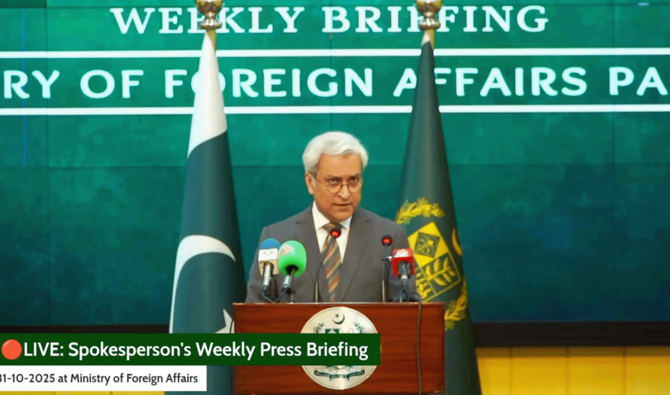
Screengrab taken from the live transmission of foreign office's press briefing showing Pakistani foreign office spokesman Tahir Andrabi speaking to the media in Islamabad, Pakistan, on October 31, 2025. (MOFA/YouTube)
Short Url
Updated 31 October 2025
Follow

Pakistan hopes for ‘positive’ outcome of next round of talks with Kabul after truce extended

  • Pakistan, Afghanistan engaged in deadly clashes this month after Islamabad conducted airstrikes on what it said were Pakistani Taliban militants inside Afghanistan
  • The two sides on Thursday extended their ceasefire until the next round of talks on Nov. 6, agreeing to put a monitoring and verification mechanism to ensure peace

ISLAMABAD: Pakistan is hoping for a “positive” outcome of its next round of talks with Afghanistan in Istanbul, the foreign office in Islamabad said on Friday, a day after both sides agreed to extend their ceasefire.

The two neighbors engaged in deadly clashes this month that killed dozens of soldiers, civilians and militants dead, before a temporary ceasefire was reached in Doha on Oct. 19. A second round of talks that started in Istanbul on Oct. 25 failed to reach breakthrough earlier this week, but Turkiye announced on Thursday evening that the ceasefire would continue.

The clashes erupted after Pakistan launched airstrikes inside Afghanistan against Pakistani Taliban militants it says are based there and responsible for attacks on its forces. Kabul condemned the strikes as a violation of its sovereignty and denies sheltering the group. The border, which runs more than 2,600 km (1,600 miles), has long been a source of friction with frequent skirmishes and mutual accusations over militant sanctuaries.

Speaking at a weekly press briefing on Friday, Pakistani foreign office spokesman Tahir Andrabi said Islamabad has always been desirous of peace and a stable Afghanistan, but the Pakistani armed forces stand ready to take “all possible measures to protect Pakistan’s sovereignty and ensure safety and security of its people.”

“Pakistan would continue to remain engaged in the mediation process and hopes for a positive outcome for the 6th November talks [in Istanbul],” Andrabi said, appreciating Qatar and Turkiye for their mediation. “They’ve been making their best efforts for an amicable and peaceful resolution of the issue.”

Pakistan has long accused Afghanistan of allowing the use of its soil by militant groups, particularly the Tehreek-e-Taliban Pakistan (TTP) that has stepped up attacks inside Pakistan in recent years. Kabul denies the allegation.

The clashes erupted on Oct. 11 after Pakistan conducted airstrikes on what it called TTP-affiliated targets in Afghanistan. Kabul said it was a violation of its sovereignty.

“All parties have agreed to put in place a monitoring and verification mechanism that will ensure maintenance of peace and impose penalties on the violating party,” Turkiye’s Foreign Ministry said of the October 25–30 talks.

It added that a follow-up meeting would be held in Istanbul on November 6 to decide how the mechanism will be implemented, and that Turkiye and Qatar “stand ready to continue cooperation with both sides for lasting peace and stability.”

Kabul government spokesman Zabihullah Mujahid issued a separate statement shortly before midnight in Istanbul confirming the conclusion of the talks and saying both sides had agreed to continue discussions in future meetings.

A senior Pakistani security official, requesting anonymity, said Islamabad viewed the Istanbul understanding as a welcome step but a conditional truce, hinging on verifiable action by Kabul.

“This ceasefire is not open-ended or unconditional. The single litmus test for its continuation is that Afghanistan will not allow its territory to be used for attacks against Pakistan and will take clear, verifiable and effective steps against [militants],” the official said.

“If Afghanistan fails to deliver verifiable proof of agreed steps, or if militants continue to launch attacks from Afghan soil, Pakistan will deem the ceasefire violated and reserves all options to safeguard its sovereignty and citizens.”


Curfew extended in Gilgit-Baltistan, probe ordered after deadly Khamenei protests

Updated 03 March 2026
Follow

Curfew extended in Gilgit-Baltistan, probe ordered after deadly Khamenei protests

  • At least 15 people were killed in clashes with law enforcement agencies over the weekend in Gilgit-Baltistan
  • Government also announces a de-weaponization campaign, crackdown on hate speech and cybercrime in region

ISLAMABAD: The government in Pakistan’s Gilgit-Baltistan (GB) region on Tuesday extended a curfew in Gilgit district and ordered a judicial probe into violent protests over the killing of Iranian Supreme Leader Ali Khamenei in US-Israeli strikes last week, an official said.

At least 15 people were killed in clashes with law enforcement agencies over the weekend in GB, where protesters torched and vandalized several buildings, including United Nations regional offices, an army-run school, software technology park and a local charity building.

The violence prompted regional authorities to impose curfew in Gilgit and Skardu districts on March 2-4 as officials urged people to stay indoors and cooperate with law enforcers, amid widespread anger in Pakistan, particularly among members of the Shiite minority, over Khamenei’s killing.

On Tuesday, the GB government convened to review the situation and announced the extension of curfew in Gilgit among a number of security measures as well as ordered the establishment of a judicial commission to investigate the weekend violence in the region.

“The government has made it clear that the law will strictly take its course against elements involved in vandalism at government institutions, private properties and incidents of vandalism in Gilgit and Skardu and no kind of mischief will be tolerated,” Shabbir Mir, a GB government spokesperson, said in a statement.

“In view of the security situation, curfew will remain in force in Gilgit, while the decision to extend the curfew in Skardu will be taken keeping the ground realities and the changing situation in view.”

The statement did not specify how long the curfew will remain in place in Gilgit.

Besides the formation of the judicial commission to investigate the violent clashes, the government also decided to launch a large-scale de-weaponization campaign in the entire Gilgit district, for which relevant institutions have been directed to immediately complete all necessary arrangements, according to Mir.

In addition, a crackdown has been ordered on hate speech, spread of fake news and cybercrime.

“The aim of these decisions is to ensure the rule of law, protect the lives and property of citizens and crack down on miscreants,” he said. “Approval has also been given to immediately survey the affected infrastructure and start their restoration work on priority basis.”

Demonstrators in Pakistan’s southern port city of Karachi also stormed the US Consulate on Sunday, smashing windows and attempting to burn the building. Police responded with batons, tear gas, and gunfire, leaving 10 people dead and more than 50 injured.

Pakistani authorities have since beefed up security at US diplomatic missions across the country, including around the US consulate building in Peshawar, to avoid any further violence.