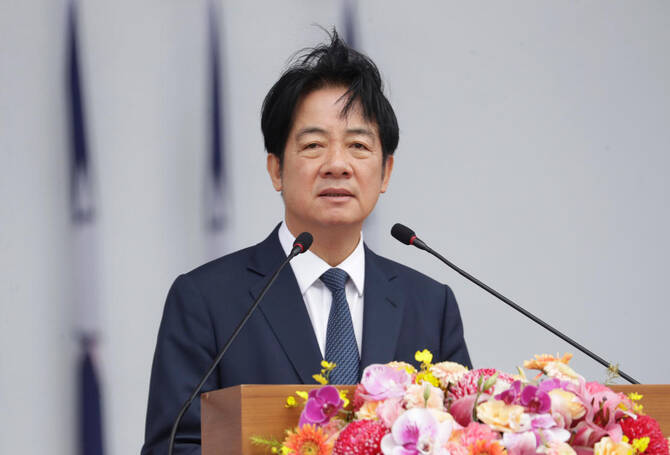
HUKOU, Taiwan: Taiwan does not want China’s “one country, two systems” and must uphold its freedom and democracy, and resolve to defend itself, President Lai Ching-te said on Friday, rejecting Beijing’s latest push to get the island to come under Chinese control.
China said this week it “absolutely will not” rule out using force over Taiwan, striking a much tougher tone than a series of articles in state media that pledged benign rule if the island comes over to Beijing under a system of autonomy it uses for Hong Kong and Macau.
Lai, whom China views as a “separatist,” told soldiers at a military base in northern Taiwan’s Hukou that only strength can bring true peace.
“Accepting the aggressor’s claims and abandoning sovereignty certainly cannot achieve peace. Therefore, we must maintain the status quo with dignity and resolve, firmly opposing annexation, aggression, and the forced advancement of unification,” he said.
“We reject ‘one country, two systems’ because we will forever uphold our free and democratic constitutional system,” Lai added.
China’s Taiwan Affairs Office did not immediately respond to a request for comment.
No support for China’s proposal
No major political party in Taiwan supports China’s “one country, two systems” idea.
Lai said that the Republic of China – Taiwan’s formal name – and the People’s Republic of China are “not subordinate” to each other and that “Taiwan’s sovereignty cannot be violated or annexed” and its future can only be decided by its people.
“The Taiwanese people safeguarding their sovereignty and preserving their democratic and free way of life should not be viewed as provocation. Investing in national defense is investing in peace.”
Lai has pledged to increase military spending to 5 percent of GDP by 2030, strengthening the island’s defenses in the face of a rising threat from its giant neighbor China.
Lai was in Hukou for a commissioning ceremony for Taiwan’s first battalion of M1A2T Abrams tanks, made by General Dynamics Land Systems, a unit of US firm General Dynamics.
Taiwan has so far received 80 of the 108 M1A2T tanks it ordered from the United States, the island’s most important international backer and arms supplier despite the lack of formal diplomatic ties.
The M1A2T tank can fire high explosive anti-tank warheads and kinetic energy ammunition, such as armor-piercing fin-stabilized discarding sabot.
The US is bound by law to provide Taiwan with the means to defend itself, though President Donald Trump has yet to approve any new arms sales since he took office earlier this year.
US Defense Secretary Pete Hegseth, meeting Chinese Defense Minister Dong Jun in Kuala Lumpur on Friday, said he had emphasized US concerns about China’s activities around Taiwan, as well as in the contested South China Sea.
Dong said China-Taiwan “reunification” was an irreversible historical trend and the US should take a clear stance in opposition to the island’s independence, his ministry said in a statement.


![]()

Taiwan does not want China’s ‘one country, two systems’, president says
Short Url
https://arab.news/pscms
Taiwan does not want China’s ‘one country, two systems’, president says
- Taiwan will defend its freedom and democracy, president says
- China making a renewed push for Taiwan to accept its autonomy offer


Latest updates


Recommended


© 2026 SAUDI RESEARCH & PUBLISHING COMPANY, All Rights Reserved And subject to Terms of Use Agreement.