

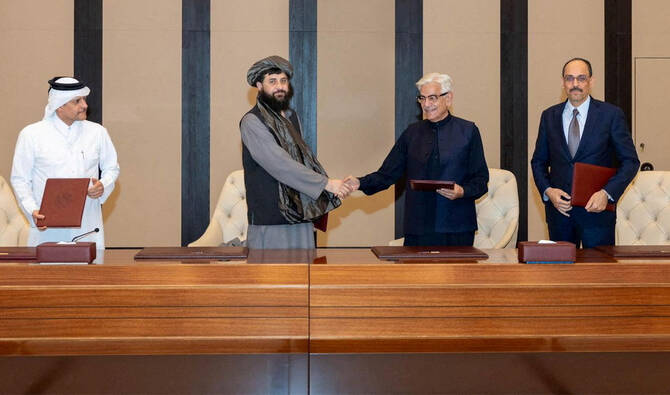

ANKARA: Pakistan and Afghanistan have agreed to maintain a ceasefire following peace talks in Istanbul, Turkiye’s Foreign Ministry announced Thursday, after a dialogue between the two sides collapsed earlier in the week.
The sides plan to meet again at a higher-level gathering in Istanbul on Nov. 6 to finalize how the ceasefire will be implemented, the ministry said in a statement released on behalf of Pakistan, Afghanistan and mediators Turkiye and Qatar.
“All parties have agreed to put in place a monitoring and verification mechanism that will ensure maintenance of peace and imposing penalty on the violating party,” the statement read.
The new round of negotiations, facilitated by Turkiye and other friendly nations, was aimed at easing border tensions between the two sides who earlier this month exchanged fire, leaving dozens of soldiers, civilians and militants dead.
Despite the collapse of the previous round of talks, a ceasefire has largely held and no new border clashes were reported this week. However, both countries have kept major crossings closed, leaving hundreds of trucks carrying goods and refugees stranded on each side.
Pakistan’s Defense Minister Khawaja Mohammad Asif told the Geo news channel the decision to give peace another chance was made by Pakistan at the request of Qatar and Turkiye, and that the Pakistani delegation, set to return home Wednesday night, was asked to stay in Istanbul.
According to Pakistani state-run television, Islamabad said the talks will be based on Pakistan’s central demand that Afghanistan take clear, verifiable and effective action against militant groups.
In Islamabad, two senior security officials told The Associated Press that Pakistan has once again stressed that Afghan soil should not be used for what it called “terrorism” against Pakistan and that it appreciates the constructive role of its hosts and remains committed to seeking a peaceful resolution in good faith.
The officials spoke on condition of anonymity because they were not authorized to discuss the matter with the media on the record.
Tensions flared earlier this month after explosions were heard in Kabul, and Afghanistan’s Taliban government accused Pakistan of carrying out airstrikes in the capital and bombing a market in the country’s east.
Afghan officials on Oct. 12 said they retaliated by targeting Pakistani military posts, claiming 58 Pakistani soldiers were killed. However, Pakistan’s military said the fighting left 23 of its soldiers dead and that its operations were targeting militant hideouts inside Afghanistan.
The clashes prompted Qatar to host emergency talks between the two neighbors, resulting in a ceasefire on Oct. 19. That was followed by four days of negotiations in Istanbul that ended inconclusively on Tuesday. Since then, Qatar and Turkiye have been working to bring the delegations back to the negotiating table, the Pakistani officials said.
On Thursday, Pakistan’s army chief, Field Marshal Asim Munir, told a gathering of tribal elders in Peshawar that Pakistan seeks peace with all its neighbors, including Afghanistan, but will not tolerate cross-border terrorism from Afghan soil.
He said Pakistan in recent years exercised restraint and made diplomatic and economic overtures to improve ties, but the Taliban government instead supported the TTP, which was listed as a terrorist group by the United Nations and the United States over a decade ago.
Pakistan has witnessed a surge in militant attacks in recent months, most claimed by the Pakistani Taliban, or Tehreek-e-Taliban Pakistan, a group closely allied to the Taliban in Afghanistan. Many of their leaders and fighters are believed to be sheltering in Afghanistan since the Taliban’s return to power in 2021.
The Pakistani military said Thursday it killed 18 militants in two separate operations in the southwestern province of Balochistan. In a separate statement, it said four Pakistani Taliban, including a high-value target, were killed as they attempted to sneak into Bajaur, a city bordering Afghanistan.


