

Pakistan PM says Saudi Arabia has offered free AI, IT training for Pakistani youth

Short Url
Updated 30 October 2025
Follow

Pakistan PM says Saudi Arabia has offered free AI, IT training for Pakistani youth

  • Prime Minister Shehbaz Sharif says Saudi officials shared their AI and IT roadmap during his visit to Riyadh
  • He says he will try to send thousands of skilled Pakistanis to Saudi Arabia to meet the growing labor demand

ISLAMABAD: Prime Minister Shehbaz Sharif said on Thursday Saudi Arabia has offered free training in information technology and artificial intelligence for Pakistani youth, as Islamabad seeks to expand opportunities for skilled employment abroad.

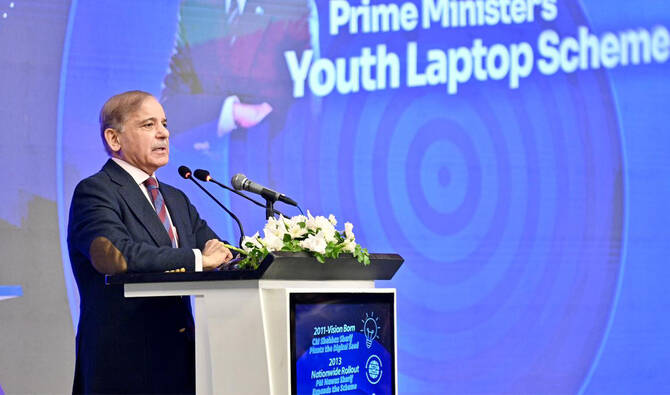
The announcement came as Sharif addressed the Youth Laptop Scheme 2025 ceremony in Islamabad, where 100,000 laptops were distributed to students under a program that has run since 2011 at an estimated total cost of Rs40-50 billion ($142-178 million). He said his government aimed to link such initiatives with international training and employment prospects.

“I just came back from Saudi Arabia. They are spending billions of dollars on AI and information technology,” he told the gathering, adding that the Saudis shared information about the entire roadmap and infrastructure that they have established.

When the prime minister told his hosts his country did not have so many resources and could not spend so much, they asked him not to worry.

“Our setup in Saudi Arabia is free for the sons and daughters of Pakistan, God willing,” Sharif quoted them as saying. “You bring them [here], we will train them.”

The prime minister said he would try to send thousands of trained Pakistanis to Saudi Arabia to meet the Kingdom’s demand for skilled technicians as it prepares to host major global events, including Expo 2030 and the 2034 FIFA World Cup.

Pakistan and Saudi Arabia enjoy close political and economic ties and have recently signed a joint defense pact and decided to launch an economic cooperation framework.

Saudi Arabia also remains the largest source of workers’ remittances to Pakistan.


Pakistan speaker raises concern over Afghan militancy in talks with Iranian delegation

Updated 12 November 2025
Follow

Pakistan speaker raises concern over Afghan militancy in talks with Iranian delegation

  • Ayaz Sadiq met Iran’s deputy speaker a day after a suicide bombing in Islamabad blamed on Afghan-based militants
  • Iran offered to mediate between Pakistan and Afghanistan this month following border clashes, failed talks in Istanbul

ISLAMABAD: Pakistan’s National Assembly Speaker Sardar Ayaz Sadiq on Wednesday voiced concern over militant violence emanating from Afghanistan a day after a suicide bombing in Islamabad killed at least 12 people and was blamed by the Pakistani authorities on the proscribed Tehreek-e-Taliban Pakistan (TTP) militant network.

Sadiq’s comments came during a meeting with Iran’s Deputy Speaker Ali Nikzad, who is leading a parliamentary delegation to Islamabad. The Iranian official, whose country also shares a border with Afghanistan, discussed expanding parliamentary and economic cooperation with the National Assembly speaker while addressing regional security challenges.

Pakistan has in recent weeks accused Afghan authorities of harboring militants and facilitating their cross-border attacks on Pakistani security forces and civilians. The tensions triggered border clashes last month, followed by a collapse of peace talks in Istanbul earlier this month that aimed at easing bilateral tensions.

Iran, which maintains relations with both Kabul and Islamabad, subsequently offered to mediate between the two sides.

“Afghanistan’s soil is being used for terrorism in Pakistan,” Sadiq said during his conversation with the Iranian official, according to a statement from the National Assembly Secretariat. “Pakistan remains committed to the complete elimination of terrorism and to resolving conflicts through peaceful means.”

The speaker emphasized that cooperation between Pakistan and Iran was vital for regional peace, describing the two as “brotherly neighbors bound by shared history, religion and culture.”

He also thanked Tehran for its support to Pakistan during a military standoff with India in May and called for unity among Muslim countries in the face of regional crises.

Sadiq condemned Israeli strikes on Iran, noting that Pakistan’s parliament had unanimously passed a resolution denouncing the attacks, and congratulated Iran for its “firm response.”

Nikzad extended condolences over the suicide bombing in Islamabad and praised Pakistan’s “steadfast support” during his country’s war with Israel.

He also noted there were wide-ranging opportunities to expand cooperation between the two countries in multiple sectors.