KYIV: The latest in a sustained Russian campaign of massive drone and missile attacks on Ukraine’s energy infrastructure brought power outages and restrictions in all the country’s regions Thursday, officials said, with the Ukrainian prime minister describing Moscow’s tactic as “systematic energy terror.”
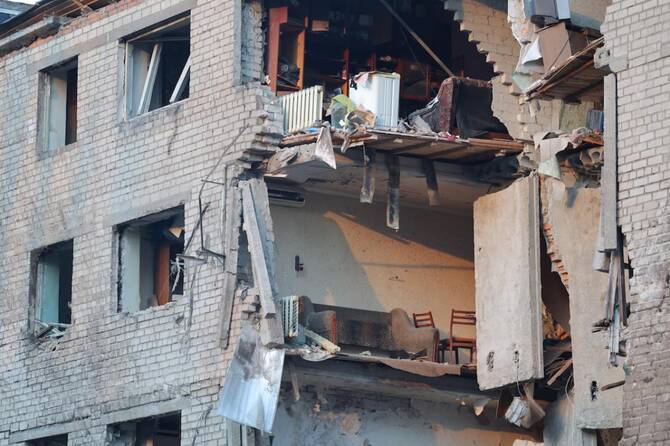
The strikes, which were the latest in Russia’s almost daily attacks on the Ukrainian power grid as bitter winter temperatures approach, killed at least six people, including a 7-year-old girl, according to authorities. Children between 2 and 16 years of age were among the 18 injured.
Russian launched more than 650 drones and more than 50 missiles of various types in the attack, Ukraine President Volodymyr Zelensky said.
Ukrainian cities use centralized public infrastructure to run water, sewage and heating systems, and blackouts stop them from working. Months of attacks have aimed to erode Ukrainian morale as well as disrupt weapons manufacturing and other war-related activity almost four years after Russia’s full-scale invasion of its neighbor.
“Russia continues its systematic energy terror — striking at the lives, dignity, and warmth of Ukrainians on the eve of winter. Its goal is to plunge Ukraine into darkness; ours is to keep the light on,” Ukrainian Prime Minister Yulia Svyrydenko said.
“To stop this terror, Ukraine needs more air defense systems, tougher sanctions, and maximum pressure on (Russia),” she added, referring to fruitless US-led diplomatic efforts to make Russia enter negotiations for a peace settlement.
Two men and a woman were killed and another person was injured in a strike on the eastern Ukraine city of Sloviansk, police said.
Russian forces hit the city, which is just 20 kilometers (12 miles) from the front line, with rockets, Vadym Lyakh, the head of the city’s military administration, said.
Strikes in the southern Zaporizhzhia region injured 17 people, including a 2-year-old girl, regional authorities said. Rescuers pulled a man from the rubble of a building, but he did not survive, according to Ivan Fedorov, head of the Zaporizhzhia regional administration. A second person was also killed in Zaporizhzhia.
A 7-year-old girl died in hospital from her injuries in Ukraine’s central-west Vinnytsia region, regional governor Nataliia Zobolotna said.
Two energy infrastructure facilities were damaged in the western Lviv region, near the border with Poland, local authorities said.
The Polish military said that it scrambled Polish and allied NATO aircraft as a preventive measure due to the Russian attack on Ukrainian territory. The Polish regional airports in Radom and Lublin were closed to ensure the military freedom of operation, the Polish Air Navigation Services Agency said.

Russia blasts Ukraine’s power grid again, causing outages across the country and killing 6
Short Url
https://arab.news/zyhy2
Russia blasts Ukraine’s power grid again, causing outages across the country and killing 6
- The strikes killed at least six people, including a 7-year-old girl
- Russian launched more than 650 drones and more than 50 missiles of various types in the attack
China FM tells EU diplomats not to blame Beijing for bloc’s problems
BEIJING: China’s foreign minister told his French and German counterparts that Beijing was not to blame for Europe’s economic and security problems as he pushed for more cooperation at a summit in Munich, a foreign ministry statement said Saturday.
Wang Yi made the comments at a meeting with France’s Jean-Noel Barrot and Germany’s Johann Wadephul on the sidelines of the Munich Security Conference on Friday.
He sought to promote China as a reliable partner of the European Union at a time when the bloc is trying to reduce its dependence on both Beijing and an increasingly unpredictable Washington.
“China’s development is an opportunity for Europe, and Europe’s challenges do not come from China,” Wang said, according to the statement.
Warning that “unilateralism, protectionism, and power politics” were on the rise globally, he said he hoped Europe would “pursue a rational and pragmatic policy toward China.”
“The two sides are partners, not adversaries; interdependence is not a risk; intertwined interests are not a threat; and open cooperation will not harm security.”
The meeting came against the backdrop of trade tensions between the two giant economies and disputes over what the EU sees as China’s support for Russia’s war in Ukraine.
The EU is seeking to cut its reliance on China for strategic goods like rare earths while also rebalancing a trade relationship that sees it run a large deficit with the world’s second-largest economy.
In recent years, the two sides have clashed over Chinese electric-vehicle exports, which threaten Europe’s car industry and which Brussels argues are based on unfair subsidies, and Chinese tariffs on EU goods ranging from cheese to cognac.
Wang urged Germany and France to help “give a clear direction for the development of China-Europe relations.”
In a separate meeting with Wadephul — also on Friday — Wang touted economic and trade cooperation as “the cornerstone of China-Germany ties,” according to a foreign ministry readout.
Wang also met Britain’s foreign minister Yvette Cooper, telling her that Beijing and London should “explore more potential for cooperation,” while the two sides also discussed Ukraine and Iran.
Wang Yi made the comments at a meeting with France’s Jean-Noel Barrot and Germany’s Johann Wadephul on the sidelines of the Munich Security Conference on Friday.
He sought to promote China as a reliable partner of the European Union at a time when the bloc is trying to reduce its dependence on both Beijing and an increasingly unpredictable Washington.
“China’s development is an opportunity for Europe, and Europe’s challenges do not come from China,” Wang said, according to the statement.
Warning that “unilateralism, protectionism, and power politics” were on the rise globally, he said he hoped Europe would “pursue a rational and pragmatic policy toward China.”
“The two sides are partners, not adversaries; interdependence is not a risk; intertwined interests are not a threat; and open cooperation will not harm security.”
The meeting came against the backdrop of trade tensions between the two giant economies and disputes over what the EU sees as China’s support for Russia’s war in Ukraine.
The EU is seeking to cut its reliance on China for strategic goods like rare earths while also rebalancing a trade relationship that sees it run a large deficit with the world’s second-largest economy.
In recent years, the two sides have clashed over Chinese electric-vehicle exports, which threaten Europe’s car industry and which Brussels argues are based on unfair subsidies, and Chinese tariffs on EU goods ranging from cheese to cognac.
Wang urged Germany and France to help “give a clear direction for the development of China-Europe relations.”
In a separate meeting with Wadephul — also on Friday — Wang touted economic and trade cooperation as “the cornerstone of China-Germany ties,” according to a foreign ministry readout.
Wang also met Britain’s foreign minister Yvette Cooper, telling her that Beijing and London should “explore more potential for cooperation,” while the two sides also discussed Ukraine and Iran.
© 2026 SAUDI RESEARCH & PUBLISHING COMPANY, All Rights Reserved And subject to Terms of Use Agreement.


