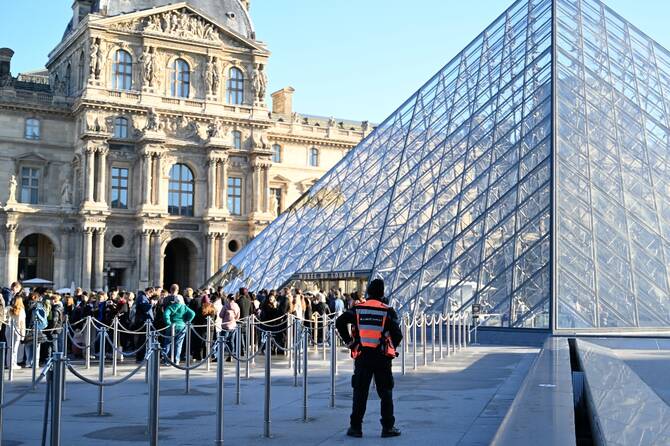
PARIS: The dragnet tightened around the Louvre on Thursday. Five more people were seized in the crown-jewels heist — including a suspect tied by DNA — the Paris prosecutor said, widening the sweep across the capital and its suburbs. Authorities said three of the four alleged members of the “commando” team, as French media have dubbed the robbers, are now in custody.
The late-night operations in Paris and nearby Seine-Saint-Denis lift the total arrested to seven. Prosecutor Laure Beccuau told RTL that one detainee is suspected of belonging to the brazen quartet that burst into the Apollo Gallery in broad daylight on Oct. 19; others held “may be able to inform us about how the events unfolded.”
Beccuau called the response an “exceptional mobilization” — about 100 investigators, seven days a week, with roughly 150 forensic samples analyzed and 189 items sealed as evidence.
Even so, she said the latest arrests did not uncover the loot — a trove valued around $102 million that includes a diamond-and-emerald necklace Napoleon gave to Empress Marie-Louise as a wedding gift, jewels tied to 19th-century Queens Marie-Amélie and Hortense, and Empress Eugénie’s pearl-and-diamond tiara.
Only one relic has surfaced so far — Eugénie’s crown, damaged but salvageable, dropped in the escape.
Beccuau renewed her appeal: “These jewels are now, of course, unsellable… There’s still time to give them back.”
Experts warn the gold could be melted and the stones re-cut to erase their past.
The choreography of a four-minute crime
Key planning details have snapped into focus. Nine days before the raid, thieves stole a truck-mounted lift — the kind movers use to reach upper floors — after answering a fake moving ad on the French classifieds site Leboncoin, Beccuau said Wednesday.
On the day itself, the same vehicle idled beneath the Louvre’s riverside façade.
At 9:30 a.m. it rose to the Apollo Gallery window; at 9:34 the glass gave way; by 9:38 the crew was gone — a four-minute strike. Only the “near-simultaneous” arrival of police and museum security stopped the thieves from torching the lift and preserved crucial traces, the prosecutor said.
Security footage shows at least four men forcing a window, cutting into two display cases with power tools and fleeing on two scooters toward eastern Paris. Investigators say there is no sign of insider help for now, though they are not ruling out a wider network beyond the four on camera.
The reckoning over security
French police have acknowledged major gaps in the Louvre’s defenses, turning an audacious theft — — carried out as visitors walked its corridors — into a national reckoning over how France protects its treasures.
Paris police chief Patrice Faure told senators the first alert to police came not from the Louvre’s security systems but from a cyclist outside who dialed the emergency line after seeing helmeted men with a basket lift. He acknowledged that aging, partly analog cameras and slow fixes left seams; $93 million of cabling work won’t finish before 2029–30, and the Louvre’s camera authorization even lapsed in July. Officers arrived fast, he said, but the delay came earlier in the chain.
Speaking to AP, former bank robber David Desclos characterized the heist as textbook and said he had warned the Louvre of glaring vulnerabilities in the layout of the Apollo Gallery. The Louvre has not responded to the claim.
Who’s charged already
Two earlier suspects, men aged 34 and 39 from Aubervilliers, north of Paris, were charged Wednesday with theft by an organized gang and criminal conspiracy after nearly 96 hours in custody. Beccuau said both gave “minimalist” statements and “partially admitted” their involvement.
One was stopped at Charles-de-Gaulle Airport with a one-way ticket to Algeria; his DNA matched a scooter used in the getaway.
French law normally keeps active investigations under a shroud of secrecy to protect police work and victims’ privacy. Only the prosecutor may speak publicly, though in high-profile cases police unions have occasionally shared partial details.
The brazen smash-and-grab inside the world’s most-visited museum stunned the heritage world. Four men, a lift truck and a stopwatch turned the Apollo Gallery’s blaze of gold and light into a crime scene — and a test of how France guards what it holds most dear.


![]()

5 more arrests as Louvre jewel heist probe deepens and key details emerge
Short Url
https://arab.news/rvny3
5 more arrests as Louvre jewel heist probe deepens and key details emerge
- The late-night operations in Paris and nearby Seine-Saint-Denis lift the total arrested to seven
- Beccuau called the response an “exceptional mobilization” — about 100 investigators, seven days a week, with roughly 150 forensic samples analyzed and 189 items sealed as evidence


Latest updates


© 2026 SAUDI RESEARCH & PUBLISHING COMPANY, All Rights Reserved And subject to Terms of Use Agreement.