

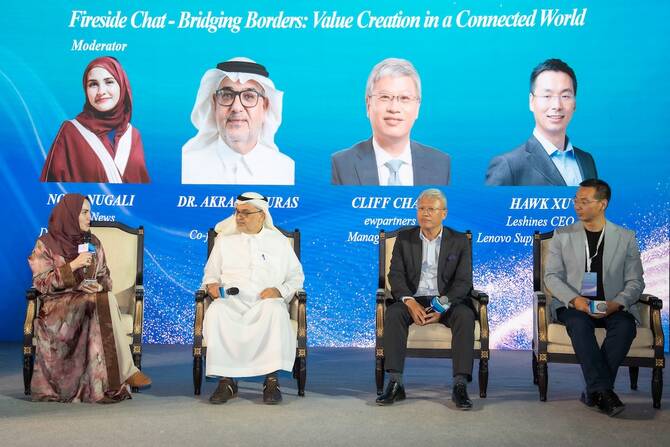

RIYADH: Business leaders from China and Saudi Arabia say cooperation between the two countries is entering a new phase, driven by technology transfer, joint innovation and large-scale infrastructure projects.
They were speaking during a panel discussion at ewpartners’ “China Night” in Riyadh on Wednesday evening, with Arab News is a media partner.
Noor Nugali, Arab News’ Deputy Editor-in-Chief, moderated the discussion.
Aces CEO Akram Aburas said that China has become an important reference point for the Kingdom as it undertakes massive development projects.
“In Saudi Arabia now, obviously everybody knows that we are going to make larger scale projects in construction, airport facilities, and healthcare facilities,” he said.
“China is a very good role model for us, because when it comes to China, any project implemented there is usually implemented on a massive scale and high-tech scale. It means that you have a robust, you have a very strong system installation base.
“It’s very good to get some of these technologies and implement them in Saudi Arabia … the potential success, is extremely high once we use it in Saudi.”
Aburas said the perception of Chinese technology has shifted dramatically over the past decade, with China now recognized for its large-scale deployment and technological maturity.
“We have to admit, and we have to realize the Chinese technology is an age of technology. The perception 10 years ago doesn’t exist,” he said.
“China has massive installations, they have massive deployment and massive investment in terms of technology.”
He noted that as a Saudi Arabia operator responsible for managing large infrastructure projects, such work demands extensive technological integration and large-scale system deployment.
Aburas also discussed how Saudi Arabia firms are starting to co-develop intellectual property with Chinese partners under government-supported initiatives.
“We are capitalizing our installation, but also our technical knowledge, with the support of the government to create an IP. And then we approach multiple technology partners, partnered with China, and now we start using for our own but also go (to) the international market.”
Hawk Xu, Leshine’s CEO and CTO of Lenovo Supply Chain, said Saudi Arabia’s geographic position makes it one of the world’s most strategic gateways for global trade and logistics.
“If you look at physical locations, definitely, it’s sitting almost at the center of Asia Pacific, GCC, and even for Europe.”
“So we believe the global trade is offering, I think, more opportunities for global supply chains, and also definitely as logistics for cross ordering … So this is definitely one of our most important strategic countries, a market we will focus (on) and we committed to continue the best.”
Xu noted that companies from across East Asia are increasingly drawn to the Kingdom’s industrial and green technology ambitions.
“We hope to bring our capabilities here and empower more companies to root here, to grow up here, and also to, really, I think, get more business here,” he said. “The green energy and also recycling economy are also key focuses for us.”
Cliff Chau, managing partner at ewpartners, emphasized the pace of China’s progress in healthcare and pharmaceutical development, describing how rapid innovation has reshaped the sector over the past decade.
“I would say that in the last 10 years, we narrowed the gap between China and US very quickly. Ten years ago, China healthcare, service, standards, equipment, pharmaceutical, (were) probably 20 years behind the US. Today, in some areas, we are ahead of the US.”
“So I understand that healthcare industry is a big thing here too, to extend the longevity of people, to prevent diseases. And I think the healthcare will have a big opportunity in this country too.”
He said that China’s progress was driven by policy support and the return of internationally trained experts.
“That’s one big important factor, is talent infusion and policy driven. And I think the two, second factor, is the kind of the China speed.”


