HANOI: Dozens of people dead, thousands evacuated and millions of dollars in damage. Vietnam is once again battling widespread flooding driven by climate change and poor infrastructure decisions, experts say.
The Southeast Asian nation’s location and topography make it naturally vulnerable to frequent typhoons and some flooding, but the situation is being made worse by the heavier rains that climate change brings and rampant urbanization.
- Stronger, wetter storms -
Vietnam is in one of the most active tropical cyclone regions on Earth and prone to heavy rains between June and September.
Ten typhoons or tropical storms usually affect Vietnam, directly or offshore, in a given year, but it has experienced 12 already in 2025.
“Climate change is already shaping Vietnam’s exposure in several important ways,” said Nguyen Phuong Loan, a climate scientist at the University of New South Wales.
Studies suggest climate change will produce fewer but “possibly more intense tropical cyclones (typhoons)” along with heavier bursts of rain because a warmer atmosphere holds more moisture.
“That means a higher chance of flash floods, especially in densely populated urban areas,” said Loan.
Rising sea levels are also putting pressure on coastal communities.
- Topography, infrastructure -
With 3,200 kilometers (around 2,000 miles) of coastline and a network of 2,300 rivers, Vietnam faces a high risk of flooding.
Much of the country has little natural ability to drain quickly after heavy flooding because of its topography, hydrological experts said.
In some cases construction and environmental degradation has made matters worse, said meteorological expert Nguyen Lan Oanh.
Upstream forest destruction for hydropower projects, cementing of drainage canals and rampant urbanization have “badly contributed to the source of flooding and increased landslides,” Oanh told AFP.
“Humans need to change their perception in the way they treat nature for a safer world.”
- Devastating impacts -
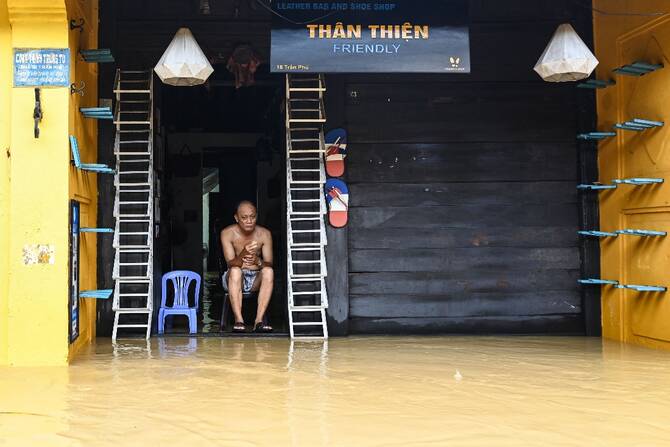
This week alone, floods triggered by record rainfall in central Vietnam have killed at least 10 people and inundated more than 100,000 homes.
In the coastal city of Hue, up to 1.7 meters of rain fell in just 24 hours.
The flooding follows several rounds of inundations in the capital Hanoi and elsewhere, linked to storm systems or heavy rain fronts.
Natural disasters — mostly storms, floods and landslides — left 187 people dead or missing in Vietnam in the first nine months of this year.
Hundreds more were killed or left missing last year, many of them in Typhoon Yagi, the strongest storm to hit Vietnam in decades.
Yagi caused an estimated $1.6 billion in economic losses.
- Responses -
Vietnam “is making great efforts at early warning,” said Ralf Toumi, director of the Grantham Institute — Climate Change and the Environment at Imperial College London.
In recent flood incidents, the government has issued evacuation orders and assisted residents moving to higher ground.
But “the infrastructure also needs to be continuously improved as the country is getting richer,” Toumi added.
Dykes, sea barriers and drainage systems in major deltas on the Red River and the Mekong have been reinforced, upgraded or newly built.
And after deadly landslides and flash floods triggered by Yagi, part of an entire village in northern Lao Cai province was relocated to safer, higher ground.
But often “the focus is on disaster infrastructure whereas it should also be on not creating disaster risk,” said Brad Jessup, an environmental expert at the University of Melbourne.
“Without attending to risk reduction, the needs for protection infrastructure keeps on increasing. It is a spiral.”
Climate adaptation is expensive, and wealthy countries have consistently failed to keep promises on climate funding for developing nations like Vietnam.
Rich countries pledged in 2021 to double their adaptation financing by 2025, but instead, the figure has fallen, the United Nations said this week.


![]()


Climate change, poor planning drive Vietnam flooding
Short Url
https://arab.news/wtr2e
Climate change, poor planning drive Vietnam flooding
- This week alone, floods triggered by record rainfall in central Vietnam have killed at least 10 people and inundated more than 100,000 homes


Trump to remove Vietnam from restricted tech list: Hanoi
HANOI: US President Donald Trump told Vietnam’s top leader To Lam he would “instruct the relevant agencies” to remove the country from a list restricted from accessing advanced US technologies, Vietnam’s government announced Saturday.
The two leaders met in person for the first time at the White House on Friday, after Lam attended the inaugural meeting of Trump’s “Board of Peace” in Washington.
“Donald Trump said he would instruct the relevant agencies to soon remove Vietnam from the strategic export control list,” Hanoi’s Government News website said.
The two countries were locked in protracted trade negotiations when the US Supreme Court ruled many of Trump’s sweeping tariffs were illegal.
Three Vietnamese airlines announced nearly $37 billion in purchases this week, in a series of contracts signed with US aerospace companies.
Fledgling airline Sun PhuQuoc Airways placed an order for 40 of Boeing’s 787 Dreamliners, a long-haul aircraft, with an estimated total value of $22.5 billion, while national carrier Vietnam Airlines placed an $8.1 billion order for around 50 Boeing 737-8 aircraft.
When Trump announced his “Liberation Day” tariffs in April, Vietnam had the third-largest trade surplus with the US of any country after China and Mexico, and was targeted with one of the highest rates in Trump’s tariff blitz.
But in July, Hanoi secured a minimum 20 percent tariff with Washington, down from more than 40 percent, in return for opening its market to US products including cars.
Trump signed off on a global 10-percent tariff on Friday on all countries hours after the Supreme Court ruled many of his levies on imports were illegal.
The two leaders met in person for the first time at the White House on Friday, after Lam attended the inaugural meeting of Trump’s “Board of Peace” in Washington.
“Donald Trump said he would instruct the relevant agencies to soon remove Vietnam from the strategic export control list,” Hanoi’s Government News website said.
The two countries were locked in protracted trade negotiations when the US Supreme Court ruled many of Trump’s sweeping tariffs were illegal.
Three Vietnamese airlines announced nearly $37 billion in purchases this week, in a series of contracts signed with US aerospace companies.
Fledgling airline Sun PhuQuoc Airways placed an order for 40 of Boeing’s 787 Dreamliners, a long-haul aircraft, with an estimated total value of $22.5 billion, while national carrier Vietnam Airlines placed an $8.1 billion order for around 50 Boeing 737-8 aircraft.
When Trump announced his “Liberation Day” tariffs in April, Vietnam had the third-largest trade surplus with the US of any country after China and Mexico, and was targeted with one of the highest rates in Trump’s tariff blitz.
But in July, Hanoi secured a minimum 20 percent tariff with Washington, down from more than 40 percent, in return for opening its market to US products including cars.
Trump signed off on a global 10-percent tariff on Friday on all countries hours after the Supreme Court ruled many of his levies on imports were illegal.
Latest updates


Recommended


© 2026 SAUDI RESEARCH & PUBLISHING COMPANY, All Rights Reserved And subject to Terms of Use Agreement.