HANOI: Dozens of people dead, thousands evacuated and millions of dollars in damage. Vietnam is once again battling widespread flooding driven by climate change and poor infrastructure decisions, experts say.
The Southeast Asian nation’s location and topography make it naturally vulnerable to frequent typhoons and some flooding, but the situation is being made worse by the heavier rains that climate change brings and rampant urbanization.
- Stronger, wetter storms -
Vietnam is in one of the most active tropical cyclone regions on Earth and prone to heavy rains between June and September.
Ten typhoons or tropical storms usually affect Vietnam, directly or offshore, in a given year, but it has experienced 12 already in 2025.
“Climate change is already shaping Vietnam’s exposure in several important ways,” said Nguyen Phuong Loan, a climate scientist at the University of New South Wales.
Studies suggest climate change will produce fewer but “possibly more intense tropical cyclones (typhoons)” along with heavier bursts of rain because a warmer atmosphere holds more moisture.
“That means a higher chance of flash floods, especially in densely populated urban areas,” said Loan.
Rising sea levels are also putting pressure on coastal communities.
- Topography, infrastructure -
With 3,200 kilometers (around 2,000 miles) of coastline and a network of 2,300 rivers, Vietnam faces a high risk of flooding.
Much of the country has little natural ability to drain quickly after heavy flooding because of its topography, hydrological experts said.
In some cases construction and environmental degradation has made matters worse, said meteorological expert Nguyen Lan Oanh.
Upstream forest destruction for hydropower projects, cementing of drainage canals and rampant urbanization have “badly contributed to the source of flooding and increased landslides,” Oanh told AFP.
“Humans need to change their perception in the way they treat nature for a safer world.”
- Devastating impacts -
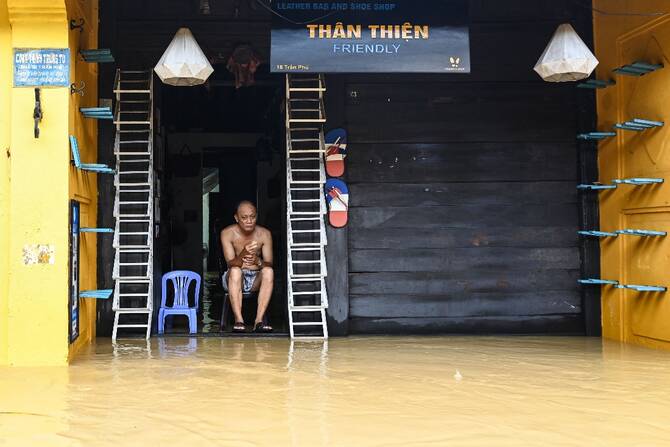
This week alone, floods triggered by record rainfall in central Vietnam have killed at least 10 people and inundated more than 100,000 homes.
In the coastal city of Hue, up to 1.7 meters of rain fell in just 24 hours.
The flooding follows several rounds of inundations in the capital Hanoi and elsewhere, linked to storm systems or heavy rain fronts.
Natural disasters — mostly storms, floods and landslides — left 187 people dead or missing in Vietnam in the first nine months of this year.
Hundreds more were killed or left missing last year, many of them in Typhoon Yagi, the strongest storm to hit Vietnam in decades.
Yagi caused an estimated $1.6 billion in economic losses.
- Responses -
Vietnam “is making great efforts at early warning,” said Ralf Toumi, director of the Grantham Institute — Climate Change and the Environment at Imperial College London.
In recent flood incidents, the government has issued evacuation orders and assisted residents moving to higher ground.
But “the infrastructure also needs to be continuously improved as the country is getting richer,” Toumi added.
Dykes, sea barriers and drainage systems in major deltas on the Red River and the Mekong have been reinforced, upgraded or newly built.
And after deadly landslides and flash floods triggered by Yagi, part of an entire village in northern Lao Cai province was relocated to safer, higher ground.
But often “the focus is on disaster infrastructure whereas it should also be on not creating disaster risk,” said Brad Jessup, an environmental expert at the University of Melbourne.
“Without attending to risk reduction, the needs for protection infrastructure keeps on increasing. It is a spiral.”
Climate adaptation is expensive, and wealthy countries have consistently failed to keep promises on climate funding for developing nations like Vietnam.
Rich countries pledged in 2021 to double their adaptation financing by 2025, but instead, the figure has fallen, the United Nations said this week.


Climate change, poor planning drive Vietnam flooding
https://arab.news/wtr2e
Climate change, poor planning drive Vietnam flooding

- This week alone, floods triggered by record rainfall in central Vietnam have killed at least 10 people and inundated more than 100,000 homes


Shooter kills 9 at Canadian school and residence
- The shooter was found dead with an apparent self-inflicted gunshot wound
- A total of 27 people were wounded in the shooting, including two with serious injuries
TORONTO: A shooter killed nine people and wounded dozens more at a secondary school and a residence in a remote part of western Canada on Tuesday, authorities said, in one of the deadliest mass shootings in the country’s history.
The suspect, described by police in an initial emergency alert as a “female in a dress with brown hair,” was found dead with an apparent self-inflicted gunshot wound, officials said.
The attack occurred in Tumbler Ridge, British Columbia, a picturesque mountain valley town in the foothills of the Rockies.
A total of 27 people were wounded in the shooting, including two with serious injuries, the Royal Canadian Mounted Police said in a statement.
Prime Minister Mark Carney said he was “devastated” by the “horrific acts of violence” and announced he was suspending plans to travel to the Munich Security Conference on Wednesday, where he had been set to hold talks with allies on transatlantic defense readiness.
Police said an alert was issued about an active shooter at Tumbler Ridge Secondary School on Tuesday afternoon.
As police searched the school, they found six people shot dead. A seventh person with a gunshot wound died en route to hospital.
Separately, police found two more bodies at a residence in the town.
The residence is “believed to be connected to the incident,” police said.
At the school, “an individual believed to be the shooter was also found deceased with what appears to be a self?inflicted injury,” police said.
Police have not yet released any information about the age of the shooter or the victims.
“We are devastated by the loss of life and the profound impact this tragedy has had on families, students, staff, and our entire town,” the municipality of Tumbler Ridge said in a statement.
Tumbler Ridge student Darian Quist told public broadcaster CBC that he was in his mechanics class when there was an announcement that the school was in lockdown.
He said that initially he “didn’t think anything was going on,” but started receiving “disturbing” photos about the carnage.
“It set in what was happening,” Quist said.
He said he stayed in lockdown for more than two hours until police stormed in, ordering everyone to put their hands up before escorting them out of the school.
Trent Ernst, a local journalist and a former substitute teacher at Tumbler Ridge, expressed shock over the shooting at the school, where one of his children has just graduated.
He noted that school shootings have been a rarity occurring every few years in Canada compared with the United States, where they are far more frequent.
“I used to kind of go: ‘Look at Canada, look at who we are.’ But then that one school shooting every 2.5 years happens in your town and things... just go off the rails,” he told AFP.
‘Heartbreak’
While mass shootings are extremely rare in Canada, last April, a vehicle attack that targeted a Filipino cultural festival in Vancouver killed 11 people.
British Columbia Premier David Eby called the latest violence “unimaginable.”
Nina Krieger, British Columbia’s minister of public safety, said it was “one of the worst mass shootings in our province’s and country’s history.”
The Canadian Olympic Committee, whose athletes are competing in the 2026 Winter Games in Italy, said Wednesday it was “heartbroken by the news of the horrific school shooting.”
Ken Floyd, commander of the police’s northern district, said: “This has been an incredibly difficult and emotional day for our community, and we are grateful for the cooperation shown as officers continue their work to advance the investigation.”
Floyd told reporters the shooter was the same suspect police described as “female” in a prior emergency alert to community members, but declined to provide any details on the suspect’s identity.
The police said officers were searching other homes and properties in the community to see if there were additional sites connected to the incident.
Tumbler Ridge, a quiet town with roughly 2,400 residents, is more than 1,100 kilometers (680 miles) north of Vancouver, British Columbia’s largest city.
“There are no words sufficient for the heartbreak our community is experiencing tonight,” the municipality said.


