Pakistan eyes increasing date exports with modern processing plants via UAE’s help

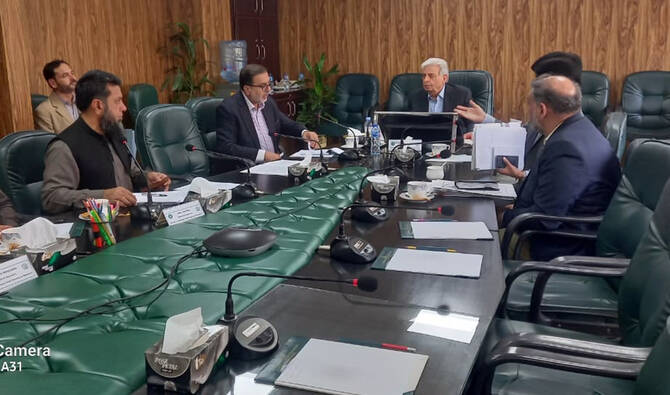
Pakistan’s National Food Security Minister Rana Tanveer Hussain (center) attends a virtual meeting with a UAE delegation, in Islamabad, Pakistan, on October 29, 2025. (PID)
Short Url
Updated 29 October 2025
Follow

Pakistan eyes increasing date exports with modern processing plants via UAE’s help

  • Pakistan says UAE delegation has assured of expediting process to set up three date processing plants
  • Both sides to formalize cooperation by signing MoU between Pakistan’s food ministry, UAE authorities

KARACHI: Pakistan’s National Food Security ministry on Wednesday hoped its proposed collaboration with the UAE would result in establishing modern processing plants and increasing value addition to boost the country’s date exports.

Pakistan’s National Food Security Minister Rana Tanveer Hussain held a virtual meeting with a UAE delegation to strengthen bilateral cooperation in the date sector, the food ministry said in a statement. Both sides reviewed potential areas of collaboration and investment to boost Pakistan’s date exports. 

Hussain shared during the meeting that Pakistan’s annual production of dates has reached over half a million tons, which is cultivated on more than 100,000 hectares of land. He stressed that major date producing regions include Balochistan and Sindh, where popular varieties such as Aseel, Muzawati, Dhakki, Rabbi, Begum Jangi, Karbala and Khudri are grown.

“The Federal Secretary, Ameer Muhyuddin, reaffirmed the Ministry’s commitment to translating this cooperation into tangible results,” the statement said.

“He emphasized that the proposed collaboration with the UAE would help in establishing modern date processing plants, improving value addition, and enhancing Pakistan’s competitiveness in the global market.”

Hussain pointed out that Pakistan’s date exports, valued at over $50 million, have shown “remarkable expansion,” while shipment data reflects a significant rise in export volumes and diversification of international buyers.

He also spoke about the challenges confronting the date industry, including Pakistan’s earlier dependence on a single export market, limited value addition, quality and SPS compliance issues.

Simisola Nicola Abere, representing the UAE delegation, appreciated Pakistan’s efforts in developing the date sector and announced the UAE would expedite the process for the establishment of three processing plants in Pakistan. 

“She added that both sides would formalize their collaboration through the signing of a Memorandum of Understanding (MoU) between the Ministry of National Food Security and Research and relevant UAE authorities,” the food security ministry said.

“This MoU would serve as the foundation for joint projects in value addition, technology transfer, and export enhancement.”

Hussain said that through such partnerships, Pakistan could enhance its export earnings, create new employment opportunities and improve farmers’ livelihoods.

“The minister concluded the meeting by expressing his optimism that the upcoming collaboration with the UAE would serve as a milestone in promoting agricultural trade and investment between the two brotherly countries,” the statement said. 


Pakistan says defense pact with Saudi Arabia elevated brotherly ties to ‘new heights’

Updated 25 February 2026
Follow

Pakistan says defense pact with Saudi Arabia elevated brotherly ties to ‘new heights’

  • Pakistan, Saudi Arabia signed strategic defense pact last year pledging aggression against one will be treated as attack on both
  • Deputy PM Ishaq Dar says enduring bonds with Islamic and Arab nations form vital pillar of Pakistan’s foreign policy 

ISLAMABAD: Deputy Prime Minister Ishaq Dar said on Wednesday that Pakistan’s defense pact with Saudi Arabia elevated its brotherly ties with the Kingdom to “new heights,” stressing that close ties with Arab and Islamic nations form a key pillar of Islamabad’s foreign policy. 

Pakistan and Saudi Arabia signed a Strategic Mutual Defense Agreement on Sept. 17 last year, pledging that aggression against one country would be treated as an attack on both, enhancing joint deterrence and formalizing decades of military and security cooperation.

Both nations agreed in October 2025 to launch an economic cooperation framework to strengthen trade and investment ties. 

“In the Middle East, our landmark Strategic Mutual Defense Agreement with Saudi Arabia has elevated our brotherly ties to new heights,” Dar said while speaking at the Pakistan Governance Forum 2026 event in Islamabad. 

The Pakistani deputy prime minister was speaking on the topic “Navigating International Relations Amidst Changing Geo-Politics.”

Dar noted that Pakistan has reinforced partnerships with other Middle Eastern nations such as the UAE, Qatar, Jordan, Oman, Egypt and Bahrain. He said these partnerships have yielded “concrete agreements” in investment, agriculture, infrastructure, and energy sectors. 

“Our enduring bonds with Islamic and Arab nations form a vital pillar of our foreign policy, and we will continue to expand our partnerships across Asia, Latin America, and Africa,” he said. 

Dar pointed out that the presidents of Kazakhstan, Uzbekistan and Kyrgyzstan have undertaken visits to Pakistan in recent months, reflecting Central Asian nations’ desire to boost cooperation with Islamabad.

On South Asia, the Pakistani deputy PM said Pakistan has successfully transformed its fraternal ties with Bangladesh into “a substantive partnership.”

“Similarly, the trilateral mechanism involving China, Pakistan, and Bangladesh has been launched with a view to expanding and deepening regional cooperation and synergy,” the Pakistani minister said. 

He said Islamabad has strengthened its “all-weather” partnership with China via the second phase of the multi-billion-dollar China-Pakistan Economic Corridor agreement and “unwavering support” from both sides for each other’s core interests. 

Dar said Pakistan had also reinvigorated its partnership with the US, advancing cooperation in trade, technology, investment, and regional stability. 

“This calibrated approach has enhanced our ability to navigate complexity with skill and confidence, ensuring that our national interests are served without compromising our core foreign policy principles,” he said.