

Security improves in Pakistan’s key business hubs of Karachi, Lahore — foreign investors report

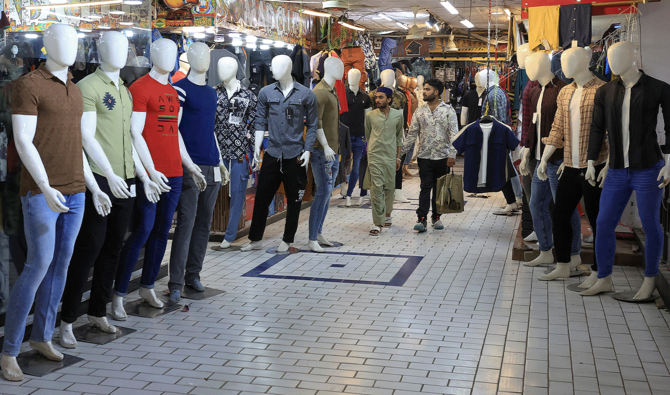
Men walk amid mannequins as they shop, ahead of Eid al-Fitr celebrations in Karachi, Pakistan March 29, 2025. (Reuters/File)
Short Url
Updated 29 October 2025
Follow

Security improves in Pakistan’s key business hubs of Karachi, Lahore — foreign investors report

  • Survey shows marked decline in street and serious crimes in Karachi and Lahore
  • Investor confidence rises as police satisfaction improves, though Balochistan remains volatile

KARACHI: Pakistan’s major business hubs of Karachi and Lahore saw a marked improvement in law and order over the past year, with a notable decline in serious and street crimes, according to the Security Survey 2025 conducted by foreign investors operating in the country.

The annual assessment by the Overseas Investors Chamber of Commerce and Industry (OICCI) — representing more than 200 multinational firms — found that both crime levels and employee security perceptions improved significantly between June 2024 and May 2025. The report said Karachi and Lahore recorded the sharpest drop in major crimes, while the overall business environment across Sindh and Punjab strengthened.

The survey’s findings come amid a renewed surge in militant attacks across Pakistan in recent months, particularly in the northwestern Khyber Pakhtunkhwa province and parts of Balochistan, where Pakistani security forces have been battling an uptick in insurgent violence and cross-border militancy.

“The security environment has shown improvement across business operations in 2025 compared to 2024,” the OICCI report said, noting that Karachi and Lahore recorded the most visible progress while the southwestern Balochistan province, wracked by a decades-long insurgency, remained a concern.

The survey, based on feedback from member companies, noted that serious crimes had decreased in Karachi, Sindh and Punjab, while street crimes fell sharply in Karachi, Lahore and Islamabad. Quetta, the provincial capital of Balocistan, and Peshawar, the capital of KP province, showed moderate progress. The overall security situation in Balochistan deteriorated, remaining the weakest among all provinces.

Respondents said employees now felt safer during daily commutes, with improved perceptions of security in the country’s largest urban centers. 

Confidence in law enforcement agencies also rose, with Karachi and Sindh Police receiving better ratings than last year, while Khyber Pakhtunkhwa Police, Sindh Rangers and the Citizens-Police Liaison Committee (CPLC) Karachi maintained strong approval levels.

The survey identified illegal gratification, expatriate security and political protests as the top challenges still affecting business confidence, though the proportion of investors ranking security as a major obstacle fell compared to previous years.

Foreign investors said the findings reflected “steady progress in urban safety” and an improved “operational climate for business,” crediting coordinated policing and provincial counter-crime efforts for the gains.


Pakistan, global crypto exchange discuss modernizing digital payments, creating job prospects 

Updated 8 sec ago
Follow

Pakistan, global crypto exchange discuss modernizing digital payments, creating job prospects 

  • Pakistani officials, Binance team discuss coordination between Islamabad, local banks and global exchanges
  • Pakistan has attempted to tap into growing crypto market to curb illicit transactions, improve oversight

ISLAMABAD: Pakistan’s finance officials and the team of a global cryptocurrency exchange on Friday held discussions aimed at modernizing the country’s digital payments system and building local talent pipelines to meet rising demand for blockchain and Web3 skills, the finance ministry said.

The development took place during a high-level meeting between Finance Minister Muhammad Aurangzeb, Pakistan Virtual Assets Regulatory Authority (PVARA) Chairman Bilal bin Saqib, domestic bank presidents and a Binance team led by Global CEO Richard Teng. The meeting was held to advance work on Pakistan’s National Digital Asset Framework, a regulatory setup to govern Pakistan’s digital assets.

Pakistan has been moving to regulate its fast-growing crypto and digital assets market by bringing virtual asset service providers (VASPs) under a formal licensing regime. Officials say the push is aimed at curbing illicit transactions, improving oversight, and encouraging innovation in blockchain-based financial services.

“Participants reviewed opportunities to modernize Pakistan’s digital payments landscape, noting that blockchain-based systems could significantly reduce costs from the country’s $38 billion annual remittance flows,” the finance ministry said in a statement. 

“Discussions also emphasized building local talent pipelines to meet rising global demand for blockchain and Web3 skills, creating high-value employment prospects for Pakistani youth.”

Blockchain is a type of digital database that is shared, transparent and tamper-resistant. Instead of being stored on one computer, the data is kept on a distributed network of computers, making it very hard to alter or hack.

Web3 refers to the next generation of the Internet built using blockchain, focusing on giving users more control over their data, identity and digital assets rather than big tech companies controlling it.

Participants of the meeting also discussed sovereign debt tokenization, which is the process of converting a country’s debt such as government bonds, into digital tokens on a blockchain, the ministry said. 

Aurangzeb called for close coordination between the government, domestic banks and global exchanges to modernize Pakistan’s payment landscape.

Participants of the meeting also discussed considering a “time-bound amnesty” to encourage users to move assets onto regulated platforms, stressing the need for stronger verifications and a risk-mitigation system.

Pakistan has attempted in recent months to tap into the country’s growing crypto market, crack down on money laundering and terror financing, and promote responsible innovation — a move analysts say could bring an estimated $25 billion in virtual assets into the tax net.

In September, Islamabad invited international crypto exchanges and other VASPs to apply for licenses to operate in the country, a step aimed at formalizing and regulating its fast-growing digital market.