

Israeli strikes kill 104, bringing grief to Gazans trying to rebuild

1 / 2
Medics attend to a children wounded in an Israeli strike, at Al-Awda hospital in Nuseirat, in the central Gaza Strip, on October 29, 2025.
2 / 2
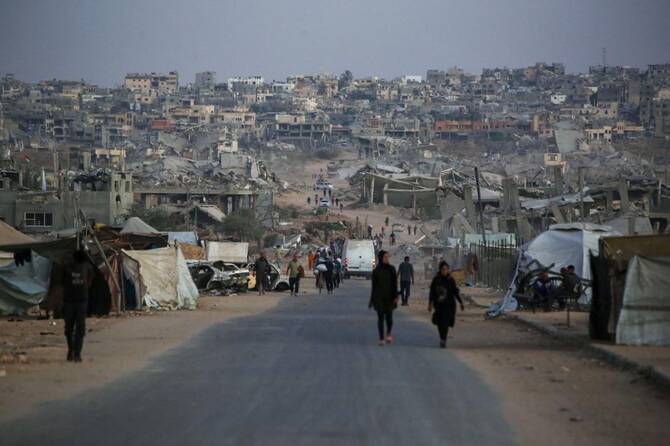
Civil defense spokesman Mahmoud Bassal described the situation in Gaza as “catastrophic and terrifying,”. (FILE/AFP)
Short Url
Updated 30 October 2025
Follow

Israeli strikes kill 104, bringing grief to Gazans trying to rebuild

  • Gaza health ministry says 46 children and 20 women were among those killed in Israeli strikes since Tuesday
  • Entire Abu Dalal family of nine wiped out in an airstrike that flattened their home

CAIRO/JERUSALEM: Israel said on Wednesday it was still committed to the US-backed ceasefire in Gaza, despite pounding the enclave in retaliation for the death of an Israeli soldier with a day of bombardment that Gaza health authorities said killed 104 people.
Even as the military affirmed it still intended to uphold the truce, it announced it had carried out another airstrike in the north of Gaza where it said weapons had been stored. Medics said two people were killed in that attack.
The killing of an Israeli soldier in Gaza on Tuesday has triggered the worst escalation in Gaza since the ceasefire came into effect on October 10.


Mourners sit beside a body of a Palestinian killed in an Israeli army strike, at Shifa Hospital in Gaza City Wednesday. (AP)

Israel says the soldier was killed in an attack by gunmen on territory within the “yellow line” where its troops withdrew under the truce. Hamas has denied blame.
Israel described its latest attack on Wednesday as a targeted strike in the area of Beit Lahia in the north of the strip, where it said weapons had been stored. It said it would continue to uphold the ceasefire agreement while responding firmly to any violation.

Hamas commmander

In response to the soldier’s death, the military launched what it described as strikes targeting dozens of Hamas militants across the enclave, as well as weapons depots and tunnels belonging to the group.
It named 24 militant targets, including one it described as a Hamas commander who took part in an attack on a kibbutz during the October 7, 2023 assault on southern Israel that triggered the war.
The Gaza health ministry said 46 children and 20 women were among the 104 people killed in the airstrikes.

Opinion

This section contains relevant reference points, placed in (Opinion field)

In Nusseirat in the central Gaza Strip, neighbors said the entire Abu Dalal family had been wiped out in an airstrike that flattened their home overnight.
A boy in a wheelchair wailed as the family’s bodies in white plastic body bags were loaded into the back of a flatbed truck. Crowds followed as the bodies were driven through the streets to a cemetery.
“It was erased from the civil registry: an entire family. About nine people: the father, the son, his wife, his son’s wife, and all the children were completely removed from the civil registry,” said neighbor Wael Najem, 52.
Despite the bombardments, US President Donald Trump said the US-backed ceasefire was not at risk.


Relatives mourn over the bodies of two children killed in an Israeli strike, at Nasser Hospital in Khan Yunis in the southern Gaza Strip on Wednesday. (AFP)

“As I understand it, they took out an Israeli soldier,” Trump told reporters aboard Air Force One. “So the Israelis hit back and they should hit back. When that happens, they should hit back,” he added.
“Nothing is going to jeopardize” the ceasefire, Trump added. “You have to understand Hamas is a very small part of peace in the Middle East, and they have to behave.”
Qatar’s Prime Minister Sheikh Mohammed bin Abdulrahman Al-Thani, who has acted as a mediator, said on Wednesday that the attack on the Israeli soldier and the subsequent Israeli airstrikes had been “very disappointing and frustrating for us.”

Night of bombardment

Displaced Palestinians feared the truce could fall apart.
“The sounds of explosions and planes made us feel as if war had started again,” Ismail Zayda, 40, living in tents in western Gaza City with his 25-member family, told Reuters via a chat app.
Under the accord, Hamas released all living hostages in return for nearly 2,000 Palestinian prisoners and wartime detainees, while Israel pulled back its troops and halted its offensive.
Hamas also agreed to hand over the remains of all dead hostages yet to be recovered, but has said that it will take time to locate and retrieve them. Israel has accused Hamas of violating the ceasefire by stalling in handing over bodies.


Washington presses Syria to shift from Chinese telecom systems

Updated 26 February 2026
Follow

Washington presses Syria to shift from Chinese telecom systems

  • Syria is exploring the possibility of procuring Chinese technology
  • It was unclear whether the United States ⁠pledged financial or logistical support to Syria to do so

DAMASCUS: The United States has warned Syria against relying on Chinese technology in its telecommunications sector, arguing it conflicts with US interests and threatens US national security, according to three sources familiar with the matter.
The message was conveyed during an unreported meeting between a US State Department team and Syrian Communications Minister Abdulsalam Haykal in San Francisco on Tuesday. Washington has been coordinating closely with Damascus since 2024, when Syria’s now President Ahmed Al-Sharaa ousted longtime leader Bashar Assad, who had a strategic partnership with China.
Syria is exploring the possibility of procuring Chinese technology to support its telecommunications towers and the infrastructure of local Internet service providers, according to a Syrian businessman involved in the procurement talks.
“The US side asked for clarity on the ministry’s plans regarding Chinese telecom equipment,” said ⁠another source briefed on ⁠the talks.
But Syrian officials said infrastructure development projects were time-critical and that Damascus was seeking greater vendor diversity, the source added.
SYRIAN OFFICIALS CITE US EXPORT CONTROLS AS TELECOMS BARRIER
Syria is open to partnering with US firms but the matter was urgent and export controls and “over-compliance” remained an issue, according to person familiar with the meeting in San Francisco.
A US diplomat familiar with the discussions told Reuters that the US State Department “clearly urged Syrians to use American technology or technology from allied countries in the telecoms sector.”
It was unclear whether the United States ⁠pledged financial or logistical support to Syria to do so.
Responding to Reuters questions, a US State Department spokesperson said: “We urge countries to prioritize national security and privacy over lower-priced equipment and services in all critical infrastructure procurement. If it seems too good to be true, it probably is.”
The spokesperson added that Chinese intelligence and security services “can legally compel Chinese citizens and companies to share sensitive data or grant unauthorized access to their customers’ systems” and promises by Chinese companies to protect customers’ privacy were “entirely inconsistent with China’s own laws and well-established practices.”
China has repeatedly rejected allegations of it using technology for spying purposes.
The Syrian Ministry of telecommunications told Reuters any decisions related to equipment and infrastructure are made “in accordance with national technical and security standards, ensuring data protection and service continuity.”
The ministry said it is also prioritizing the diversification of partnerships and technology sources to ⁠serve the national interest.
Syria’s telecom ⁠infrastructure has relied heavily on Chinese technology due to US sanctions imposed on successive Assad governments over the civil war that grew from a crackdown on anti-government protests in 2011.
Huawei technology accounts for more than 50 percent of the infrastructure of Syriatel and MTN, the country’s only telecom operators, according to a senior source at one of the companies and documents reviewed by Reuters. Huawei did not immediately respond to a request for comment.
Syria is seeking to develop its private telecommunications sector, devastated by 14 years of war, by attracting foreign investment.
In early February, Saudi Arabia’s largest telecom operator, STC, announced it would invest $800 million to “strengthen telecommunications infrastructure and connect Syria regionally and internationally through a fiber-optic network extending over 4,500 kilometers.”
The ministry of telecommunications says that US restrictions “hinder the availability of many American technologies and services in the Syrian market,” emphasizing that it welcomes expanding cooperation with US companies when these restrictions are lifted.
Syria has inadequate telecommunications infrastructure, with network coverage weak outside city centers and connection speeds in many areas barely exceeding a few kilobits per second.