

Police officer, two assailants killed as militants storm remote town in Pakistan’s Balochistan

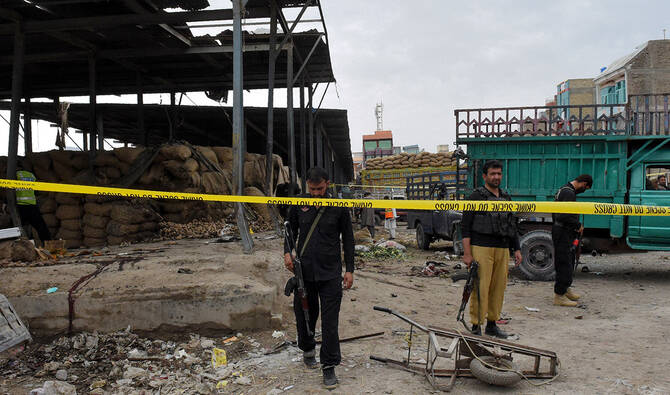
Pakistani police officials cordon off the site after a bomb blast at a fruit market in Quetta on April 12, 2019. (AFP/ file)
Short Url
Updated 27 October 2025
Follow

Police officer, two assailants killed as militants storm remote town in Pakistan’s Balochistan

  • No group immediately claimed responsibility for the assault in Bhag town, but Baloch separatists have staged similar assaults in the past
  • Pakistan has frequently blamed a surge in militancy in its western regions on Afghanistan and India, an allegation denied by Kabul and New Delhi

QUETTA: A police officer and two militants were killed in a gunfight in Pakistan’s southwestern Balochistan province, a senior police official said on Monday.

The gunfight ensued after dozens of armed men stormed the remote town of Bhag in Kachi district, located some 230 kilometers from the provincial capital of Quetta, at around 4:15pm local time.

Maaz-ur-Rehman, the Kachi senior superintendent of police (SSP), told Arab News the attackers, armed with heavy weapons, targeted the Bhag police station, Levies paramilitary station, a government-owned bank and offices.

While no group immediately claimed responsibility for the assault, Baloch separatist militants have staged similar assaults in the past in a bid to seize control of towns in the insurgency-hit, sparsely populated province.

“Police and Levies forces resisted with bravery and killed two terrorists,” SSP Rehman told Arab News. “Unfortunately, Station House Officer (SHO) Bhaag Lutf Khosa was killed and another policeman was injured while repulsing the attack.”

Videos circulating on social media showed dozens of fighters roaming in the streets of the town. In one clip, a man, who identifies himself as an employee of National Bank, describes how the attackers vandalized their bank branch.

“The terrorists have taken away one body of their killed members, while the other was seized by Counter-Terrorism Department (CTD) officials with weapons and grenades,” SSP Rehman said, adding the attackers also snatched a sniper rifle from a paramilitary Levies member.

Balochistan, Pakistan’s largest and resource-rich province, has long been plagued by a low-level insurgency led by ethnic Baloch separatist groups like the BLA. They accuse Islamabad of exploiting the province’s natural resources, such as gold and copper, while neglecting the local population.

Pakistan rejects these allegations, asserting that the federal government has prioritized Balochistan’s development by investing in health, education and infrastructure projects.

In January, armed fighters from the Balochistan Liberation Army (BLA) group attacked the Zehri town in Balochistan’s Khuzdar district, seizing government facilities before security forces regained control, an administration official in the area said. Last week, two policemen were killed in a drive-by shooting in Nushki district of the resource-rich region bordering Afghanistan and Iran.

Pakistan has frequently accused Afghanistan of allowing the use of its soil and India of backing militant groups for cross-border attacks in Pakistan’s western regions. Kabul and New Delhi have consistently denied the allegations.


Pakistan opposition to hold protest today over jailed ex-PM Khan’s deteriorating eye condition

Updated 6 sec ago
Follow

Pakistan opposition to hold protest today over jailed ex-PM Khan’s deteriorating eye condition

  • A court-appointed lawyer this week visited Imran Khan at prison and recommended independent ophthalmology review of his right eye
  • Information Minister Attaullah Tarar said Khan party’s narrative has ‘fallen flat on its face’ after ex-PM voiced ‘satisfaction’ with facilities

ISLAMABAD: Pakistan’s opposition alliance has announced a sit-in outside the Parliament House in Islamabad today, Friday, over jailed former prime minister Imran Khan’s deteriorating eye condition, following a rare prison visit by a Supreme Court-appointed lawyer this week.

Barrister Salman Safdar, who was appointed ‘amicus curiae,’ or friend of the court, visited Khan at Rawalpindi’s Adiala jail on Feb. 10 and filed a detailed report on his living conditions and health, which was made public on Thursday.

The report stated that in view of the seriousness of Khan’s ocular condition, “it is imperative that the seriousness of the condition be independently ascertained without delay.” There was no immediate response from prison authorities on the findings.

The Tehreek-e-Tahafuz-e-Ayin-e-Pakistan opposition alliance late Thursday demanded that Khan be transferred to Al-Shifa Hospital and announced a sit-in outside parliament until the former prime minister is allowed treatment in the presence of his personal physicians.

“The sit-in will be held tomorrow,” Mahmood Khan Achakzai, the head of the opposition alliance, told reporters in Islamabad, adding that they will peacefully lay down all demands at the sit-in. “If, God forbids, something happens, then the government will be responsible for that.”

Khan, 73, has been in custody since August 2023 in connection with multiple cases that he and his party describe as politically motivated. The government denies the allegation.

Concerns about Khan’s health have resurfaced in recent weeks after authorities confirmed he had been briefly taken from prison to a hospital in Islamabad for an eye procedure. The government said at the time his condition was stable, while Khan’s family and his Pakistan Tehreek-e-Insaf (PTI) political party complained they had not been informed in advance and alleged he was being denied timely and independent medical access.

The issue was then taken up by the Supreme Court earlier this week, which tasked Safdar, who has represented Khan in the past, with visiting the ex-premier and submitting a written report.

According to a medical condition report from the Pakistan Institute of Medical Sciences (PIMS), dated Feb. 6, 2026 and referenced in Safdar’s court filing, Khan was diagnosed with “right central retinal vein occlusion” after reporting reduced vision in his right eye.

The report states that he underwent anti-VEGF intravitreal injection treatment at PIMS and was discharged with follow-up advice.

However, in his interaction with Safdar, Khan said he had experienced “rapid and substantial loss of vision over the preceding three months” and claimed his complaints had not been addressed promptly while in custody. He further stated that despite treatment, he had been left with “only 15 percent vision in his right eye.”

Safdar’s report notes that the former premier appeared “visibly perturbed and deeply distressed by the loss of vision and the absence of timely and specialized medical intervention.” The amicus also recommended that the Supreme Court consider directing involvement of Khan’s personal physicians or other specialists of his choice, warning that “any further delay poses a serious risk to the Petitioner’s well-being.”

Beyond medical concerns, the report addressed Khan’s confinement conditions, noting that he expressed “satisfaction regarding his safety and security within the cell-block,” as well as contentment with basic amenities and food provisions.

Responding to the report, Information Minister Attaullah Tarar rejected claims of mistreatment, saying the “narrative being propagated to international media” by Khan’s family had “fallen flat on its face.”

He said the prison report on Khan’s daily routine and diet had removed any ambiguity and maintained that all facilities were available to the former premier, who he said enjoyed privileges “more than any other prisoner.” His X post did not address the allegations on Khan’s health issues.