

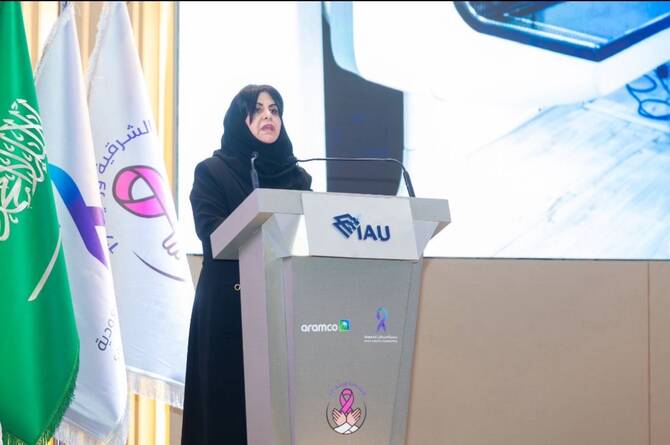


RIYADH: Saudi Arabia’s Dr. Selwa Al-Hazzaa, founder of the startup SDM, is among many physicians turning to AI, and spearheading new and innovative technologies such as SAMIA, to detect breast cancer in patients within minutes.
“We chose the month of October for the launch of SAMIA, the Saudi Automated Mammogram Image Analysis, as this October is the month of Breast Cancer Awareness,” Al-Hazzaa told Arab News.
SDM, known as the first health tech startup incubated and accelerated in The Garage of the King Abdullah City for Science and Technology, works on diagnosing chronic diseases through imaging.
Al-Hazzaa and her team began working on diabetic retinopathy diagnosis through retinal imaging and have now added breast cancer detection as their newest diagnostic landmark.
“We decided to choose another important disease that has affected everybody. Everyone knows about breast cancer, they’ve either, God forbid, been affected, or a family member, or a relative,” Al-Hazzaa said.
According to Saudi Arabia’s Ministry of Health, breast cancer is the most common of all cancers internationally, regionally and nationally, and more common among women aged 40 or older in the Kingdom.
Al-Hazzaa said SAMIA works in combination with current and traditional medical treatments. “When a female goes to perform a mammogram, it all depends on the institution she’s going to, but very, very seldom does she get her results immediately.
“Technically, she can wait anywhere from one to two days up to weeks for the actual result, which can be very, very disturbing,” she explained.
“The way it (SAMIA) works is when a female has her mammogram, the mammogram is sent immediately to the cloud.
“And within minutes, and I’m not exaggerating, could even be less than a minute, the results come back, being totally annotated and graded, and showing exactly if, God forbid, there is any suspicious areas.”
Early detection has been proven to save lives, reduce mortality rates and cut treatment costs drastically.
Dr. Omar Iskanderani, assistant professor and chairman of the radiotherapy and tumor boards at King Abdulaziz University’s Faculty of Medicine, highlighted the importance of the new technology.
“AI is improving cancer detection and treatment by enhancing treatment planning, accuracy and efficiency, and enabling more personalized care through automated analysis of complex data.
“This includes faster and more precise tumor delineation, automated quality control, and real-time adjustments for image-guided therapy, which could lead to standardized, high-quality treatment globally, even in resource-limited settings.
“Breast cancer has the highest treatment cost of any cancer. Providing a comprehensive benefits package and a wellness-focused culture can ease some of this strain,” Iskanderani said.
“Early detection can reduce care costs by 20 to 30 percent, and encouraging healthy habits may reduce the risk of developing the disease. And also will increase the survival rate up to 95 percent if we catch the tumor in the early stage,” he added.
According to Saudi Arabia’s Ministry Health, more than 50 percent of breast cancer cases in the Kingdom are detected at a late stage, compared to 20 percent in advanced countries.
This causes higher breast cancer mortality, less potential for curing the disease and higher treatment costs.
Mammography is aimed at detecting breast cancer early, which makes it easier to treat and reducing mortality by up to 30 percent.
Through the SAMIA and SDM, Al-Hazzaa is localizing treatments through mobile diagnostics that can provide detection for patients in remote areas.
“What makes SAMIA different from other mammogram AI diagnostic technologies is that all the previous technologies are actually foreign technologies, meaning they are not localized, they have never tested on Saudi patients, which makes their sensitivity and accuracy less.
“SDM has over 25,000 Saudi mammogram patients, which have been graded and annotated locally. This gives SAMIA an edge over all the other programs and applications, and diagnostic technologies available now.
“Artificial Intelligence, whether for chronic diseases, malignant diseases, will never take the place of a physician, but it will actually augment their work.
“But instead of having multiple physicians in one area, having the AI will actually reduce the human resources.
“And secondly, it will reduce the financial cost because the oncologist/radiologist will be able to see more patients as the exam will only take one minute.”
With the AI having “already annotated and graded the suspicious areas, where the physician only has to cross-check the results … it will also give him comfort to be able to examine more patients in less time, thereby reducing the operational burden,” she said.
Along with the SDM, she said multiple organizations made the launch of SAMAI possible. This includes the Saudi Cancer Foundation run by Mai AlJabr, who assisted in propagating SDM’s diagnostic technology in the Eastern Province.
The Ahyaha Society in Madinah also played an important role in supporting SAMIA by providing mammogram images, according to Al-Hazzaa.
The Imam Abdulrahman bin Faisal University was also “very instrumental” in providing “1,500 patients for our proof of concept in the beginning.”


