

Pakistan central bank holds key policy rate at 11 percent for fourth straight meeting

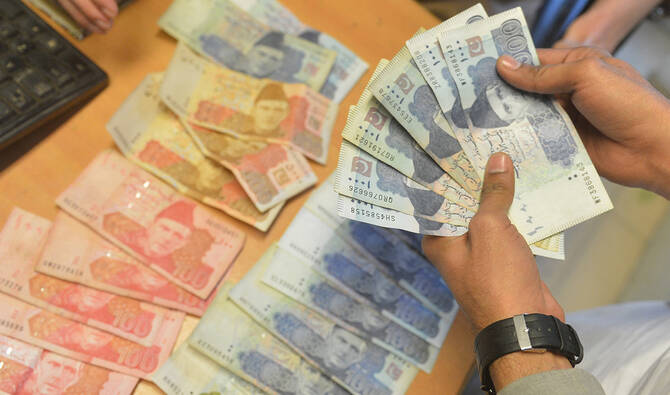
A money changer counts Pakistan's currency at a market in Karachi on January 6, 2023. (AFP/ file)
Short Url
Updated 27 October 2025
Follow

Pakistan central bank holds key policy rate at 11 percent for fourth straight meeting

  • The move comes at a time when the central bank is juggling modest economic growth, external‐sector vulnerabilities and inflation risks
  • The central bank has lowered rates by 1,100 basis points since June 2024, when they peaked at 22 percent after inflation neared 40 percent a year before

ISLAMABAD: The Monetary Policy Committee (MPC) of the State Bank of Pakistan on Monday decided to keep the policy rate unchanged at 11 percent, marking the fourth consecutive meeting in which borrowing costs have been held steady.

The SBP’s decision comes at a time when the central bank is juggling modest economic growth, external‐sector vulnerabilities and inflation risks. After having slashed rates significantly in 2024, it entered a pause campaign earlier this year, choosing stability over further easing given flood-related supply disruptions, rising food inflation and pressures on the current account.

“The Monetary Policy Committee decided to keep the policy rate unchanged at 11 percent in its meeting held on October 27, 2025,” the central bank said on X.

The central bank added that the current account deficit is expected to remain within the 0–1 percent of GDP range in fiscal 2026, with the realization of official inflows projected to raise foreign exchange reserves to $15.5 billion by December 2025 and around $17.8 billion by June 2026.

Last week, all 10 analysts surveyed by Reuters said they expected the State Bank of Pakistan (SBP) to keep the policy rate unchanged, extending its pause as recent floods ravaged farmland and border closures with Afghanistan since Oct. 11 drove up prices of staples like tomatoes and apples.

“The SBP [maintained] status quo amid concerns about rising inflation following flood losses and [to] support rupee,” Ahsan Mehanti of Arif Habib Commodities said, attributing the central bank decision to the “IMF (International Monetary Fund) pressure to keep a tight fiscal and monetary policy.”

The SBP last held rates in September, warning floods could push inflation above its 5–7 percent target. Pakistan’s headline inflation rate accelerated to 5.6 percent on a year-on-year basis, up 2 percent from the previous month.

Monsoon floods swamped farmland and industrial hubs in Pakistan’s breadbasket Punjab province, killing more than 1,000 people nationwide, displacing 2.5 million and damaging crops and factories.

The central bank has lowered rates by 1,100 basis points since June 2024, when they peaked at 22 percent after inflation neared 40 percent the year before. Its last 100-bps cut came in May, followed by holds in June, July, and September amid uncertainty over energy and food prices.


Pakistan PM to attend Gaza peace board meeting as Islamabad backs Palestinian statehood

Updated 5 sec ago
Follow

Pakistan PM to attend Gaza peace board meeting as Islamabad backs Palestinian statehood

  • Islamabad says participation tied to ceasefire, reconstruction and pre-1967 Palestinian state
  • Analysts call move diplomatic balancing act between Muslim bloc coordination and US ties

ISLAMABAD: Pakistan Prime Minister Shehbaz Sharif will attend the inaugural meeting of US President Donald Trump’s Board of Peace on Gaza in Washington today, Thursday, as Islamabad says its participation is aimed at securing a ceasefire, reconstruction, and an independent Palestinian state.

The visit comes at Trump’s invitation and will run from Feb. 18–20, according to the Prime Minister’s Office, with Sharif accompanied by Deputy Prime Minister and Foreign Minister Ishaq Dar and other senior officials.

The Board of Peace, formed under a UN Security Council resolution following a fragile October 2025 ceasefire between Israel and Hamas, is intended to oversee international stabilization and rebuilding efforts in Gaza after months of war.

“Pakistan joined the Board of Peace as part of its almost eight decades long support for the rights and dignity of the Palestinian people. This begins and ends with the establishment of a Palestinian state based on pre 1967 borders and Al Quds Al Sharif as its capital,” Prime Minister’s spokesperson for foreign media Mosharraf Zaidi told Arab News.

Pakistan formally joined the body last month after Sharif signed its charter alongside other world leaders in Davos. The forum includes an eight-nation Muslim bloc comprising Türkiye, Egypt, Jordan, Indonesia, Qatar, Saudi Arabia and the United Arab Emirates.

“The primary motivation for the Board of Peace is President Trump’s sincere commitment to the end of the genocide in Gaza and the consensus of the eight-country Islamic and Arab bloc to support a UN-endorsed Gaza framework focused on a permanent ceasefire, reconstruction, and the Palestinian right to self-determination and statehood,” Zaidi said.

Islamabad hopes involvement in the forum will allow it to shape post-war governance arrangements while protecting Palestinian political rights.

“Pakistan’s participation is explicitly tied to a pathway to Palestinian statehood and international law,” Zaidi said.

He added that participation did not signal recognition of Israel.

“Participating in this historic initiative is not recognition of Israel and does not change Pakistan’s principled position on Palestine.”

He also stressed that multilateral engagement does not equal diplomatic normalization.

“Engagement in multilateral mechanisms that includes Israel does not equal diplomatic relations. Israel is a UN member state, and a member of the World Bank and IMF since 1954–but this does not entail normalization.”

Pakistan’s foreign office says the prime minister will also meet senior US leadership and other heads of government on the sidelines.

“The occasion will provide an opportunity for discussions on bilateral matters, as well as global issues of mutual concern,” the PMO statement said.

A BALANCING ACT

Analysts say Islamabad sees participation as both strategic and low-risk given multiple Muslim countries are involved.

“Since eight major Muslim countries are on board the process, Pakistan sees little to lose,” former diplomat Abdul Basit told Arab News.

However, he warned against any direct military enforcement role.

“We must not be part of any effort toward disarming Hamas ... peacekeeping is okay but not peace enforcement.”

Basit said Pakistan could instead contribute humanitarian assistance.

“If at all we may send our medical corps and engineering corps to help rebuild Gaza.”

Umer Karim, an associate fellow at the King Faisal Center for Research and Islamic Studies in Riyadh, said Pakistan was attempting to coordinate with Muslim partners while preserving relations with Washington.

“I think Pakistan is trying to work collectively alongside the group of Muslim nations to achieve a resolution of the conflict that results eventually in the departure of Israeli forces from Gaza and paves the way for comprehensive reconstruction of the strip,” Karim said.

He described Islamabad’s diplomacy as delicate:

“This scenario remains a difficult balancing act and diplomatic skills as well as the personal rapport of Pakistani leadership with President Trump will be tested again and again.”