

Afghan, Pakistan peace talks enter third day as Trump again offers help

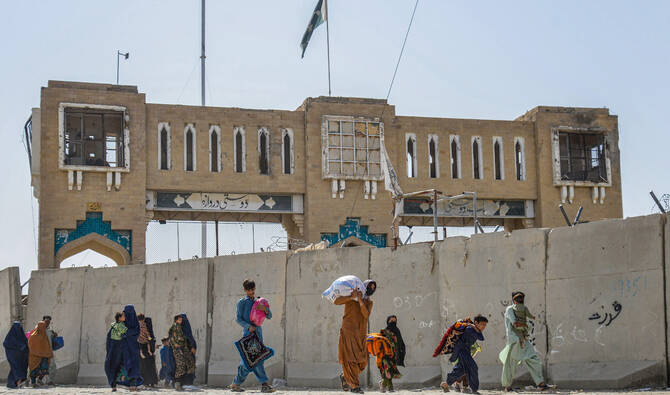
Afghan refugees deported from Pakistan arrive with their belongings at the zero point border crossing between Afghanistan and Pakistan in the Spin Boldak district of Kandahar province on October 19, 2025. (AFP/File)
Short Url
Updated 27 October 2025
Follow

Afghan, Pakistan peace talks enter third day as Trump again offers help

  • Two Pakistan security sources accused the Afghan Taliban of not cooperating with the dialogue process
  • Pakistan Defense minister says failure to reach an agreement in the Istanbul talks would mean “open war”

ISLAMABAD: Afghanistan and Pakistan officials met in Istanbul on Monday for a third day of talks after failing to clinch a lasting peace, three sources familiar with the matter said, as US President Donald Trump repeated an offer to mediate.

The South Asian neighbors agreed to a ceasefire in Doha on October 19 after days of border clashes that killed dozens in the worst such violence since the Taliban seized power in Kabul in 2021.

The current second round of peace talks mediated by Turkiye aims to hammer out a long-term truce, but both sides have offered markedly different interpretations of the talks.

Two Pakistan security sources accused the Afghan Taliban of not cooperating with the dialogue process.

“The Pakistani delegation has made it clear that no compromise is possible on our core demands on cross border terrorism,” one of the sources said.

A Taliban delegate to the talks dismissed as “false” the suggestion that the Islamist group was holding up the talks, adding that the discussions were still in progress.

“Overall the meeting is going well and we discussed multiple issues in a friendly environment,” the person said.

The sources spoke on condition of anonymity as they were not authorized to speak publicly on the issue.

In comments on Monday to state broadcaster RTA, Taliban spokesperson Zabihullah Mujahid said, “The Islamic Emirate of Afghanistan supports dialogue and believes that problems and issues can be resolved through dialogue.”

A spokesperson for Pakistan’s foreign ministry declined to comment on the current status of talks.

On Saturday, Pakistan’s defense minister said he believed Afghanistan wanted peace but that failure to reach an agreement in the Istanbul talks would mean “open war.”

Late on Sunday, Trump repeated an offer to help end the conflict.

“I’ll get that solved very quickly, I know them both,” he said in the Malaysian capital of Kuala Lumpur on the sidelines of a regional summit.

“I have no doubt we are going to get that done quickly.”

The clashes began after Pakistan’s air strike this month on Kabul, the Afghan capital, targeting the head of the Pakistani Taliban, a militant group separate from the Taliban that rules Afghanistan.

The Taliban responded with attacks on Pakistani military posts along the length of the 2,600 km (1,600 miles) border.

Pakistan accuses the Taliban of allowing the Pakistani Taliban to operate with impunity inside Afghanistan, from where it launches attacks on Pakistani security forces. Kabul denies this.

Clashes between Pakistan and the Pakistani Taliban over the weekend killed five Pakistani soldiers and 25 militants near the border with Afghanistan, the military said on Sunday.


Islamic military coalition, Pakistan to deepen cooperation to combat ‘terrorism’ — Pakistani military

Updated 02 February 2026
Follow

Islamic military coalition, Pakistan to deepen cooperation to combat ‘terrorism’ — Pakistani military

  • Islamic Military Counter Terrorism Coalition is a 43-member alliance that includes Pakistan, Saudi Arabia, Egypt, Jordan, UAE and other nations
  • The Pakistani military statement comes after a meeting between IMCTC secretary-general and the chief of Pakistani defense forces in Rawalpindi

ISLAMABAD: Pakistan and the Islamic Military Counter Terrorism Coalition (IMCTC) have reaffirmed their commitment to deepening cooperation, including intelligence sharing and capacity building, to jointly combat “terrorism” and “extremism,” the Pakistani military said on Monday.

The IMCTC is a 43-member military alliance that was formed on Saudi Arabia’s initiative in Dec. 2015 to consolidate Muslim countries’ efforts in countering “terrorism.”

A 17-member IMCTC delegation is visiting Pakistan from Feb. 2-6 to conduct a training at National University of Sciences and Technology on “Re-integration and Rehabilitation of Extremist Elements,” according to the Pakistani military.

On Monday, IMCTC Secretary-General Maj. Gen. Mohammed bin Saeed Al-Moghedi held a meeting with Chief of Pakistani Defense Forces Field Marshal Asim Munir to discuss cooperation among IMCTC member states.

“During the meeting, matters of mutual interest were discussed, with particular emphasis on regional security dynamics and enhanced cooperation in counter-terrorism efforts,” the Inter-Services Public Relations (ISPR), the Pakistani military’s media wing, said in a statement.

“Both sides reaffirmed their shared commitment to combating terrorism and extremism through collaborative strategies, intelligence sharing, and capacity building among member states.”

The IMCTC features Pakistan, Saudi Arabia, Türkiye, Afghanistan, Egypt, Jordan, Qatar, Palestine, UAE, Bangladesh and other nations. In 2017, Pakistan’s former army chief Gen. (retd) Raheel Sharif was appointed as the IMCTC commander-in-chief.

During discussions with Major General Al-Moghedi, Field Marshal Munir appreciated the role of IMCTC in fostering stability and promoting coordinated counterterrorism initiatives across the Islamic world, according to the ISPR.

The IMCTC secretary-general acknowledged Pakistan’s significant contributions and sacrifices in the fight against militancy and lauded the professionalism of Pakistan’s armed forces.

“The meeting underscored the resolve of both sides to further strengthen institutional collaboration for peace, stability, and security in the region,” the ISPR added.

Pakistan enjoys cordial ties with most Muslim countries around the world, particularly Gulf Cooperation Council countries. In Sept. 2025, Pakistan signed a landmark defense pact with Saudi Arabia according to which an act of aggression against one country will be treated as an act of aggression against both.