Ireland’s president elect is a left-wing, anti-establishment figure who is outspoken on Gaza

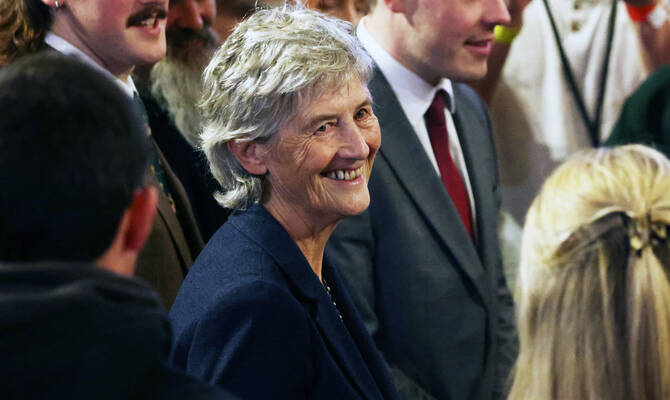
Catherine Connolly smiles to supporters after being elected as the new President of Ireland at Dublin Castle, Ireland, Saturday, Oct. 25, 2025. (AP)
Short Url
Updated 27 October 2025
Follow

Ireland’s president elect is a left-wing, anti-establishment figure who is outspoken on Gaza

  • Connolly vowed Saturday to be “an inclusive president” who would champion diversity and be “a voice for peace”
  • Connolly’s outspoken style and message of social equality and inclusivity have appealed to many, especially younger voters

LONDON: Ireland’s president for the next seven years is an independent lawmaker who has long spoken in support of Palestinians and has been vocal about her distrust of European Union policies.
Left-wing independent Catherine Connolly, 68, secured 63 percent of votes in a landslide election victory on Saturday, comfortably defeating her center-right rival, former Cabinet minister Heather Humphreys.
The politician won after Ireland’s left-leaning opposition parties, including Sinn Féin, united to back her, and she is expected to be a voice unafraid to challenge Ireland’s center-right government.
While Irish presidents hold a largely ceremonial role and do not have executive powers like shaping laws, they represent Ireland on the world stage and are often seen as a unifying voice on major issues. Connolly will succeed Michael D. Higgins, a popular president who has been vocal about the war in Gaza and NATO spending, among other things.
Connolly vowed Saturday to be “an inclusive president” who would champion diversity and be “a voice for peace.”
A look at Connolly’s background and views:
From independent lawmaker to president
Connolly, a mother to two sons, has served three terms as an independent lawmaker for Galway West since she was elected to Parliament in 2016. In 2020 she became the first woman to be the deputy speaker of Parliament’s lower house.
She grew up in social housing in a suburb of Galway in western Ireland as one of 14 children. Her mother died when she was nine years old, and her father worked at a local shipyard. As a student, she volunteered with a Catholic organization to help older people and took on other community roles.
She has degrees in clinical psychology and law, and was a lawyer before she entered politics.
Connolly began her political career when she was elected as a Labour Party member of Galway City Council in 1999. Five years later, she was elected mayor of the city of Galway. She left Labour in 2007.
Outspoken views against Israel and the EU
Connolly has not shied from criticizing Israel over the war in Gaza.
In September she drew fire for calling Hamas “part of the fabric of the Palestinian people.” Prime Minister Micheál Martin criticized her for appearing reluctant to condemn the militant group’s actions in the Oct. 7, 2023, attack on Israel that ignited the two-year Israel-Hamas war in Gaza.
She later maintained that she “utterly condemned” Hamas’ actions, while also criticizing Israel for carrying out what she called a genocide in Gaza.
On Europe, she has repeatedly criticized the European Union for its growing “militarization” following Russia’s full-scale invasion of Ukraine, drawn comparisons with Nazi-era armament in the 1930s, and questioned NATO expansion in the east. Critics have said those comments, along with others critical of the US and UK, risk alienating Ireland’s allies.
Connolly has also stressed she wants to defend Ireland’s tradition of military neutrality, in the face of calls for the country to contribute more to European defense. During her campaign, she said there should be a referendum on a government plan to remove the “triple lock” — the conditions for the deployment of Irish soldiers on international missions.
Connolly’s outspoken style and message of social equality and inclusivity have appealed to many, especially younger voters. In televised presidential debates, she has said she will respect the limits of the office — though she also said in her acceptance speech that she would speak “when it’s necessary” as president.
“Together, we can shape a new republic that values everybody, that values and champions diversity and that takes confidence in our own identity, our Irish language, our English language, and new people who have come to our country,” she said Saturday at Dublin Castle.


US senators visit key Ukrainian port city as they push for fresh sanctions on Russia

Updated 5 sec ago
Follow

US senators visit key Ukrainian port city as they push for fresh sanctions on Russia

  • The visit and the push for Congress to take up sanctions on Russia come at a crucial moment in the conflict

WASHINGTON: A delegation of US senators was returning Wednesday from a trip to Ukraine, hoping to spur action in Congress for a series of sanctions meant to economically cripple Moscow and pressure President Vladimir Putin to make key concessions in peace talks.
It was the first time US senators have visited Odesa, Ukraine’s third-most populous city and an economically crucial Black Sea port that has been particularly targeted by Russia, since the war began nearly four years ago. Democratic Sens. Jeanne Shaheen, Chris Coons, Richard Blumenthal and Sheldon Whitehouse made the trip. Republican Sen. Thom Tillis had planned to join but was unable to for personal reasons.
“One of the things we heard wherever we stopped today was that the people of Ukraine want a peace deal, but they want a peace deal that preserves their sovereignty, that recognizes the importance of the integrity of Ukraine,” Shaheen said on a phone call with reporters.
The visit and the push for Congress to take up sanctions on Russia come at a crucial moment in the conflict. Delegations for the two sides were also meeting in Switzerland for two days of US-brokered talks, but neither side appeared ready to budge on key issues like territory and future security guarantees. The sanctions, senators hoped, could prod Putin toward settling for peace, as the US has set a June deadline for settlement.
“Literally nobody believes that Russia is acting in good faith in the negotiations with our government and with the Ukrainians,” Whitehouse said. “And so pressure becomes the key.”
Still, legislation to impose tough sanctions on Russia has been on hold in Congress for months.
Senators have put forward a range of sanction measures, including one sweeping bill that would allows the Trump administration to impose tariffs and secondary sanctions on countries that purchase Russia’s oil, gas, uranium and other exports, which are crucial to financing Russia’s military. The Senate Foreign Relations Committee has also advanced a series of more-targeted bills that would sanction China’s efforts to support Russia’s military, commandeer frozen Russian assets and go after what’s known as Moscow’s “shadow fleet” of oil tankers being used to circumvent sanctions already in place.
Republican Sen. Lindsey Graham, who has co-sponsored the Senate’s sweeping sanctions and tariff legislation, also released a statement during the Munich Security Conference this weekend saying that Senate Majority Leader John Thune had committed to bringing up the sanctions bill once it clearly has the 60 votes needed to move through the Senate.
“This legislation will be a game changer,” Graham said. “President Trump has embraced it. It is time to vote.”
Blumenthal, who co-sponsored that bill alongside Graham, also said there is bipartisan support for the legislation, which he called a “very tough sledgehammer of sanctions and tariffs,” but he also noted that “we need to work out some of the remaining details.” Democrats, and a handful of Republicans, have been opposed to President Donald Trump’s campaign to impose tariffs around the world in an effort to strike trade deals and spur more manufacturing in the US
In the House, Democrats are opposed to the tariff provisions of that bill. Instead, a bipartisan group of lawmakers, led by Republican Rep. Brian Fitzpatrick, has proposed separate legislation that makes it more difficult for Trump to waive sanctions, but does away with the tariff provisions.
A separate bill, led by the top Democrat on the House Foreign Affairs Committee, Rep. Gregory Meeks, would bolster US military support for Ukraine by $8 billion. Democrats currently need one more Republican to support an effort to force a vote on that bill.
Once they return to the US, the senators said they would detail how US businesses based in Ukraine have been attacked by Russia. The Democrats are also hoping to build pressure on Trump to send more US weapons to Ukraine. “Putin understands weapons, not words,” Blumenthal said.
Still, the lawmakers will soon return to a Washington where the Trump administration is ambivalent about its long-term commitments to securing peace in Ukraine, as well as Europe. For now, at least, they were buoyed by the conversations from their European counterparts and Republican colleagues.
“We and the Republican senators who were with us in Munich spoke with one voice about our determination to continue to support Ukraine,” Coons said.