

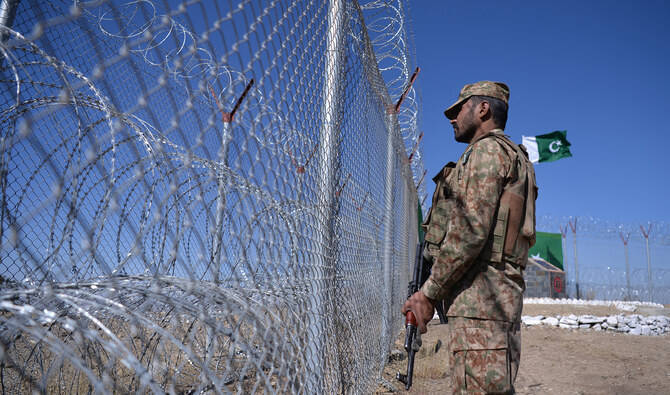

ISLAMABAD: Five Pakistani soldiers and 25 Tehreek-e-Taliban Pakistan (TTP) militants were killed in two separate engagements near the country’s border with Afghanistan, the Pakistani military said on Sunday, amid talks between Islamabad and Kabul in Turkiye to firm up a truce between the neighbors.
The talks in Istanbul, which began on Saturday, mark the latest attempt by Pakistan and Afghanistan to prevent a relapse into violence after deadly border skirmishes between the neighbors this month killed dozens of people on both sides.
Despite the ongoing talks, Pakistan’s military said it engaged two large groups of TTP militants who were trying to infiltrate into Pakistan from Afghanistan in the northwestern Kurram and North Waziristan districts.
The deceased militants included four suicide bombers, security forces seized a sizeable cache of weapons, ammunition and explosives during the raids, according to the Inter-Services Public Relations (ISPR), the military’s media wing.
“It is significant to point out that these infiltration attempts by Fitna al Khwarij (TTP militants) are being carried out at a time when delegations of Pakistan and Afghanistan are engaged in talks in Türkiye, casting doubts on intentions of interim Afghan government with regards to addressing the issue of terrorism emanating from its soil,” the ISPR said.
“Pakistan has consistently been asking interim Afghan government to ensure effective border management on their side of the border and is expected to fulfil its obligations of Doha agreement and deny the use of Afghan soil by Khwarij against Pakistan.”
There was no immediate comment from the Afghan side on the Pakistani military’s statement.
Pakistan has long accused Afghanistan of harboring militant groups such as the TTP and the separatist Baloch Liberation Army (BLA), which carry out attacks against its security forces and civilians. Kabul denies the allegations, but the issue has remained a major sticking point between the two countries.
Border clashes erupted between the neighbors on Oct. 11 after Pakistan conducted airstrikes on Kabul following the killing of a dozen Pakistani soldiers in the Khyber Pakhtunkhwa province that borders Afghanistan.
The skirmishes and strikes continued intermittently before the two sides reached a ceasefire in Doha on Oct. 19.
“The second round of talks between Pakistan and the Afghan Taliban has not yet concluded, with deliberations on Pakistan’s proposal still underway in Istanbul,” state-run Pakistan TV reported on Sunday, citing intelligence sources.
The broadcaster said talks between the two sides lasted nine hours on Saturday, focusing on a three-point agenda: establishing a joint monitoring and oversight mechanism to curb cross-border militant movement; ensuring respect for national sovereignty under existing laws and international obligations; and addressing trade matters, refugee repatriation, and the separation of bilateral issues from internal political pressures.
While the Afghan delegation is being led by its deputy interior minister, Hajji Najib, Islamabad has not said who it has sent to the talks.
The TTP, which is a separate group but seen as an ally of the Afghan Taliban, has stepped up its attacks against Pakistan since the Taliban’s takeover of Kabul in 2021.
Pakistan has carried out several military operations in KP for over a decade to drive out TTP militants, who officials say have managed to regroup during a fragile, months-long truce with the banned outfit in 2022.


