

Ouattara set for fourth term after Ivory Coast presidential vote

1 / 2
President Alassane Ouattara casts his vote at a polling station during the presidential elections in Abidjan, Ivory Coast, on Oct. 25, 2025. (AP)
2 / 2
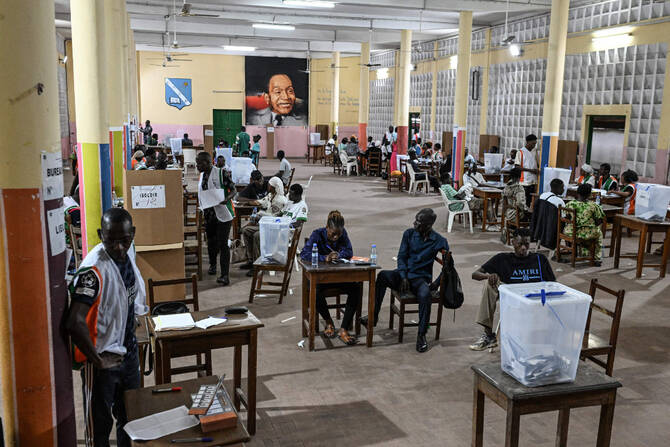
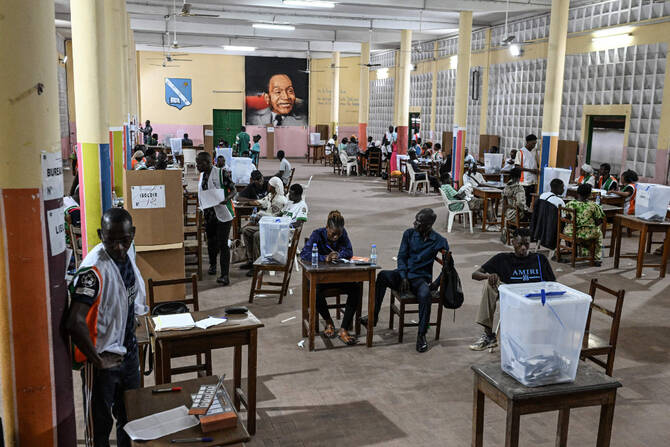
Electoral workers count votes during the presidential election, at a polling station in a school in Abidjan, Ivory Coast, on October 25, 2025. (REUTERS)
Short Url
Updated 26 October 2025
Follow

Ouattara set for fourth term after Ivory Coast presidential vote

  • Senior opposition figure has dismissed the vote as “electoral robbery”
  • Ouattara, 83, has wielded power in the world’s top cocoa producer since 2011

ABIDJAN: Voting ended Saturday in Ivory Coast for a new president, with incumbent Alassane Ouattara expected to win a fourth term against a divided opposition further hobbled by the barring of two leading candidates.
One senior opposition figure has already dismissed the vote as “electoral robbery” and turnout was low in parts of the country’s south and west, where the opposition is popular.
“I didn’t vote,” said 26-year-old student Olivier in the working-class Blockhaus district of Abidjan. “My candidate was barred.”
On Saturday, a 13-year-old boy was killed by a shot fired from a public transport vehicle in the center-west town of Gregbeu, security sources told AFP. It was the fifth death this month during the election period.

Voting equipment stolen

Ouattara, 83, has wielded power in the world’s top cocoa producer since 2011, when the country began reasserting itself as a west African economic powerhouse.
Nearly nine million Ivorians were eligible to vote in the polls, which closed at 6:00 p.m. (1800 GMT), choosing between five contenders.
Turnout was expected to be a key factor. Polling stations in the economic capital Abidjan visited by AFP in the afternoon were not crowded but there were many more voters in the second city Bouake, a Ouattara stronghold.
“It’s the first time that I’m voting and I’m happy to be able to express my choice,” said Ben Kone, a young voter in Bouake, where AFP reporters saw long queues to vote.


A general view of the Notre-Dame College polling station, where a painting of Ivory Coast's first President Felix Houphouet-Boigny is seen on a wall, in Plateau, the business district of Abidjan, on October 25, 2025. (AFP)

Roads were cut off in some parts of the country’s south and west and vote observers reported the theft of election materials there.
That was particularly the case in Mama, the birthplace of former president Laurent Gbagbo, one of those barred from running for the presidency, said observers.
In Lopou, a town of some 9,000 people west of Abidjan, the mood was tense after police fired tear gas to quell protests against Ouattara before election day.
“There will be no voting here in Lopou,” an elderly man said.
“Ouattara’s candidacy is unconstitutional,” added a youth.
Many voting centers in pro-opposition areas were nearly empty, AFP reporters said.

Banned rallies 

Ouattara’s leading rivals — Gbagbo and Credit Suisse ex-CEO Tidjane Thiam — were both barred from standing, Gbagbo for a criminal conviction and Thiam for acquiring French nationality.
With the opposition calling for protests and unrest turning deadly in recent days, the government slapped a night-time curfew in some areas and deployed 44,000 security forces.
A policeman was among those who died in political unrest in recent weeks. On Monday, an independent electoral commission building was torched.
The government has responded by banning demonstrations, and the courts have sentenced several dozen people to three-year jail terms for disturbing the peace.
Security forces were deployed across the country of 30 million, especially in former opposition strongholds in the south and west.
Authorities say they want to avoid a repeat of unrest surrounding the 2020 presidential election, in which 85 people died.

‘Electoral robbery’ 

After being re-elected in 2015 with 83 percent of the vote, Ouattara had promised not to run again given a two-term presidential limit.
But when his chosen successor, Amadou Gon Coulibaly, died suddenly, Ouattara changed his mind, buoyed by a revision of the constitution that he argued reset his number of terms to zero.
On Wednesday, former president Gbagbo condemned the poll as a “civilian coup d’etat” and “electoral robbery.”
“Those who could have won have been eliminated. I do not accept this,” he said.
None of the four rival candidates represents an established party, nor do they have the reach of Ouattara’s RHDP.
Ouattara came to power following the 2010-2011 presidential clash between him and Gbagbo, which cost more than 3,000 lives among their supporters.
Ouattara’s government touts several years of strong economic growth and general security, despite jihadist threats on Ivory Coast’s borders.
Critics say this growth has only benefitted a small portion of the population and has been accompanied by a spiralling cost of living.


Pakistan says it struck militant hideouts along Afghan border after surge in deadly attacks

Updated 43 min 55 sec ago
Follow

Pakistan says it struck militant hideouts along Afghan border after surge in deadly attacks

  • Pakistan has seen a surge in militant violence in recent years, much of it blamed on the TTP and outlawed Baloch separatist groups

ISLAMABAD: Pakistan said early Sunday it carried out strikes along the border with Afghanistan, targeting hideouts of Pakistani militants it blames for recent attacks inside the country.
Islamabad did not say in precisely which areas the strikes were carried out or provide other details. There was no immediate comment from Kabul, and reports on social media suggested the strikes were carried out inside Afghanistan.
In comments before dawn Sunday, Information Minister Attaullah Tarar wrote on X that the military conducted what he described as “intelligence-based, selective operations” against seven camps belonging to the Pakistani Taliban, also known as Tehrik-e-Taliban Pakistan, or TTP, and its affiliates. He said an affiliate of the Daesh group was also targeted in the border region.
In October, Pakistan also conducted strikes deep inside Afghanistan to target militant hideouts.
Tarar said Pakistan “has always strived to maintain peace and stability in the region,” but added that the safety and security of Pakistani citizens remained a top priority.
The latest development came days after a suicide bomber, backed by gunmen, rammed an explosives-laden vehicle into the wall of a security post in Bajaur district in northwestern Khyber Pakhtunkhwa province bordering Afghanistan. The blast caused part of the compound to collapse, killing 11 soldiers and a child, and authorities later said the attacker was an Afghan national.
Hours before the latest border strikes, another suicide bomber targeted a security convoy in the nearby Bannu district in the northwest, killing two soldiers, including a lieutenant colonel. After Saturday’s violence, Pakistan’s military had warned that it would not “exercise any restraint” and that operations against those responsible would continue “irrespective of their location,” language that suggested rising tensions between Islamabad and Kabul.
Tarar said Pakistan had “conclusive evidence” that the recent attacks , including a suicide bombing that targeted a Shiite mosque in Islamabad and killed 31 worshippers earlier this month, were carried out by militants acting on the “behest of their Afghanistan-based leadership and handlers.”
He said Pakistan had repeatedly urged Afghanistan’s Taliban rulers to take verifiable steps to prevent militant groups from using Afghan territory to launch attacks in Pakistan, but alleged that no substantive action had been taken.
He said Pakistan urges the international community to press Afghanistan’s Taliban authorities to uphold their commitments under the Doha agreement not to allow their soil to be used against other countries.
Pakistan has seen a surge in militant violence in recent years, much of it blamed on the TTP and outlawed Baloch separatist groups. The TTP is separate from but closely allied with Afghanistan’s Taliban, who returned to power in 2021. Islamabad accuses the TTP of operating from inside Afghanistan, a charge both the group and Kabul deny.
Relations between the neighboring countries have remained tense since October, when deadly border clashes killed dozens of soldiers, civilians and suspected militants. The violence followed explosions in Kabul that Afghan officials blamed on Pakistan.
A Qatar-mediated ceasefire has largely held, but talks in Istanbul failed to produce a formal agreement, and relations remain strained.