

Pakistan defense minister warns of ‘open war’ with Afghanistan if peace talks fail

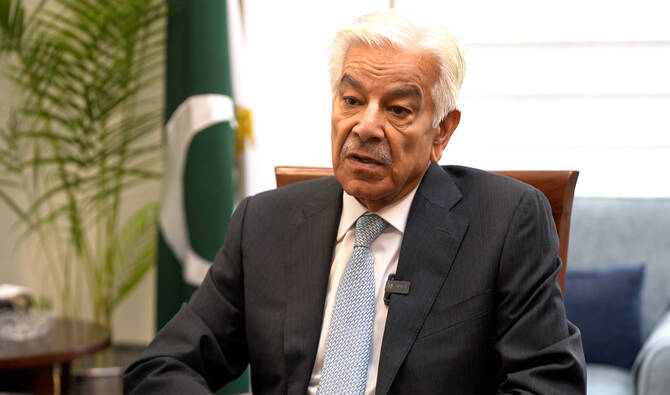
Pakistan’s Defense Minister Khawaja Asif speaks with Arab News Pakistan in Islamabad, Pakistan, on June 17, 2025. (AN/File)
Short Url
Updated 25 October 2025
Follow

Pakistan defense minister warns of ‘open war’ with Afghanistan if peace talks fail

  • Khawaja Asif says ceasefire holding as Pakistan, Afghanistan hold talks in Istanbul to avert renewed clashes
  • Islamabad accuses Kabul of harboring militants behind cross-border attacks, an allegation the Taliban reject

KARACHI: Pakistan’s defense minister said on Saturday he believes Afghanistan wants peace but that failure to reach an agreement during talks in Istanbul would mean “open war,” days after both sides agreed to a ceasefire following deadly border clashes.

The talks in Istanbul, which began on Saturday and are expected to continue into Sunday, mark the latest attempt by Pakistan and Afghanistan to prevent a relapse into violence after the worst border fighting since the Taliban’s 2021 takeover of Kabul.

The talks are meant to devise a mechanism to enforce the Doha ceasefire longer term.

Khawaja Muhammad Asif said there had been no incidents in the four to five days since it was agreed, and both sides were complying with the truce.

“We have the option, if no agreement takes place, we have an open war with them,” he said in televised remarks from Pakistan. “But I saw that they want peace.”

The clashes erupted earlier this month after Islamabad demanded that the Taliban curb militants it says are attacking Pakistan from sanctuaries inside Afghanistan.

Pakistan launched airstrikes across the border and both sides exchanged heavy fire, killing dozens and prompting the closure of key crossings that remain shut.

Islamabad accuses Kabul of sheltering militants who target Pakistani forces.

The Taliban reject the charge and says Pakistan’s military operations violate Afghan sovereignty.


Pakistan air chief highlights modernization as PAF marks seven years since India aerial clash

Updated 27 February 2026
Follow

Pakistan air chief highlights modernization as PAF marks seven years since India aerial clash

  • Swift Retort was launched in 2019 after India attempted airstrikes following a Kashmir suicide bombing
  • Air chief’s remarks come amid fierce clashes between Pakistan and Afghanistan over cross-border militancy

ISLAMABAD: Pakistan’s air chief said on Friday the country’s air force had undertaken “comprehensive modernization and indigenization” in recent years, as he addressed a ceremony at Air Headquarters to mark seven years since an aerial confrontation with India.

Operation Swift Retort was launched on Feb. 27, 2019, a day after India attempted airstrikes inside Pakistan following a suicide bombing in Indian-administered Kashmir that killed at least 40 Indian paramilitary troops.

Pakistan responded with aerial strikes across the Line of Control and shot down an Indian fighter jet in a subsequent dogfight, capturing one pilot who was later returned in what Islamabad called a gesture of de-escalation.

“PAF has pursued comprehensive modernization and indigenization to transition into a Next Generation Air Force,” Air Chief Marshal Zaheer Ahmed Baber Sidhu said, according to a statement circulated by the military’s media wing, the Inter-Services Public Relations.

He added that the force had recalibrated its operational doctrine and rapidly inducted advanced combat and support capabilities, including indigenously developed unmanned systems, electronic warfare, space and cyber assets, establishing what he described as a “home-grown multi-domain kill chain.”

Sidhu said Pakistan remained committed to peace but would respond decisively to violations of its sovereignty.

“Pakistan is a responsible country which desires peace with honor,” he continued.

The remarks come amid renewed security tensions on Pakistan’s western frontier.

Islamabad earlier this week launched airstrikes inside Afghanistan targeting what it described as hideouts of Tehreek-e-Taliban Pakistan (TTP) and Daesh militants. Afghan authorities condemned the strikes and subsequently launched their own military response that led to fierce clashes between the two sides overnight.

Pakistan has frequently accused Kabul of allowing militant groups to use Afghan territory to carry out cross-border attacks on Pakistani civilians and security forces, an allegation denied by Afghan officials.

Pakistani authorities said earlier in the day small drones launched from the Afghan side were intercepted and brought down by the country’s air defense systems.

Sidhu said the PAF would continue to maintain a vigilant yet responsible defense posture to safeguard national sovereignty.