

Top US diplomat vows return of all hostage bodies to Israel, says multiple countries want to join Gaza stabilization force

1 / 2
The Israeli campaign group, the Hostages and Missing Families Forum, welcomed US Secretary of State Marco Rubio’s remarks. (AFP)
2 / 2
US Secretary of State Marco Rubio departs for Doha from Ben Gurion airport in Tel Aviv, Israel, on October 25, 2025. (Pool via REUTERS)
Short Url
Updated 26 October 2025
Follow

Top US diplomat vows return of all hostage bodies to Israel, says multiple countries want to join Gaza stabilization force

  • US could call for a UN resolution supporting the force so more nations can take part, says State Secretary Rubio
  • Adds that mediators of Gaza ceasefire shared information to uncover a recent threat

JERUSALEM/WASHINGTON: US Secretary of State Marco Rubio vowed Saturday to secure the return of all deceased hostages still held in Gaza, as he met with the families of two captives during his visit to Israel.

He also said that the US could call for a United Nations resolution supporting an international stabilization force that aims to deploy to Gaza so that more nations can take part.

“We will not forget the lives of the hostages who died in the captivity of Hamas,” Rubio said on X.

“Today I met with the families of American citizens Itay Chen and Omer Neutra. We will not rest until their – and all – remains are returned,” he said, hours before wrapping up his three-day visit to Israel.

Gaza stabilization force

On the planned international stabilization force to be deployed to Gaza, Rubio said multiple countries are interested in joining but that they need more details about the mission and rules of engagement.

Many of the countries who want to be a part of the force “can’t do it without” an international mandate, he told reporters en route from Israel to Qatar, where he met up with President Donald Trump for a multistop tour in Asia.


He added that the US has been talking with Qatar, Egypt and Turkiye — all mediators of the Gaza ceasefire, along with the US —  and noting interest from Indonesia and Azerbaijan.

Rubio also said that Israel and the ceasefire mediators are sharing information to disrupt any threats and that allowed them to identify a possible impending attack last weekend.

The State Department said a week ago that it had “credible reports” Hamas could violate the ceasefire with an attack on Palestinian civilians in Gaza.

“We put out a message through State Department, sent it to our mediators as well, about an impending attack, and it didn’t happen,” he said. “So that’s the goal here, is ultimately to identify a threat before it happens.”

He said that next week the chairman of the Joint Chiefs of Staff, Gen. Dan Caine, is expected to be the latest in a parade of US officials to travel to Israel.

Vice President JD Vance joined special envoy Steve Witkoff and Trump adviser and son-in-law Jared Kushner earlier in the week in Israel in an effort to shore up the fragile ceasefire deal. Rubio arrived just as Vance was departing, meeting with Israel Prime Minister Benjamin Netanyahu and touring a US-led coordination center monitoring the ceasefire.

Return of dead hostages

The Israeli campaign group, the Hostages and Missing Families Forum, welcomed Rubio’s pledge to secure the return of all deceased hostages still held in Gaza.

“Thirteen hostages need to come home. Thirteen families need closure,” the group said on X, thanking the US secretary of state.

“Please don’t stop – until the last hostage is released,” it added.
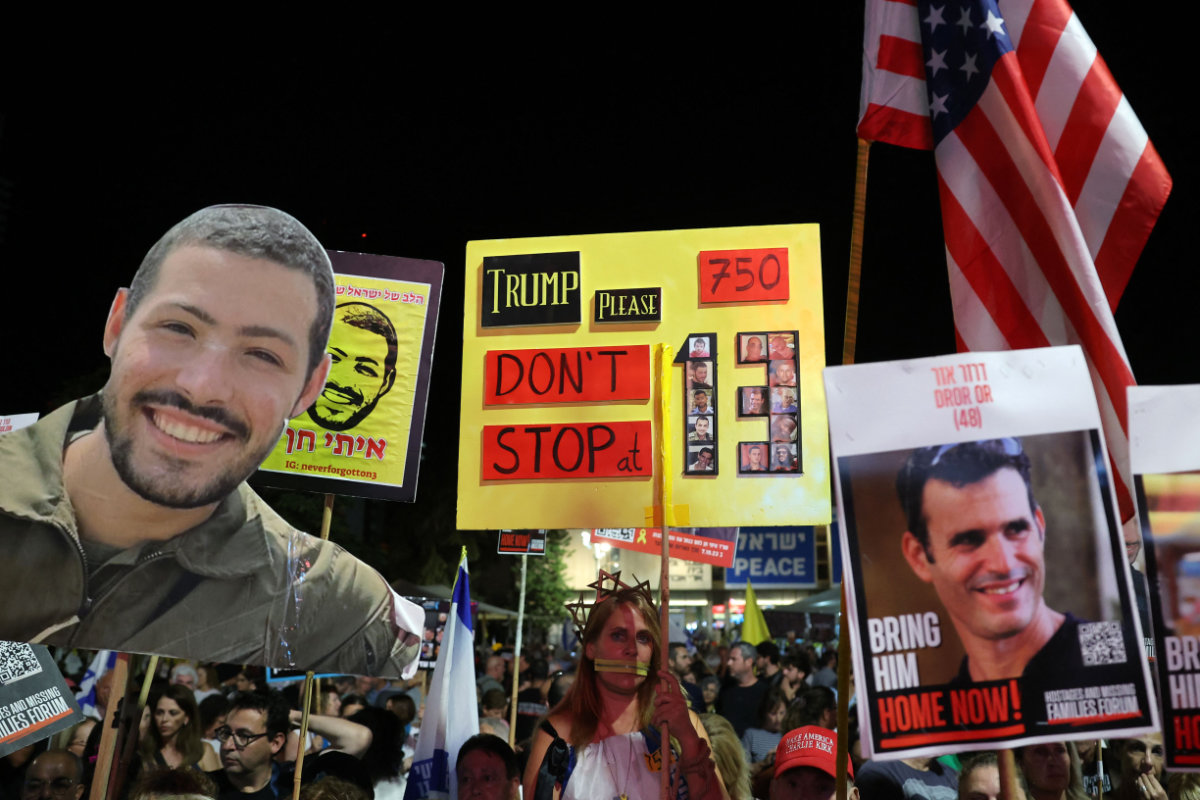


Israelis rally at Hostage Square in the Israeli coastal city ofTel Aviv on October 25, 2025, calling for the release of all the bodies of hostages held in Gaza by the Palestinian militant group Hamas. (AFP)

Chen, a dual Israel-US national and a sergeant in the Israeli army, was working at the border with the Gaza Strip when Hamas and its allies attacked on October 7, 2023.

The military announced his death five months later in March 2024.

It said Chen, 19 at the time of the attack, died in combat and his body was taken to Gaza.

Neutra, 21 at the time of the attack and also a US-Israeli national, was a volunteer soldier killed on October 7.
Raised in New York, Neutra came to Israel to experience the country of his parents, his mother Orna Neutra said in November 2023. He later enlisted for military service as most young Israelis do.
Under the US-brokered ceasefire between Israel and Hamas, which came into effect on October 10, all 20 living hostages have been freed by Palestinian militants.
Remains of 15 deceased hostages have also been returned to Israel, while the bodies of 13 others remain in Gaza.
In exchange, Israel has released nearly 2,000 prisoners, mostly Palestinians, along with dozens of Palestinian bodies, as part of the deal.
The ceasefire has largely halted hostilities but on Sunday Israel carried out a wave of air strikes that left dozens of Gazans dead, according to the territory’s health ministry.
Israel said its troops came under attack, resulting in the death of two soldiers, after which it launched the strikes. Later, Israel reinforced the ceasefire.

With AFP & AP)


How Lebanon’s ancient olive trees became casualties of Israel-Hezbollah war

Updated 9 sec ago
Follow

How Lebanon’s ancient olive trees became casualties of Israel-Hezbollah war

  • Southern Lebanon’s olive groves, a lifeline for tens of thousands of families, suffered extensive damage during the war
  • The government has begun distributing free olive seedlings to help farmers rebuild their agricultural livelihoods

BEIRUT: Farmers in southern Lebanon have long held a fierce pride in their ancient olive groves. Many boast that their trees, which stretch along the border with Israel, contain specimens “dating back to the time of the pharaohs.”

However, since the most recent war between Israel and Hezbollah, which ran from October 2023 to November 2024, these trees — the stoic, living witnesses of history — have become casualties of the destruction.

The bombardment was not confined to military positions. It struck at the heart of agricultural life in the south, destroying a heritage that provides the economic lifeline for tens of thousands of families.

Olives from the south account for 38 percent of the total olives grown in Lebanon, making their fate critical to the nation’s food security and identity.

The extent of the damage is starkly clear in the official assessments. Agricultural engineer Hussein Al-Saqa, the head of the Agriculture Department in the Nabatieh Governorate at the Ministry of Agriculture, confirmed the deep wounds inflicted on the region’s primary crop.

“There has been structural damage to olive crops, in terms of the destruction that targeted olive groves through burning, bulldozing and uprooting, estimated at around 40 percent in border villages and reaching 3 percent in villages north of the Litani River,” he said.

The immediate economic impact is even more severe. “There is also damage to olive oil production, with losses in the south reaching 90 percent,” Al-Saqa added.

According to a report by the Ministry of Agriculture, the region lost around 47,000 trees as a result of flares, phosphorus bombs, and shelling.

The destruction of these trees, some of which “date back to the time of the Phoenicians,” around 1500 B.C. to 300 B.C., as one farmer lamented, has been nothing short of a disaster for agricultural production.

The war has reduced 24 border villages rich in olive trees to scorched earth.

Following the Oct. 7, 2023, Hamas-led attacks on southern Israel that triggered the Gaza war, Hezbollah initiated limited operations against Israel’s north in solidarity with the Palestinian militant groups responsible for the assault.

Israel retaliated against Hezbollah’s attacks with escalating strikes, which included the use of incendiary weapons like white phosphorus. Besides the significant degradation of Hezbollah, the primary consequence of the grinding conflict, which ended with a fragile ceasefire in November 2024, was the mass displacement of farming communities and the devastation of civilian infrastructure across southern Lebanon.

Neither party has yet fulfilled its obligations under the US- and French-brokered ceasefire deal, with Hezbollah failing to disarm and fully withdraw its fighters north of the Litani River and Israeli troops continuing to occupy five strategic hilltops on Lebanese territory.

The devastation wrought by the conflict is deeply personal for farmers like Mahmoud Sarhan, 65, from the border town of Kafr Kila. For him, the loss of the trees is an attack on his very existence.

“I have 10 dunams of land planted with olive trees, and the Israelis uprooted half of them,” said Sarhan. He recounted returning to his field after the war to prune the trees and cultivate the land, only to inhale white phosphorus residue, causing severe lung damage.

Sarhan now relies on oxygen tanks to breathe and is unable to walk. He moved his family to the town of Tuleh, north of the Litani River, but his commitment to his trees remains absolute. “I used to pamper them like my own children,” he said.

The physical destruction is compounded by a bureaucratic siege that has made accessing and salvaging the remaining harvest almost impossible.

Farmer Tariq Mazraani from the town of Hula, a shareholder in the local agricultural cooperative, said farmers had lost “a third season this year.”

While farmers managed a desperate harvest in October 2023 despite the initial attacks, it became impossible to reach the groves the following year due to the intense bombing and mass displacement.

This year, the process required to safely access the fields is layered and restrictive.

Farmers must submit a request to the Lebanese Army Command, specifying their tasks and destination. This request is then forwarded to the UN Interim Force in Lebanon, which in turn sends it to the Israeli side for approval.

The core difficulty, according to Mazraani, “lies in the permits.

“They limit us to two hours to do what we need to do, but it takes a whole day or more. The process involves picking the olives and removing the sheets placed under the trees.”

Mazraani detailed the impossibility of the time constraint, particularly given the state of the infrastructure and labor shortage.

“Most of the olive trees are located in rugged areas that take time to reach, and we have to pack the olives and transport them to the trucks.

“This cannot be done in two hours, especially since the workers we used to employ were Syrians, and most of them have left the area, and transport vehicles cannot reach the area due to the destruction of the roads.”

Even the act of seeking permission carries risk for farmers like Sarhan, who, despite his injuries, does not want his only son going to town for fear of Israeli attacks.

Sarhan said those submitting requests “must provide detailed information and personal details, all of which reach the Israelis, and I do not want that. I am a farmer and have nothing in this world but God’s mercy.”

The economic impact reverberates across Lebanon. Olive cultivation is the source of livelihood for more than 100,000 southern families and provides seasonal employment for thousands of workers.

The difficulties encountered in harvesting olives, coupled with the destruction of olive presses in the border area and a steep drop in supply, have pushed up the price of olive oil. The price of 20 liters of olive oil now ranges between $180 and $200, compared to just $100 in 2023.

Lebanon typically produces about 20,000 tonnes of olive oil annually, and the commodity is considered an essential ingredient in Lebanese cuisine.

Furthermore, the trees that survived the immediate shelling now face a slow decline from neglect. Engineer Al-Saqa described a scene “reminiscent of Hiroshima,” noting that “the situation in the front-line villages is much worse than we thought.

“There is destruction and devastation, and the trees that survived the war are neglected, infested with insects and disease, affected by humidity, and surrounded by weeds, which weakens the trees and sets them back years,” he said.

The consequence is a grim outlook for future production, even for the surviving groves. Al-Saqa warned that “although the trees remain alive, they will not produce olives in the near future.”

The violence also claimed the lives of those dedicated to their craft. Mazraani noted that “many skilled farmers and craftsmen were killed during the war because they refused to evacuate their homes and leave their farms.”

And the losses are not limited to olives. Vast forest areas, estimated at 18 million square meters in the south, have been destroyed, affecting oak and other perennial trees.

Yet, farmers remain defiantly attached to their land. Abu Ali, from the village of Blida near the Israeli border, said he was unable to harvest this year due to the damage to his field. He will nevertheless persevere.

“Poor farmers are attached to their land and insist on living in their semi-destroyed homes despite the daily fear of death,” he said. “They cultivate their land and harvest their crops despite all the risks.”

The olive trees, which have stood the test of time, are among the few things that can withstand the conditions of war, and farmers are gradually returning.

In an attempt to mitigate the losses, the Ministry of Agriculture has announced the allocation of 50,000 free olive seedlings in the frontline areas.

Minister of Agriculture Nizar Hani, accompanied by UN coordinator Imran Riza, visited the border area to assess the damage firsthand.

Hani affirmed that “the state is steadfast in its support for the south, given its fundamental role in national agricultural production.”

He pledged that the ministry “will adopt a gradual and comprehensive approach in supporting farmers affected by Israeli attacks, leading to the rehabilitation of fields and orchards and the restoration of the entire production cycle, in close cooperation with the UN.

“Farmers in the south are the first line of defense for Lebanon’s food security. It is our duty to stand by them.”