


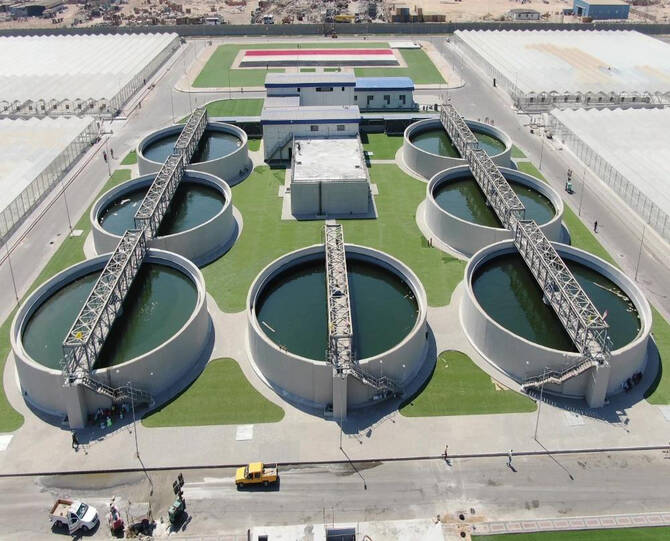


The Kuwait Fund for Development’s receipt of the Abdullatif Yousef Al-Hamad Development Award for the Best Economic and Social Development Project in the Arab World for 2024, in recognition of its financing of the “Bahr Al-Baqar” project in Egypt, underscores the exceptional development efforts made by the fund since its establishment over six decades ago. This prestigious honor, received at a dedicated ceremony, confirms the fund’s long-standing commitment to advancing development in the region.
The Bahr Al-Baqar project, inaugurated on Sept. 27, 2021, was comprehensive in its technical planning and practical application, meeting the award’s criteria and making it deserving of this win.
This project is considered one of the most significant projects financed by the Kuwait Fund in Egypt, with a cost of approximately $416 million. It includes three main components: the construction of barrages to divert 5 million cubic meters of water per day from the Bahr Al-Baqar drain, the construction of a treatment plant with a capacity of about 5 million cubic meters of water per day east of the Suez Canal, and the reclamation of agricultural land, the establishment of agricultural reserves, and factories for agricultural processing, along with activities for livestock development.
Waleed Shamlan Al-Bahar, acting director general of the Kuwait Fund for Development, said the project is currently operating at high efficiency, producing around 5 million cubic meters of treated water per day, which is discharged into the Sheikh Jaber Canal for agricultural use.
Focus on economic, social, and environmental aspects
The fund is committed to financing projects with significant economic, social, and environmental impacts on the countries it operates in. Economically, this project supports the cultivation of thousands of acres using treated water, establishing agricultural reserves, factories for agricultural processing, and activities for livestock development, thereby achieving economic stability, increasing exports, and reducing imports for the country.
Socially, the project improves the living and economic conditions of residents in the project area by contributing to developmental projects and creating new job opportunities, both during and after the project’s completion.
Environmentally, the project addresses the degradation in the northern delta region, including Lake Manzala, one of Egypt’s largest natural lakes, which had suffered from continuous pollution, reducing its area by 75 percent.
Achievement of sustainable development goals
The project aligns with several sustainable development goals, including Goal 2: Zero Hunger, Goal 6: Clean Water and Sanitation, Goal 8: Decent Work and Economic Growth, Goal 9: Industry, Innovation, and Infrastructure, and Goal 11: Sustainable Cities and Communities, among others.
Cooperation between the fund and Egypt
The relationship between the Kuwait Fund and Egypt is deep and longstanding. This project continues the fund’s development efforts in Egypt, which began in 1964 with the financing of the Suez Canal Development Project. To date, the fund has provided 54 loans to Egypt, covering sectors such as agriculture, transport, energy, industry, water and sanitation, social development, and development banks.
The role of Arab Coordination Group
The Bahr Al-Baqar project highlights the collective role of the Arab Coordination Group in advancing large-scale development initiatives that address global development priorities. Within this framework, the Kuwait Fund for Development played a key role in financing the project, reflecting the group’s shared commitment to achieving tangible progress in sustainable development worldwide.
Recognition and appreciation
The Abdullatif Yousef Al-Hamad Development Award highlights and encourages successful development projects that have addressed existing problems, enhancing economic and social capacities in the Arab world. The award honors entities that finance outstanding development projects, appreciating their efforts and commitment to achieving development in the region.
Named after Abdullatif Yousef Al-Hamad in recognition of his achievements in development work in the Arab world, the award acknowledges his leadership of the Kuwait Fund for Development (1963-1982), the Ministry of Finance and Planning (1981-1983), and the Arab Fund for Economic and Social Development (1985-2020). His more than 50-year career focused on supporting development activities and directly supervising hundreds of projects that created thousands of jobs and improved the lives of millions in the Arab world. As a result of his significant contributions, Al-Hamad was honored by many Arab leaders and awarded honorary doctorates by various educational, regional, and international institutions.


