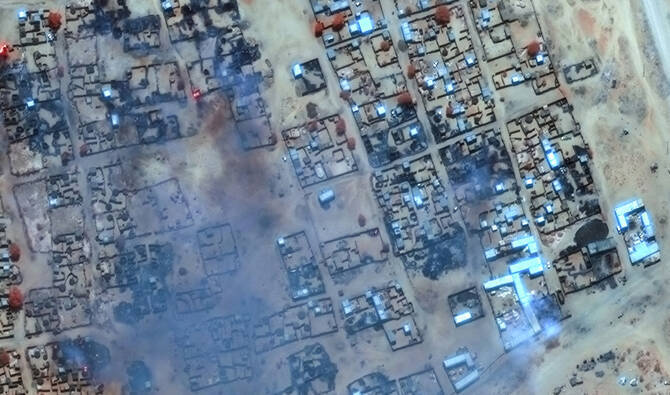
UN agencies warn of escalating catastrophe in Sudan as millions face hunger and displacement

With Sudan midway through the third year of a civil war, four major UN agencies issued an urgent appeal on Friday for a scaled-up humanitarian response in the country, where millions of people continue to face hunger, displacement and the collapse of essential services. (AFP/File)
Short Url
Updated 24 October 2025
Follow

UN agencies warn of escalating catastrophe in Sudan as millions face hunger and displacement

  • Organizations make urgent appeal for increased humanitarian response in country experiencing ‘world’s worst displacement crisis,’ where more than 30m people need aid
  • The crisis is particularly tough on children: 1.4m experiencing or at risk of famine, 150,000 likely to suffer severe acute malnutrition this year in North Darfur alone

NEW YORK CITY: With Sudan midway through the third year of a civil war, four major UN agencies issued an urgent appeal on Friday for a scaled-up humanitarian response in the country, where millions of people continue to face hunger, displacement and the collapse of essential services.
Speaking during a joint virtual briefing, the International Organization for Migration’s deputy director general for operations, Ugochi Daniels, said the situation was now “the world’s worst displacement crisis.”
More than 30 million people are in need of humanitarian assistance, she added, and her organization has registered 9.6 million internally displaced persons and 4.3 million people displaced across borders.
Daniels said 2.6 million people who fled to other countries have now returned to Sudan. They include 1 million in Khartoum alone, 94 percent of whom originally came from other parts of the country.
She called for the immediate restoration of key infrastructure and public services, and direct support for vulnerable returnees, host communities and internally displaced persons.
“Humanitarian, development and peace actors must work together,” she said, echoing a call by UN Secretary-General Antonio Guterres for the “immediate cessation of hostilities, the protection of civilians, unhindered humanitarian access and simplified procedures for aid delivery.”
Kelly Clements, the deputy high commissioner of UNHCR, the UN’s refugee agency, described the devastation and trauma she witnessed and heard about during recent visits to Port Sudan and Khartoum.
“We heard horrific stories of rights violations, the fear, the utter destruction of infrastructure and services … but also the resilience of the people,” she said.
Since the conflict between rival military factions began in April 2023, about 12 million people have been forced to flee their homes for other parts of Sudan or across borders, Clements noted, which is equivalent to about one in three of the population.
“Their biggest concerns are basic services that aren’t available … they are worried about their security,” she said.
Clements also highlighted Sudan’s continuing generosity, saying: “Despite the war and the challenging context, Sudan continues to host nearly 900,000 refugees and asylum-seekers.”
Ted Chaiban, the UN Children’s Fund’s deputy executive director for humanitarian action and supply operations, said the toll of the crisis is heaviest on youngsters.
“What I saw was alarming,” he said. “Sudan is the world’s largest humanitarian crisis, the conflict is escalating, and children are paying the highest price every day.”
About 1.4 million children are in areas where there is the risk of famine or famine is already present, he added. In North Darfur alone, 150,000 children are likely to suffer severe acute malnutrition this year.
In addition, 14 million children are out of school, Chaiban said, which is “four out of every five children in Sudan,” and at least 350 cases of grave violations against children, including killing and maiming, have been verified in North Darfur in the past six months alone.
The World Food Programme’s assistant executive director, Valerie Guarnieri, highlighted the operational challenges the organization faces in its attempts to reach those most in need, even as it expands its reach.
She said that in September alone, it reached 1.8 million people in famine-risk areas, covering more than 85 percent of the assessed population, up from less than 20 percent previously.
“Humanitarian access remains a critical issue, … in Al-Fasher, El-Dugli and Dilling it remains severely constrained,” she said.
The four agencies together called for urgent and sustained international support for their work in Sudan — including funding, improved humanitarian access, and renewed peace efforts — to enable them to deliver full humanitarian and development responses.


First rain of autumn falls in Iran’s capital, but the drought-ravaged nation needs far more

Updated 2 sec ago
Follow

First rain of autumn falls in Iran’s capital, but the drought-ravaged nation needs far more

TEHRAN: Rain fell for the first time in months in Iran’s capital Wednesday, providing a brief respite for the parched Islamic Republic as it suffers through the driest autumn in over a half century.
The drought gripping Iran has seen its president warn the country it may need to move its government out of Tehran by the end of December if there’s not significant rainfall to recharge dams around the capital. Meteorologists have described this fall as the driest in over 50 years across the country — from even before its 1979 Islamic Revolution — further straining a system that expends vast amounts of water inefficiently on agriculture.
The water crisis has even become a political issue in the country, particularly as Israeli Prime Minister Benjamin Netanyahu has repeatedly offered his country’s help to Iran, a nation he launched a 12-day war against in June. Water shortages also have sparked localized protests in the past, something Iran has been trying to avoid as its economy struggles under the weight of international sanctions over its nuclear program.
“The water crisis in Iran has, in recent years, escalated from a recurring drought issue into a profound political and security problem that has the regime leadership concerned,” the New York-based Soufan Center said.
Drying reservoirs, light snowpack challenge Iran
The drought has been a long subject of conversation across Tehran and wider Iran, from government officials openly discussing it with visiting journalists to people purchasing water tanks for their homes. In the capital, government-sponsored billboards call on the public not to use garden hoses outside to avoid waste. Water service reportedly goes out for hours in some neighborhoods of Tehran, home to 10 million people.
Snowpack on the surrounding Alborz Mountains remains low as well, particularly after a summer that saw temperatures rise near 50 degrees Celsius (122 degrees Fahrenheit) in some areas of the country, forcing government buildings to shut down.
Ahad Vazifeh, an official in the government’s Iran Meteorological Organization office, called the drought “unprecedented” in an interview with the Fararu news outlet last week. Precipitation now stands at about 5 percent of what’s considered a normal autumn, he added.
“Even if rain in the winter and spring will be normal, we will have 20 percent shortage,” Vazifeh warned.
Social media videos show people standing in some reservoirs, the water lines clearly visible. Satellite pictures analyzed by The Associated Press also show reservoirs noticeably depleted. That includes the Latyan Dam — one of five key reservoirs — which is now under 10 percent full as Tehran has entered its sixth consecutive year of drought.
The state-owned Tehran Times newspaper, often following the theocracy’s line, was blunt about the scale of the challenge.
“Iran is facing an unprecedented water crisis that threatens not only its agricultural sector but also regional stability and global food markets,” the newspaper said in a story this past weekend. The faithful have also offered prayers for rain at the country’s mosques.
Long-arid Iran faces challenge of climate change
Iran, straddling the Mideast and Asia, long has been arid due to its geography. Its Alborz and Zagros mountain ranges cause a so-called “rain shadow” across much of the nation, blocking moisture coming from the Caspian Sea and the Arabian Gulf.
But the drain on the country’s water supplies has been self-inflicted. Agriculture uses an estimated 90 percent of the country’s water supplies. That hasn’t been stopped even through these recent drought years. That’s in part due to policies stemming from Iran’s 1979 Islamic Revolution and then-Supreme Leader Ayatollah Ruhollah Khomeini, who pledged water would be free for all. The intervening years of the Iran-Iraq war saw the country push for self-sufficiency above all else, irrigating arid lands to grow water-intensive crops like wheat and rice, and overdrilling wells.
Experts have described Iran as facing “water bankruptcy” over its decisions. In the past, Iranian officials have blamed their neighbors in part for their water shortage, with hard-line former President Mahmoud Ahmadinejad at one point falsely suggesting that “the enemy destroys the clouds that are headed toward our country and this is a war Iran will win.”
But that’s changed with the severity of the crisis leading to current President Masoud Pezeshkian warning the capital may need to be moved. However, such a decision would cost billions of dollars the country likely doesn’t have as it struggles through a major economic crisis.
Meanwhile, climate change likely has accelerated the droughts plaguing Iraq, which has seen the driest year on record since 1933, as well as Syria and Iran, said World Weather Attribution, a group of international scientists who study global warming’s role in extreme weather.
With the climate warmed by 1.3 degrees Celsius (2.3 degrees Fahrenheit) due to fossil fuel burning, the severity of drought seen in Iran over the last year can be expected to return every 10 years, the group said. If the temperature hadn’t risen by that much, it could be expected between every 50 to 100 years, it added.
“The current acute crisis is part of a longer term water crisis in Iran and the wider region that results from a range of issues including, frequent droughts with increasing evaporation rates, water-intensive agriculture and unsustainable groundwater extraction,” World Weather Attribution said in a recent report.
“These combined pressures contribute to chronic water stress in major urban centers including Tehran, reportedly at risk of severe water shortages and emergency rationing, while also straining agricultural productivity and heightening competition over scarce resources.”