Pakistan, Maldives to boost military cooperation amid shifting regional dynamics

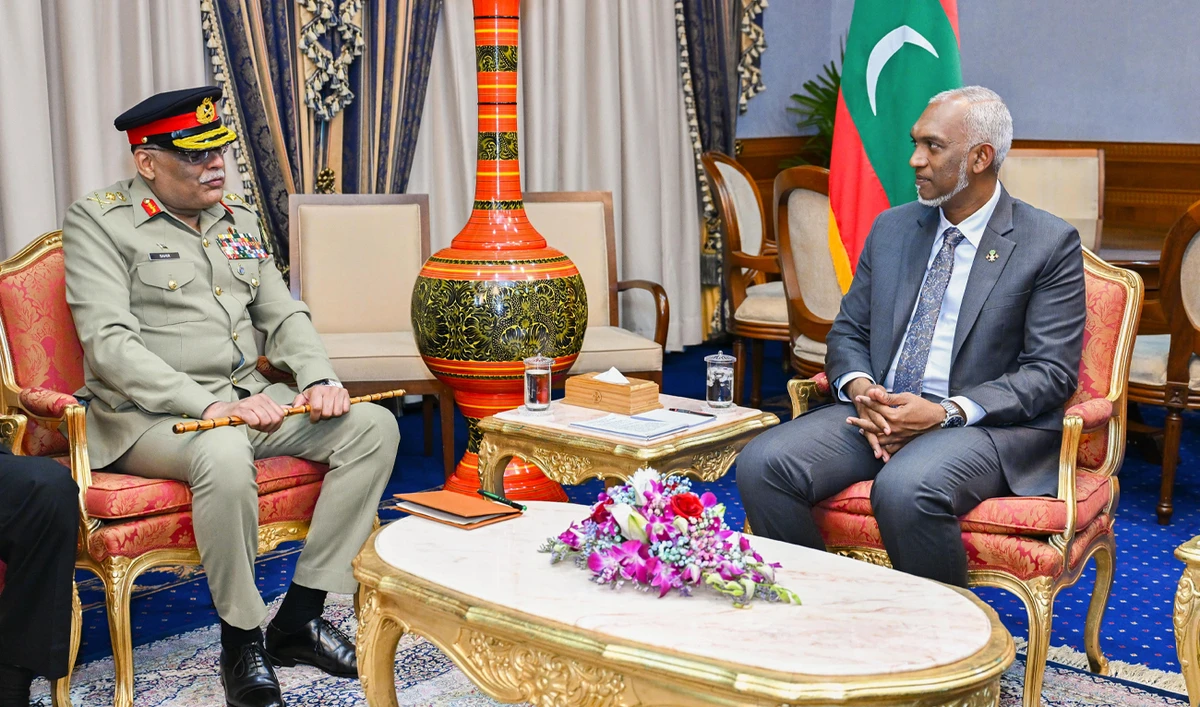
Maldives President Dr. Mohamed Muizzu meets Pakistan’s Chairman of the Joint Chiefs of Staff Committee (CJCSC) General Sahir Shamshad Mirza (left) in Malé, Maldives, on October 24, 2025. (President’s Office, Republic of Maldives)
Short Url
Updated 24 October 2025
Follow

Pakistan, Maldives to boost military cooperation amid shifting regional dynamics

  • General Sahir Shamshad Mirza meets President Mohamed Muizzu during his visit to the Maldives
  • The two countries share long-standing diplomatic relations and are members of SAARC and the OIC

ISLAMABAD: Pakistan’s Chairman of the Joint Chiefs of Staff Committee (CJCSC) General Sahir Shamshad Mirza and Maldivian leaders agreed to step up military cooperation amid shifting regional and global security dynamics, the Pakistan military said on Friday.

The development came during Mirza’s official visit to the Maldives, where he met President Mohamed Muizzu, Defense Minister Mohamed Ghassan Maumoon and Chief of Defense Forces Major General Ibrahim Hilmy.

The two countries have deepened military cooperation this year, with Hilmy calling on Pakistan Army Chief Field Marshal Asim Munir in February to discuss bilateral defense cooperation and regional security dynamics.

“Both sides held discussions on the evolving global and regional security environment and issues of mutual interest including bilateral defense and security cooperation,” the military’s media wing, Inter-Services Public Relations (ISPR), said in a statement.

“They also considered avenues to further enhance military-to-military engagements between the two countries and reaffirmed their shared commitment to further strengthening the partnership.”

The Maldivian side lauded the professionalism of Pakistan’s armed forces, the statement added, and acknowledged their sacrifices in the fight against militancy.

Pakistan and the Maldives share long-standing diplomatic ties dating back to July 1966, rooted in Islamic brotherhood and mutual participation in forums like the Organization of Islamic Cooperation and the South Asian Association for Regional Cooperation.

Mirza, the only four-star general in the Pakistan Army, regularly visits friendly countries to strengthen defense and security ties.

In July this year, he visited Egypt for the third round of defense and security talks between the two nations.

Pakistan says defense pact with Saudi Arabia elevated brotherly ties to ‘new heights’

Updated 25 February 2026
Follow

Pakistan says defense pact with Saudi Arabia elevated brotherly ties to ‘new heights’

  • Pakistan, Saudi Arabia signed strategic defense pact last year pledging aggression against one will be treated as attack on both
  • Deputy PM Ishaq Dar says enduring bonds with Islamic and Arab nations form vital pillar of Pakistan’s foreign policy 

ISLAMABAD: Deputy Prime Minister Ishaq Dar said on Wednesday that Pakistan’s defense pact with Saudi Arabia elevated its brotherly ties with the Kingdom to “new heights,” stressing that close ties with Arab and Islamic nations form a key pillar of Islamabad’s foreign policy. 

Pakistan and Saudi Arabia signed a Strategic Mutual Defense Agreement on Sept. 17 last year, pledging that aggression against one country would be treated as an attack on both, enhancing joint deterrence and formalizing decades of military and security cooperation.

Both nations agreed in October 2025 to launch an economic cooperation framework to strengthen trade and investment ties. 

“In the Middle East, our landmark Strategic Mutual Defense Agreement with Saudi Arabia has elevated our brotherly ties to new heights,” Dar said while speaking at the Pakistan Governance Forum 2026 event in Islamabad. 

The Pakistani deputy prime minister was speaking on the topic “Navigating International Relations Amidst Changing Geo-Politics.”

Dar noted that Pakistan has reinforced partnerships with other Middle Eastern nations such as the UAE, Qatar, Jordan, Oman, Egypt and Bahrain. He said these partnerships have yielded “concrete agreements” in investment, agriculture, infrastructure, and energy sectors. 

“Our enduring bonds with Islamic and Arab nations form a vital pillar of our foreign policy, and we will continue to expand our partnerships across Asia, Latin America, and Africa,” he said. 

Dar pointed out that the presidents of Kazakhstan, Uzbekistan and Kyrgyzstan have undertaken visits to Pakistan in recent months, reflecting Central Asian nations’ desire to boost cooperation with Islamabad.

On South Asia, the Pakistani deputy PM said Pakistan has successfully transformed its fraternal ties with Bangladesh into “a substantive partnership.”

“Similarly, the trilateral mechanism involving China, Pakistan, and Bangladesh has been launched with a view to expanding and deepening regional cooperation and synergy,” the Pakistani minister said. 

He said Islamabad has strengthened its “all-weather” partnership with China via the second phase of the multi-billion-dollar China-Pakistan Economic Corridor agreement and “unwavering support” from both sides for each other’s core interests. 

Dar said Pakistan had also reinvigorated its partnership with the US, advancing cooperation in trade, technology, investment, and regional stability. 

“This calibrated approach has enhanced our ability to navigate complexity with skill and confidence, ensuring that our national interests are served without compromising our core foreign policy principles,” he said.