

Pakistan’s Punjab warns of rise in smog levels in coming days

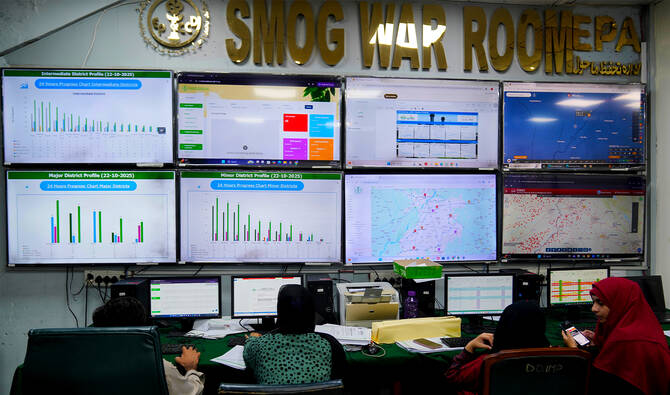
Employees of Environment Protection Agency monitor smog and air quality in a monitoring room, called the Smog Cell, in Lahore, Pakistan, on Oct. 23, 2025. (AP)
Short Url
Updated 24 October 2025
Follow

Pakistan’s Punjab warns of rise in smog levels in coming days

  • The statement came as Lahore ranked the most polluted city in the world at around 12pm on Friday, with an air quality index of 217
  • Vulnerable populations, including children, elderly and people with pre-existing health conditions, are at high risk, authority says

ISLAMABAD: The Provincial Disaster Management Authority (PDMA) in Pakistan’s Punjab province has warned of a rise in smog levels in major cities in the coming days, citing stable and dry weather conditions.

Cold, heavy air traps pollutants, including vehicle emissions, industrial smoke and dust, from November to mid-December. The seasonal crisis is often exacerbated by crop residue burning and lasts until February.

Lahore, a city of around 14 million people and the capital of Pakistan’s most populous Punjab province, this month began using anti-smog guns for the first time in an effort to reduce airborne pollutants.

On Friday, the PDMA said calm wind pattern, lower temperatures and humidity may prevent pollutants from dispersing and causing thick layers of smog in Lahore, Gujranwala, Sheikhupura, Kasur, Nankana Sahib, Faisalabad, Multan, Bahawalpur, Rahim Yar Khan, Bahawalnagar and Khanpur districts.

“The rise in smog levels may trigger an increase in respiratory illnesses, asthma cases, and other pollution-related health problems,” the authority said.

“Vulnerable populations, including children, the elderly, and people with pre-existing health conditions, are at high risk.”

The statement came as Lahore ranked the most polluted city in the world at around 12pm on Friday, with an air quality index (AQI) of 217, according to air quality monitor IQ Air.

Poor air quality can cause reduced visibility on roads, leading to a surge in traffic accidents, according to the PDMA. Outdoor activities can also be disrupted.

“Clear any hindrances on road to ensure smooth traffic flow,” it directed district administrations.

“Ensure sufficient staffing round-the-clock in DEOCS (district emergency operations centers) for effective coordination and coordinate with PDMA and all relevant departments to ensure a unified prompt response. Ensure accurate and timely dissemination of information on safety measures and evacuation plans through electronic and social media.”


Pakistan, global crypto exchange discuss modernizing digital payments, creating job prospects 

Updated 05 December 2025
Follow

Pakistan, global crypto exchange discuss modernizing digital payments, creating job prospects 

  • Pakistani officials, Binance team discuss coordination between Islamabad, local banks and global exchanges
  • Pakistan has attempted to tap into growing crypto market to curb illicit transactions, improve oversight

ISLAMABAD: Pakistan’s finance officials and the team of a global cryptocurrency exchange on Friday held discussions aimed at modernizing the country’s digital payments system and building local talent pipelines to meet rising demand for blockchain and Web3 skills, the finance ministry said.

The development took place during a high-level meeting between Finance Minister Muhammad Aurangzeb, Pakistan Virtual Assets Regulatory Authority (PVARA) Chairman Bilal bin Saqib, domestic bank presidents and a Binance team led by Global CEO Richard Teng. The meeting was held to advance work on Pakistan’s National Digital Asset Framework, a regulatory setup to govern Pakistan’s digital assets.

Pakistan has been moving to regulate its fast-growing crypto and digital assets market by bringing virtual asset service providers (VASPs) under a formal licensing regime. Officials say the push is aimed at curbing illicit transactions, improving oversight, and encouraging innovation in blockchain-based financial services.

“Participants reviewed opportunities to modernize Pakistan’s digital payments landscape, noting that blockchain-based systems could significantly reduce costs from the country’s $38 billion annual remittance flows,” the finance ministry said in a statement. 

“Discussions also emphasized building local talent pipelines to meet rising global demand for blockchain and Web3 skills, creating high-value employment prospects for Pakistani youth.”

Blockchain is a type of digital database that is shared, transparent and tamper-resistant. Instead of being stored on one computer, the data is kept on a distributed network of computers, making it very hard to alter or hack.

Web3 refers to the next generation of the Internet built using blockchain, focusing on giving users more control over their data, identity and digital assets rather than big tech companies controlling it.

Participants of the meeting also discussed sovereign debt tokenization, which is the process of converting a country’s debt such as government bonds, into digital tokens on a blockchain, the ministry said. 

Aurangzeb called for close coordination between the government, domestic banks and global exchanges to modernize Pakistan’s payment landscape.

Participants of the meeting also discussed considering a “time-bound amnesty” to encourage users to move assets onto regulated platforms, stressing the need for stronger verifications and a risk-mitigation system.

Pakistan has attempted in recent months to tap into the country’s growing crypto market, crack down on money laundering and terror financing, and promote responsible innovation — a move analysts say could bring an estimated $25 billion in virtual assets into the tax net.

In September, Islamabad invited international crypto exchanges and other VASPs to apply for licenses to operate in the country, a step aimed at formalizing and regulating its fast-growing digital market.