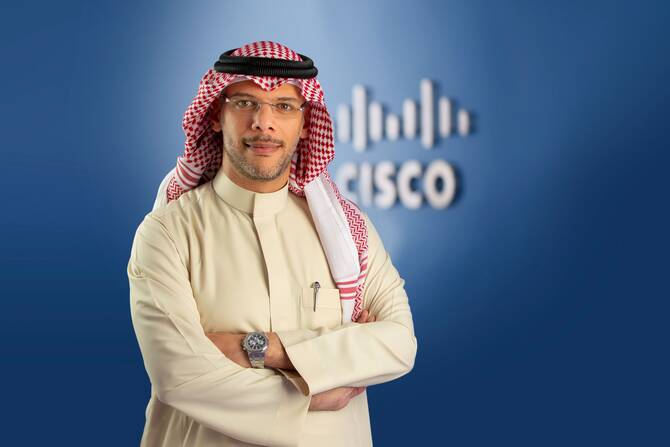

The most encouraging advancement is the growth of Saudi Arabia’s information and communication technology sector, according to Salman Faqeeh, managing director, Cisco Saudi Arabia.
Last year, ICT spending in the Kingdom exceeded $10 billion, consolidating its position as the largest tech market in the MENA region, he said.
"Another promising trend is a heightened focus on cybersecurity. Saudi Arabia’s cybersecurity market is expected to reach a compound annual growth rate of 18.33% by 2029. The Kingdom is also rapidly advancing its vision for smart cities. The government has allocated $500 billion for its flagship smart city project Neom, which aims to integrate cutting-edge technologies such as AI, the Internet of Things, and renewable energy.
"Saudi Arabia is well on its way to becoming a global leader in innovation and technology adoption. At Cisco, we are at the forefront of supporting this journey by revolutionizing how infrastructure and data connect and protect organizations in the AI era," Faqeeh added.
Amidst mounting complexity and expanding attack surfaces, cybersecurity is the bedrock of a prosperous digital economy. "At Cisco, we are taking a fundamental new approach to safeguarding the digital ecosystem, where security meets the network," he said.
"Cisco AI Defense, our end-to-end AI security solution, protects every stage of AI development and deployment with unmatched visibility and control over networks," Faqeeh explained.
Meanwhile, Cisco Hypershield, our groundbreaking security architecture, powers and protects the engine of the AI revolution – AI-scale data centers and clouds.
Faqeeh said: "We are helping organizations across Saudi Arabia strengthen their cybersecurity posture with platform-based solutions like Security Cloud and Extended Detection and Response. A prime example is our work with stc to upgrade its Cyber Defense Center, which has resulted in increasing security cover by up to 95% and reducing incident response time from eight hours to one hour.
"AI brings immense opportunities to healthcare, promising faster and more accurate diagnoses, personalized treatments, and predictive care that could transform patient outcomes. While AI boosts productivity, workers can focus on tasks better suited for human expertise, like patient care. In education, AI serves as a complementary tool that enhances the educational experience while preserving vital human elements of teaching and learning. And finally, smart cities would not exist without AI, as AI powers IoT, on which smart cities run, using smart devices to deliver a connected living experience."
He added: "At Cisco, we are a trusted partner that helps organizations across diverse sectors accelerate their AI journeys within a responsible AI framework. Our collaborations with public and private sector entities are instrumental in building AI-ready infrastructure and fostering local innovation. We will continue to support Saudi Arabia’s giga-projects by deploying smart building technologies and IoT solutions to create sustainable, connected urban environments.
"In today's rapidly evolving threat landscape, relying solely on human-scale defense is no longer enough. We need AI to combat threats because we need to protect the ecosystem at machine scale, not just human scale. But the best defense won’t be artificial or human – it will be a collaboration between the two."
According to our 2025 Cybersecurity Readiness Index, Faqeeh said, only 1% of organizations in Saudi Arabia have achieved the "mature" level of readiness required to effectively withstand today’s cybersecurity threats. "To tackle today’s cybersecurity challenges, enterprises must invest in AI-driven solutions, simplify security infrastructures, and enhance AI threat awareness. Prioritizing AI for threat detection, response, and recovery is essential, as is addressing talent shortages and mitigating risks from unmanaged devices and unregulated AI deployments, also known as shadow AI."
Faqeeh further said: "Security leaders have the responsibility to contribute their expertise to developing homegrown talent in the markets where they operate. At Cisco, we are committed to fostering a diverse and digitally skilled workforce in Saudi Arabia.
"Since its inception in the Kingdom in partnership with King Abdulaziz University, the Cisco Networking Academy has trained over 479,000 learners in cybersecurity and other digital technology fields for free. Notably, 36% of the participants have been women – one of the highest percentages globally. We are on track to achieve our target of upskilling 500,000 learners in five years.
"We have also joined forces with King Abdullah University of Science and Technology to establish the Cisco AI Institute that will train future AI leaders while driving AI innovation. In addition, we are providing Cisco Certified Internetwork Expert certifications in collaboration with King Abdulaziz City for Science and Technology."