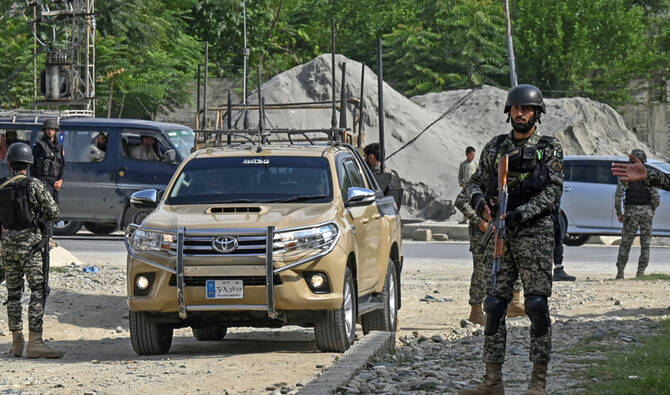
ISLAMABAD: Authorities have deployed troops and imposed a three-day curfew in the northern Pakistani cities of Gilgit and Skardu, according to a notification issued Monday, after over a dozen people were killed in clashes over the killing of Iran’s Supreme Leader Ayatollah Ali Khamenei in US-Israeli strikes.
Pakistan’s northern Gilgit-Baltistan (GB) region, where the two cities are located, saw violent clashes on Sunday as protesters set fire to and vandalized several buildings, including United Nations (UN) regional offices, army-run school, software technology park and an Aga Khan Rural Support Programme office.
Clashes with law enforcement agencies caused the deaths of at least 14 people in the region, among them a soldier, GB Caretaker Information Minister Ghulam Abbas confirmed told Arab News. He said around 50 others were injured.
“In wake of prevailing precarious law-and-order situation... it is expected that the situation may deteriorate further in Gilgit-Baltistan, particularly in District Gilgit and Skardu,” Deputy Home Secretary Ghulam Hasan said in a notification on Monday.
“It is therefore requested that Pakistan Army troops may be deployed in District Gilgit and Skardu and curfew may be imposed for an initial period of three days (2nd, 3rd and 4th March) to prevent any untoward incident and danger to human life and property.”
Separately, UN spokesman Stephane Dujarric said on Monday that protesters became violent near the UN Military Observer Group in Pakistan (UNMOGIP) Field Station, which was vandalized.
“The safety and security of UN personnel and premises throughout the region remain our top priority, and we continue to closely monitor the situation,” Dujarric said.
Shabir Mir, a Gilgit-Baltistan government spokesman, said the situation was under control and that the curfew would remain in place until Wednesday as police chief Akbar Nasir Khan urged residents to stay indoors.
Anger has been rising in Pakistan, particularly among members of the Shiite minority, following US and Israeli strikes on Iran that killed Khamenei and other senior officials. While Shiites are a minority nationwide, they form a majority in some northern districts and boast significant numbers in major urban centers.
Demonstrators in Pakistan’s southern port city of Karachi also stormed the US Consulate on Sunday, smashing windows and attempting to burn the building. Police responded with batons, tear gas, and gunfire, leaving 10 people dead and more than 50 injured.
The US embassy and its consulates in Karachi and Lahore canceled visa appointments and American Citizen Services on Monday, citing security concerns. Pakistani authorities have beefed up security at US diplomatic missions across the country, including around the US consulate building in Peshawar, to avoid any further violence.
Also Monday, the Pakistan Stock Exchange plunged, with the benchmark KSE-100 Index falling nearly 10 percent amid rising geopolitical tensions following attacks on Iran. Investors sold off shares across sectors, with analysts citing heightened uncertainty as the main driver behind the sharp decline.
Sunday’s unrest came amid ongoing cross-border fighting between Pakistan and Afghanistan, which began Thursday after Afghanistan launched attacks in retaliation for Pakistani airstrikes the previous Sunday. Pakistan has since carried out repeated operations along the border.
— With additional input from AP.