EU leaders seek role in Gaza at summit focused on Ukraine and Russia

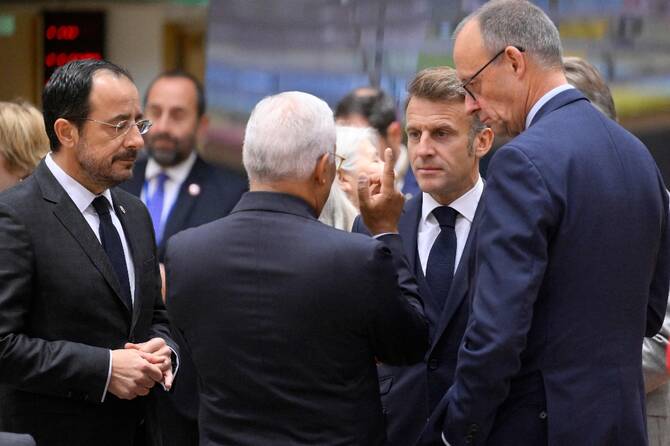
Cyprus' President Nikos Christodoulides, European Council President Antonio Costa, France's President Emmanuel Macron and Germany's Chancellor Friedrich Merz speak after their arrival for a European Council meeting in Belgium. (AFP)
Short Url
Updated 23 October 2025
Follow

EU leaders seek role in Gaza at summit focused on Ukraine and Russia

  • Outrage over the war in Gaza has riven the 27-nation bloc and pushed relations between Israel and the EU to a historic low
  • European Commission President Ursula von der Leyen announced in September plans to seek sanctions and a partial trade suspension against Israel, aimed to pressure it to reach a peace deal in Gaza

BRUSSELS: European Union leaders are seeking a more active role in Gaza and the occupied West Bank after being sidelined from the US-brokered ceasefire between Israel and Hamas.
At a summit Thursday in Brussels largely focused on Ukraine and Russia, EU heads of state are also expected to discuss the shaky ceasefire in Gaza and potential EU support for stability in the war-torn coastal enclave. The EU has been the biggest provider of aid to the Palestinians and is Israel’s top trading partner.
“It is important that Europe not only watches but plays an active role,” said Luc Frieden, the prime minister of Luxembourg, as he headed in to the meeting. “Gaza is not over; peace is not yet permanent,” he said.
Outrage over the war in Gaza has riven the 27-nation bloc and pushed relations between Israel and the EU to a historic low.
European Commission President Ursula von der Leyen announced in September plans to seek sanctions and a partial trade suspension against Israel, aimed to pressure it to reach a peace deal in Gaza.
Momentum driving the measures seemed to falter with the ceasefire deal mediated by US President Donald Trump, but European supporters say they should still be on the table as violence continues to flare up in Gaza and the occupied West Bank.
In the run-up to the ceasefire, Israeli Prime Minister Benjamin Netanyahu said earlier this month that “Europe has essentially become irrelevant and displayed enormous weakness.”
The deal came about with no visible input from the EU, and European leaders have since scrambled to join the diplomacy effort currently reshaping Gaza.
The EU’s top diplomat, Kaja Kallas, has said the EU should play a role in Gaza and not just pay to support stability and eventually reconstruction.
The EU has provided key support for the Palestinian Authority, which administers parts of the occupied West Bank, pledged to help flood Gaza with humanitarian aid, and said it could bring a West Bank police support program to Gaza to buttress a stabilization force called for in the current 20-point ceasefire plan.
It has also sought membership in the plan’s “Board of Peace” transitional oversight body, Dubravka Šuica, European Commissioner for the Mediterranean, said this week.
The European Border Assistance Mission in Rafah, on the Gaza-Egypt border, began in 2005. In January, it deployed 20 security border police experts from Italy, Spain and France.
During the February-March ceasefire, the mission helped 4,176 individuals leave the Gaza Strip, including 1,683 medical patients. Those efforts were paused when fighting resumed.


Afghanistan says it thwarted Pakistani airstrike on Bagram Air Base as fighting enters fourth day

Updated 01 March 2026
Follow

Afghanistan says it thwarted Pakistani airstrike on Bagram Air Base as fighting enters fourth day

  • The fighting has been the most severe between the neighbors for years
  • Pakistan accuses Taliban government of harboring militant groups that stage attacks against it

KABUL: Afghanistan thwarted attempted airstrikes on Bagram Air Base, the former US military base north of Kabul, authorities said Sunday, while cross-border fighting between Pakistan and Afghanistan stretched into a fourth day.
The fighting has been the most severe between the neighbors for years, with Pakistan declaring that it’s in “open war” with Afghanistan.
The conflict has alarmed the international community, particularly as the area is one where other militant organizations, including Al-Qaeda and the Daesh group, still have a presence and have been trying to resurface.
Pakistan accuses Afghanistan’s Taliban government of harboring militant groups that stage attacks against it and also of allying with its archrival India.
Border clashes in October killed dozens of soldiers, civilians and suspected militants until a Qatari-mediated ceasefire ended the intense fighting. But several rounds of peace talks in Turkiye in November failed to produce a lasting agreement, and the two sides have occasionally traded fire since then.
On Sunday, the police headquarters of Parwan province, where Bagram is located, said in a statement that several Pakistani military jets had entered Afghan airspace “and attempted to bomb Bagram Air Base” at around 5 a.m.
The statement said Afghan forces responded with “anti-aircraft and missile defense systems” and had managed to thwart the attack.
There was no immediate response from Pakistan’s military or government regarding Kabul’s claim of attempted airstrikes on Bagram or the ongoing fighting.
Bagram was the United States’ largest military base in Afghanistan. It was taken over by the Taliban as they swept across the country and took control in the wake of the chaotic US withdrawal from the country in 2021. Last year, US President Donald Trump suggested he wanted to reestablish a US presence at the base.
The current fighting began when Afghanistan launched a broad cross-border attack on Thursday night, saying it was in retaliation for Pakistani airstrikes the previous Sunday.
Pakistan had said its airstrike had targeted the outlawed Pakistani Taliban, also known as Tehreek-e-Taliban Pakistan, or TTP. Afghanistan had said only civilians were killed.
The TTP militant group, which is separate but closely allied with Afghanistan’s ruling Taliban, operates inside Pakistan, where it has been blamed for hundreds of deaths in bombings and other attacks over the years.
Pakistan accuses Afghanistan’s Taliban government of providing a safe haven within Afghanistan for the TTP, an accusation that Afghanistan denies.
After Thursday’s Afghan attack, Pakistani Defense Minister Khawaja Mohammad Asif declared that “our patience has now run out. Now it is open war between us.”
In the ongoing fighting, each side claims to have killed hundreds of the other side’s forces — and both governments put their own casualties at drastically lower numbers.
Two Pakistani security officials said that Pakistani ground forces were still in control on Sunday of a key Afghan post and a 32-square-kilometer area in the southern Zhob sector near Kandahar province, after having seized it during fighting Friday. The captured post and surrounding area remain under Pakistani control, they added. The officials spoke on condition of anonymity, because they weren’t authorized to speak publicly.
In Kabul, the Afghan government rejected Pakistan’s claims. Deputy government spokesman Hamdullah Fitrat called the reports “baseless.”
Afghan officials said that fighting had continued overnight and into Sunday in the border areas.
The police command spokesman for Nangarhar province, Said Tayyeb Hammad, said that anti-aircraft missiles were used from the provincial capital, Jalalabad, and surrounding areas on Pakistani fighter jets flying overhead Sunday morning.
Defense Ministry spokesman Enayatulah Khowarazmi said that Afghan forces had launched counterattacks with snipers across the border from Nangarhar, Paktia, Khost and Kandahar provinces overnight. He said that two Pakistani drones had been shot down and dozens of Pakistani soldiers had been killed.
Fitrat said that Pakistani drone attacks hit civilian homes in Nangarhar province late Saturday, killing a woman and a child, while mortar fire killed another civilian when it hit a home in Paktia province.
There was no immediate response to the claims from Pakistani officials.