LONDON: The only British soldier ever charged in the 1972 Bloody Sunday massacre will learn his fate Friday in a Northern Ireland courtroom.
Judge Patrick Lynch is due to deliver his verdict in Belfast Crown Court on whether the former paratrooper identified only as Soldier F committed murder and attempted murder in the deadliest shooting of the three decades of sectarian violence known as “The Troubles.”
Prosecutors said the lance corporal, who has not been named to protect him from retaliation, killed two people and tried to kill five others when he and other troops fired at fleeing unarmed civilians on Jan. 20, 1972, in Londonderry, also known as Derry.
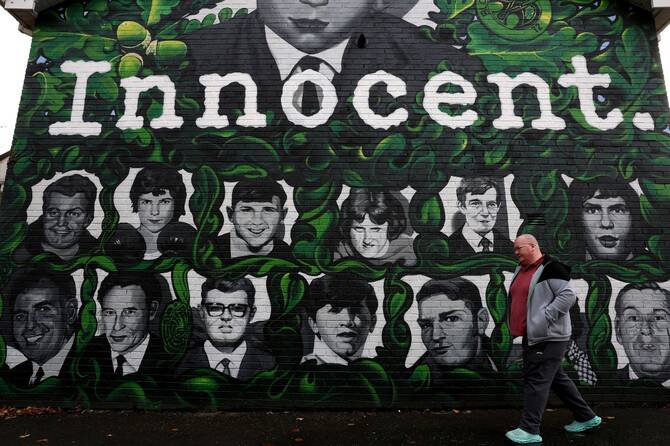
Thirteen people were killed and 15 were wounded in the event that has come to symbolize the conflict between mainly Catholic supporters of a united Ireland and predominantly Protestant forces that wanted to remain part of the United Kingdom.
While the violence largely ended with the 1998 Good Friday peace accord, tensions remain. Families of civilians killed continue to press for justice, while supporters of army veterans complain that their losses have been downplayed and that they have been unfairly targeted in investigations.
Soldier F, who was shrouded from view in court by a curtain, did not testify in his defense and his lawyer presented no evidence. The soldier told police during a 2016 interview that he had no “reliable recollection” of the events that day but was sure he had properly discharged his duties as a soldier.
Defense lawyer Mark Mulholland attacked the prosecution’s case as “fundamentally flawed and weak” for relying on soldiers he dubbed “fabricators and liars,” and the fading memories of survivors who scrambled to avoid live gunfire that some mistakenly thought were rounds of rubber bullets.
Surviving witnesses spoke of the confusion, chaos and terror as soldiers opened fire and bodies began falling after a large civil rights march through the city.
The prosecution relied on statements by two of Soldier F’s comrades — Soldier G, who is dead, and Soldier H, who refused to testify. The defense tried unsuccessfully to exclude the hearsay statements because they could not be cross-examined.
Prosecutor Louis Mably argued that the soldiers, without justification, had all opened fire, intending to kill, and thus shared responsibility for the casualties.
The killings were a source of shame for a British government that had initially claimed that members of a parachute regiment fired in self-defense after being attacked by gunmen and people hurling fuel bombs.
A formal inquiry cleared the troops of responsibility, but a subsequent and lengthier review in 2010 found soldiers shot unarmed civilians fleeing and then lied in a cover-up that lasted decades.
Then-Prime Minister David Cameron apologized and said the killings were “unjustified and unjustifiable.”
The 2010 findings cleared the way for the eventual prosecution of Soldier F, though delays and setbacks kept it from coming to trial until last month.
Soldier F has pleaded not guilty to two counts of murder for the deaths of James Wray, 22, and William McKinney, 27, and five counts of attempted murder for the shootings of Joseph Friel, Michael Quinn, Joe Mahon, Patrick O’Donnell, and for opening fire at unarmed civilians.

Judge to rule in 1972 Bloody Sunday murder case against former British soldier
https://arab.news/y99rp
Judge to rule in 1972 Bloody Sunday murder case against former British soldier
- Prosecutors said the lance corporal, who has not been named to protect him from retaliation, killed two people and tried to kill five others when he and other troops fired at fleeing unarmed civilians on Jan. 20, 1972, in Londonderry, also known as Derry
Myanmar, Afghan hopeful scholars mourn UK study visa ban
- Myanmar, Afghanistan, Sudan and Cameroon citizens will be barred from obtaining university visas
- Britain’s travel block is “really painful” for Afghan women hoping to escape to an education abroad, said one female
YANGON, Myanmar: Aspiring students are lamenting Britain’s ban on education visas for their war-weary countries — dashing dreams of bettering themselves and their home nations.
Myanmar, Afghanistan, Sudan and Cameroon citizens will be barred from obtaining university visas, London announced this week, saying asylum applications by visiting students had “rocketed” nearly 500 percent from 2021 to 2025.
“It’s like the country is punishing the weak, the most vulnerable people,” said one woman from Myanmar.
She was preparing for a scholarship interview for a master’s in climate change finance when her plans were upended by Downing Street’s decree on Wednesday.
“I could not focus the whole morning,” the 28-year-old told AFP from Yangon, speaking on condition of anonymity for security reasons in a country riven by civil war since a 2021 military coup.
“I can’t picture my future.”
Like in much of the developed world, immigration has become a divisive issue in Britain.
Efforts to beat back arrivals mirror the sweeping travel bans issued by US President Donald Trump which have shut out citizens of Myanmar, Sudan and Afghanistan.
Since the chaotic military withdrawal of Britain, the United States and other NATO nations in 2021, Afghanistan has been ruled by a resurgent Taliban government which has banned women over age 12 from attending school.
Britain’s travel block is “really painful” for Afghan women hoping to escape to an education abroad, said one female child social worker in Ghazni province, who asked to remain anonymous for security reasons.
She has now canceled her plans to study for a master’s in both the US and the UK.
“Now I am trying to be hopeful, but I think it would also be a mistake,” said the 27-year-old.
In the summer of 2024, Arefa Mohammadi fled to neighboring Pakistan, living in limbo as she applied to universities.
She got an offer to study public health in England but now cannot accept it.
“It was truly shocking for me,” said the 24-year-old.
“This situation put me in a place where I haven’t any goals, because all my goals and all my futures are unpredictable.”
- ‘Cruel and short-sighted’ -
In Kabul, a 39-year-old man faces similar heartbreak.
He was accepted to study specialist subjects related to water management at three universities in England and Scotland.
“When I was a child I witnessed several challenges like flash floods, water scarcity, environmental neglect, inefficient irrigation systems,” he said, asking to remain anonymous for security reasons. “To address these challenges I made my application.”
“I hoped to acquire modern knowledge. It’s impossible to acquire in Afghanistan,” he added.
Some 33 million people in the country face severe water shortages, aid agencies say, a result of compounding multi-year droughts, climate change and infrastructure battered by decades of war.
Britain’s Labour government made the decision to curb visas as the right-wing Reform UK party surges in opinion polls with its hard-line stance against immigration.
The UK Home Office said almost 135,000 asylum seekers had entered the country through legal routes since 2021.
Activist organization Burma Campaign UK called the visa ban “exceptionally cruel and shortsighted.”
“The opportunity to come to the UK to study is life-changing for the individual student but also an investment in the future of Myanmar,” said program director Zoya Phan in a statement.
One exiled Myanmar journalist has been living over the border in Thailand after escaping the military rule which has clamped down on press freedoms.
“When the military coup happened I was just 22, so I had a lot of dreams,” she said. “But over the past five years there have been a lot of struggles — I couldn’t complete my dreams.”
Every year since the junta takeover she applied for further education to buoy her spirits.
But she received an email Thursday morning canceling her place to study for a master’s at a London university.
“Everything is gone,” she said. “My UK dream is all disappeared.”


