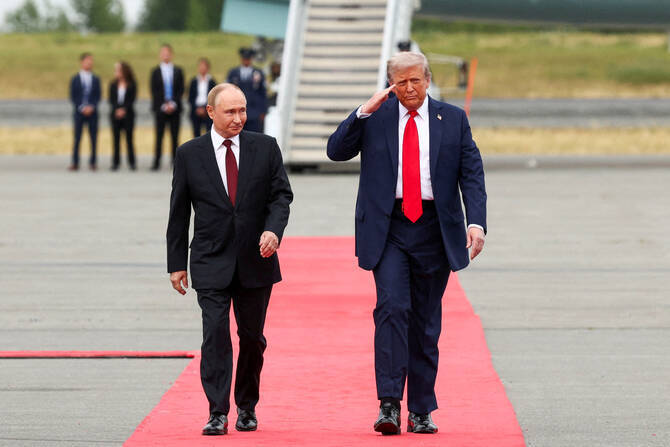
A planned summit between US President Donald Trump and Russian President Vladimir Putin was put on hold on Tuesday, as Moscow’s rejection of an immediate ceasefire in Ukraine cast a cloud over attempts at negotiations.
A senior White House official told Reuters “there are no plans for President Trump to meet with President Putin in the immediate future” after Secretary of State Marco Rubio and Russian Foreign Minister Sergei Lavrov had a “productive call” but opted against an in-person meeting.
Trump had announced last week that he and Putin would meet soon in Hungary to try to bring an end to the war in Ukraine. But Putin has been unwilling to consider concessions. Moscow has long demanded that Ukraine agree to cede more territory before any ceasefire.
Trump, asked by reporters about the prospect for a summit, said he did not want to have a “wasted meeting” but suggested there could be more developments and that “we’ll be notifying you over the next two days” about them.
Kirill Dmitriev, Putin’s investment envoy, said in a social media post that “preparations continue” for a summit.
Russia reiterated its long-standing terms for a peace deal in a private communique known as a “non paper” that it sent to the US last weekend, according to two US officials and two people familiar with the situation.
The communique reaffirmed Russia’s demand for full control of the long-contested eastern Donbas region, according to one official, effectively rejecting Trump’s call for a ceasefire to commence with a freeze of the frontlines at their prevailing locations.
Russia controls all of the province of Luhansk and about 75 percent of neighboring Donetsk, which together make up the Donbas region.
European leaders called on Washington on Tuesday to hold firm in demanding an immediate ceasefire in Ukraine, with present battle lines to serve as the basis for any future talks.
NATO said Secretary General Mark Rutte traveled to Washington on Tuesday for talks with Trump that two sources familiar with the matter said would take place on Wednesday.
A Western official, speaking on condition of anonymity, said Rutte planned to present to Trump the European views on a ceasefire and any subsequent peace negotiations.
Trump, who last week spoke by phone to Putin and met Ukrainian President Volodymyr Zelensky, had hoped for another high-profile session with the Russian leader after their August summit in Alaska failed to advance negotiations.
But the two sides postponed a preparatory meeting between Rubio and Lavrov that had been expected to take place in Budapest on Thursday.
Lavrov and Rubio spoke by phone on Monday. Lavrov said the place and the timing of the next Trump-Putin summit was less important than the substance of implementing the understandings reached in Alaska.
The Kremlin said there was no clear date and that “serious preparation” for a summit was needed, which may take time.
“Listen, we have an understanding of the presidents, but we cannot postpone what has not been finalized,” Kremlin spokesman Dmitry Peskov said. “Neither President Trump nor President Putin gave exact dates.”
Asked if Moscow had an understanding of a possible date for the summit, Peskov said: “No, there is no understanding.”
Neither side has publicly abandoned plans for Trump to meet Putin. Hungary’s foreign minister, Peter Szijjarto, was in Washington on Tuesday, where he posted on Facebook: “We have some serious days ahead.”
But two senior European diplomats said the postponement of the Rubio-Lavrov meeting was a sign the Americans would be reluctant to go ahead with a Trump-Putin summit unless Moscow yields its demands.
“I guess the Russians wanted too much and it became evident for the Americans that there will be no deal for Trump in Budapest,” said one.
The Russians “haven’t at all changed their position, and are not agreeing to ‘stop where they are’,” said the second diplomat. “And I assume Lavrov gave the same spiel, and Rubio was like: ‘See you later’.”
Ukraine’s European allies have been concerned that Trump could meet Putin for a second time without getting any serious concessions from the Russian leader.
In a statement on Tuesday, the leaders of European powers including Britain, France, Germany and the EU said they “strongly support President Trump’s position that the fighting should stop immediately, and that the current line of contact should be the starting point of negotiations.”
Trump has often changed his emphasis in public when speaking about Ukraine. But last Friday after his meeting with Zelensky at the White House, he explicitly endorsed the position that a ceasefire should start with forces at their present positions.
Reuters and other news organizations reported that Trump’s meeting with Zelensky behind closed doors was contentious, with the US president repeatedly using profanity and pushing Zelensky to accept some Russian demands. But Zelensky has painted the meeting as a success because it ended with Trump publicly backing a ceasefire at the present lines, Kyiv’s longstanding position.
European leaders are due to meet this week with Zelensky as their guest, first at an EU summit and then at a meeting of the “coalition of the willing” countries discussing a security force to guarantee a post-war settlement in Ukraine. Russia rejects such an international security force.
The choice of Budapest as a venue for a Putin-Trump meeting is contentious within the EU, where Hungary’s Prime Minister Viktor Orban is an outlier as one of the few leaders to maintain warm relations with Russia. Any trip to Budapest would require Putin to fly through the airspace of other EU countries. Poland said on Tuesday it could force Putin’s plane down and arrest him on an international warrant if he flies over its territory, but Bulgaria said Putin could use its airspace to reach the meeting.


Putin-Trump summit on hold after Russia rejects ceasefire
https://arab.news/nvht3
Putin-Trump summit on hold after Russia rejects ceasefire

- Ryabkov said it was “premature to talk about the schedule” of the preparatory Lavrov-Rubio meeting
- “Neither before the phone call nor during yesterday’s call was the meeting specifically raised“


Afghanistan says it thwarted Pakistani airstrike on Bagram Air Base as fighting enters fourth day
- The fighting has been the most severe between the neighbors for years
- Pakistan accuses Taliban government of harboring militant groups that stage attacks against it
KABUL: Afghanistan thwarted attempted airstrikes on Bagram Air Base, the former US military base north of Kabul, authorities said Sunday, while cross-border fighting between Pakistan and Afghanistan stretched into a fourth day.
The fighting has been the most severe between the neighbors for years, with Pakistan declaring that it’s in “open war” with Afghanistan.
The conflict has alarmed the international community, particularly as the area is one where other militant organizations, including Al-Qaeda and the Daesh group, still have a presence and have been trying to resurface.
Pakistan accuses Afghanistan’s Taliban government of harboring militant groups that stage attacks against it and also of allying with its archrival India.
Border clashes in October killed dozens of soldiers, civilians and suspected militants until a Qatari-mediated ceasefire ended the intense fighting. But several rounds of peace talks in Turkiye in November failed to produce a lasting agreement, and the two sides have occasionally traded fire since then.
On Sunday, the police headquarters of Parwan province, where Bagram is located, said in a statement that several Pakistani military jets had entered Afghan airspace “and attempted to bomb Bagram Air Base” at around 5 a.m.
The statement said Afghan forces responded with “anti-aircraft and missile defense systems” and had managed to thwart the attack.
There was no immediate response from Pakistan’s military or government regarding Kabul’s claim of attempted airstrikes on Bagram or the ongoing fighting.
Bagram was the United States’ largest military base in Afghanistan. It was taken over by the Taliban as they swept across the country and took control in the wake of the chaotic US withdrawal from the country in 2021. Last year, US President Donald Trump suggested he wanted to reestablish a US presence at the base.
The current fighting began when Afghanistan launched a broad cross-border attack on Thursday night, saying it was in retaliation for Pakistani airstrikes the previous Sunday.
Pakistan had said its airstrike had targeted the outlawed Pakistani Taliban, also known as Tehreek-e-Taliban Pakistan, or TTP. Afghanistan had said only civilians were killed.
The TTP militant group, which is separate but closely allied with Afghanistan’s ruling Taliban, operates inside Pakistan, where it has been blamed for hundreds of deaths in bombings and other attacks over the years.
Pakistan accuses Afghanistan’s Taliban government of providing a safe haven within Afghanistan for the TTP, an accusation that Afghanistan denies.
After Thursday’s Afghan attack, Pakistani Defense Minister Khawaja Mohammad Asif declared that “our patience has now run out. Now it is open war between us.”
In the ongoing fighting, each side claims to have killed hundreds of the other side’s forces — and both governments put their own casualties at drastically lower numbers.
Two Pakistani security officials said that Pakistani ground forces were still in control on Sunday of a key Afghan post and a 32-square-kilometer area in the southern Zhob sector near Kandahar province, after having seized it during fighting Friday. The captured post and surrounding area remain under Pakistani control, they added. The officials spoke on condition of anonymity, because they weren’t authorized to speak publicly.
In Kabul, the Afghan government rejected Pakistan’s claims. Deputy government spokesman Hamdullah Fitrat called the reports “baseless.”
Afghan officials said that fighting had continued overnight and into Sunday in the border areas.
The police command spokesman for Nangarhar province, Said Tayyeb Hammad, said that anti-aircraft missiles were used from the provincial capital, Jalalabad, and surrounding areas on Pakistani fighter jets flying overhead Sunday morning.
Defense Ministry spokesman Enayatulah Khowarazmi said that Afghan forces had launched counterattacks with snipers across the border from Nangarhar, Paktia, Khost and Kandahar provinces overnight. He said that two Pakistani drones had been shot down and dozens of Pakistani soldiers had been killed.
Fitrat said that Pakistani drone attacks hit civilian homes in Nangarhar province late Saturday, killing a woman and a child, while mortar fire killed another civilian when it hit a home in Paktia province.
There was no immediate response to the claims from Pakistani officials.


