Syria gives banks six months to absorb losses from Lebanese crisis

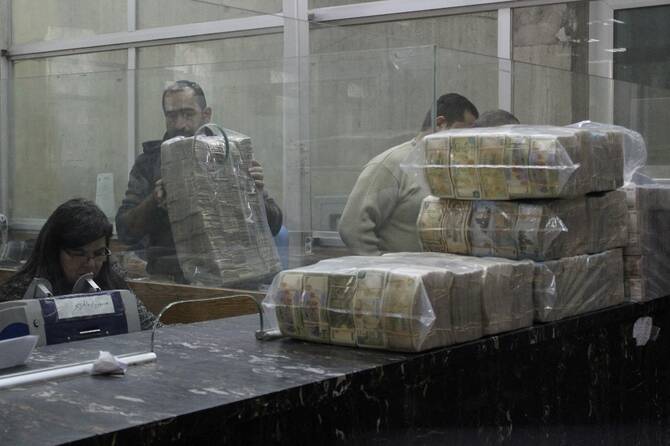
Bundles of Syrian currency notes are stacked up as an employee counts money at Syrian central bank, after the ousting of Syria's Bashar al Assad in Damascus, Syria. (Reuters)
Short Url
Updated 21 October 2025
Follow

Syria gives banks six months to absorb losses from Lebanese crisis

  • Syrian officials say the decision is part of a wider effort to clean up a banking sector crushed by 14 years of war and Western sanctions and help address a liquidity crisis that has stifled economic activity

DAMASCUS: Syria’s central bank has ordered commercial lenders to fully provision for losses tied to Lebanon’s financial collapse and submit credible restructuring plans within six months, a move that could reshape the country’s battered banking sector.
The directive issued on September 22 requires banks to recognize 100 percent of their exposure to Lebanon’s financial system, where Syrian lenders parked funds during the country’s civil war.
Syrian officials say the decision is part of a wider effort to clean up a banking sector crushed by 14 years of war and Western sanctions and help address a liquidity crisis that has stifled economic activity.
The order has prompted some banks to seek new investors or explore foreign acquisitions, three Syrian bankers told Reuters.
“They will need to provide us with a credible plan for restructuring, and now the countdown has started,” Syrian Central Bank governor Abdelkader Husriyeh told Reuters.
“They can find various ways to do this, including via their sister banks in Lebanon or by partnering with other international institutions,” he said.

SYRIAN BANKS FACE SIGNIFICANT EXPOSURE
Syrian commercial banks have more than $1.6 billion in exposure to Lebanon, Husriyeh said.
That represents a significant proportion of the $4.9 billion in total deposits in the Syrian commercial banking sector, according to a Reuters calculation based on the 2024 financial reports of all 14 commercial banks in Syria, published by the Damascus Stock Exchange.
The banks most affected include Bank Al-Sharq, Fransabank, Bank of Syria and Overseas, and Banque Bemo Saudi Faransi, Shahba Bank and Ahli Trust Bank, all originally Lebanese banks that opened branches in Syria in the 2000s. None of the banks immediately responded to requests for comment.
Bankers say they turned to Lebanon during Syria’s civil war, with few other options due to Western sanctions that have gradually been rolled back since former leader Bashar Assad was ousted last year.
But those deposits were trapped when Lebanon’s banking system imploded in 2019, following years of fiscal mismanagement and political paralysis.
Lebanon has yet to adopt a plan to resolve the crisis, although Lebanese officials say they have made significant progress toward a “financial gap law” to determine how to prioritize compensating people for their losses.

BANKS CHALLENGE SHORT DEADLINE
Some Syrian bankers have criticized the short timeline to comply with the directive to fully provision for losses related to Lebanon.
“The decision in and of itself is justified, but the time given isn’t,” one banker said. “It’s preemptive, premature — pre-whatever you want. Political.”
Syrian officials deny any political motives.
Husriyeh said the move was part of a broader effort to adhere to regulations neglected by the previous government.
“We don’t want any bank to face issues, but denial is also not a solution,” he said. “We are moving from the denial of the old regime to acknowledgement and treatment of the problem.”
Some of the affected banks are in the early stages of talks with Arab financial institutions, including banks based in Jordan, Saudi Arabia and Qatar, over possible acquisitions, three Syrian bankers said.
Husriyeh said the government aims to double the number of commercial banks operating in Syria by 2030 and said some foreign banks were already in the process of getting licensed. He declined to provide details, citing the confidentiality of the process.


How one displaced family in Gaza is observing Ramadan’s first day under a fragile ceasefire deal

Updated 57 min 48 sec ago
Follow

How one displaced family in Gaza is observing Ramadan’s first day under a fragile ceasefire deal

  • Al Zamli said the war has deprived him and his family of many things

KHAN YOUNIS, Gaza Strip: Waleed Al Zamli longingly recalled the joys and traditions of the first day of Ramadan before the Israel-Hamas war had drastically altered his life: Lanterns for the children. Sweets. Special dishes.
“Before the war, we would greet it with happiness,” the father of 11 said, speaking from Muwasi, an area crowded with tents sheltering Palestinians who were forced by the Israeli military offensive to flee their homes.
Not anymore, he said.
It saddens and pains him that he’s unable to provide for his family, which now ekes out an existence in displacement. Al Zamli lost his job after the shop where he had worked was destroyed, he said.
So, for the first Ramadan “iftar,” the fast-breaking meal, his wife picked up meals Wednesday from a charity kitchen that the family has heavily depended on. She made soup to go with it.
“This year, there’s no happiness,” al Zamli said.
Hardships and losses dampen Ramadan’s spirit for many
Ramadan arrived in Gaza under a fragile ceasefire deal, but many Palestinians there say the month’s typically festive spirit is eluding them as they grapple with the hardships of their daily lives and the grief and losses of the war.
Some of these difficulties were on display at the charity kitchen where dozens crowded, many with their arms outstretched as they vied for a spot and held empty pots. They included children, women and elderly people.
During Ramadan, observant Muslims fast daily from dawn to sunset. It’s a time for increased worship, religious reflection and charity. In normal circumstances, the month often brings families and friends together to break their fast in joyous gatherings.
But circumstances in Gaza are far from normal. Israel’s military offensive has killed more than 72,000 Palestinians, according to Gaza’s Health Ministry, and caused widespread destruction and displaced most of the territory’s residents. Israel launched the offensive after Hamas-led militants killed some 1,200 people, mostly civilians, and took another 251 hostage in their attack on Oct. 7, 2023.
For al Zamli, the biggest challenge this Ramadan is providing food for his family. He said he’s received limited aid. Foods, like meat and poultry, are more expensive than their prewar prices, he said, and with no income many items are beyond his reach.
“The children want to feel happy like other people’s children, to get dressed and to eat something clean and special,” he said.
The financial strain can be especially amplified during Ramadan, he said. Typically, many shoppers throng to markets to stock up on food staples and buy decor and other supplies. Food can play a central role as the daily fasting gives way to nourishing, and for some elaborate, iftar meals. Muslims also eat a predawn meal known as “suhoor” to nurture their bodies ahead of the fast.
As Gaza residents visited markets this week, some lamented how economic woes cast a pall on the month.
Ramadan decorations among the ruins
Still, amid the struggles, some in the Gaza Strip have worked to bring a taste of the month’s festivities — for example, hanging strands of Ramadan decorations among the ruins. At their displacement camp, al Zamli’s children played with empty soda cans fashioned to look like Ramadan lanterns.
The Oct. 10 US-brokered ceasefire deal attempted to halt more than two years of war between Israel and Hamas. While the heaviest fighting has subsided, the ceasefire has seen almost daily Israeli fire.
Israeli forces have carried out repeated airstrikes and frequently fire on Palestinians near military-held zones, killing more than 600 Palestinians, according to Gaza health officials. The ministry, which is part of the Hamas-led government, maintains detailed casualty records that are seen as generally reliable by UN agencies and independent experts. But it does not distinguish between civilians and militants.
Militants have carried out shooting attacks on Israeli troops, and Israel says its strikes are in response to that and other violations. Four Israeli soldiers have been killed.
Despite some much-needed respite under the shaky ceasefire deal, many daily struggles, big and small, persisted.
Al Zamli said the war has deprived him and his family of many things. A son-in-law, he said, was killed, shortly after he married his now-widowed daughter.
This Ramadan, he will pray “for the bloodshed to end … and to feel security, safety, and tranquility” and “to be able to provide good food and clothes for our children.”