Pakistan defense minister confirms airstrikes in Kabul, other cities during latest conflict with Afghanistan

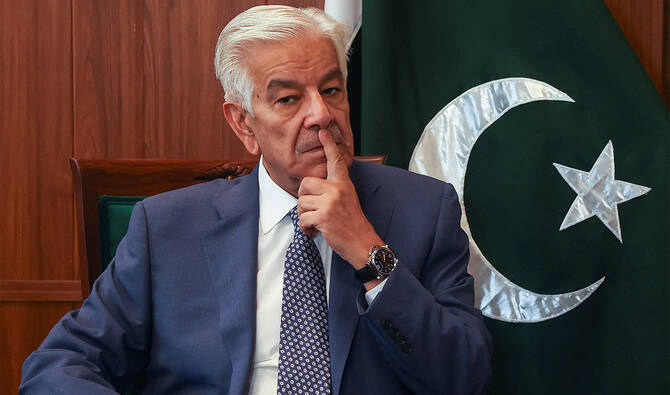
Pakistan's Defence Minister Khawaja Muhammad Asif gestures during an interview with Reuters in Islamabad, Pakistan, on May 8, 2025. (REUTERS/File)
Short Url
Updated 21 October 2025
Follow

Pakistan defense minister confirms airstrikes in Kabul, other cities during latest conflict with Afghanistan

  • Khawaja Asif’s remarks mark Pakistan’s first acknowledgment of airstrikes carried out during this month’s border conflict
  • Ceasefire brokered in Doha ended a week of deadly clashes ahead of new talks between the two sides in Istanbul on Oct. 25

ISLAMABAD: Pakistan’s Defense Minister Khawaja Asif has confirmed for the first time that the country carried out airstrikes inside Afghanistan during a week-long conflict earlier this month, saying the operations targeted militants of the Tehreek-e-Taliban Pakistan (TTP) in Kabul and other cities.

The latest crisis began when two explosions rocked central Kabul and an airstrike hit a market in eastern Afghanistan, days after 11 Pakistani soldiers were killed in a TTP attack. The Afghan government blamed Pakistan for the strikes, saying civilians had been killed — a charge Islamabad neither confirmed nor denied — before Kabul launched retaliatory cross-border raids that killed at least 23 Pakistani soldiers.

Pakistan responded last Wednesday with attacks across the border, including airstrikes in Kabul and Kandahar, Afghanistan’s two largest cities. Hours later, both countries entered an initial 48-hour ceasefire to defuse tensions.

When that truce expired on Friday, Afghanistan said new Pakistani airstrikes killed 17 people, including three Afghan cricketers. Pakistan denied killing civilians and said the operations had targeted militants. Throughout the fighting, the Pakistani military did not confirm air raids, saying only that it had responded to attacks by Afghan forces and allied militants on its border posts.

A new ceasefire was announced Sunday after talks in Doha, bringing respite from the worst flare-up of tensions between the neighbors in years.

“They [TTP] are housed over there, nobody can deny that,” Asif told Arab News in an interview on Monday. “And their leadership is there and that is why we went after them when there were strikes in Kabul last week and a couple of other cities.”

His remarks mark the first public acknowledgment by a senior Pakistani official of cross-border airstrikes that Afghanistan has repeatedly condemned as violations of its sovereignty. Until now, Islamabad had referred only to “counter-terrorism operations” or fighting with Afghan forces and affiliated militants like the TTP near the frontier.

Asif said an understanding was reached in Doha that Türkiye and Qatar would act as guarantors to ensure the TTP no longer used Afghan soil for attacks in Pakistan. The two sides are scheduled to meet again in Istanbul on Oct. 25 for follow-up discussions.

“The mechanism of this arrangement will be decided over there, how to monitor the activities of the TTP in Afghanistan,” Asif said.

Pakistan is grappling with a renewed wave of militancy since 2021, when the Afghan Taliban returned to power in Afghanistan and attacks by the TTP and its affiliates sharply increased. 

Islamabad has been demanding that Kabul rein in militants it says operate from havens in Afghanistan. The government in Afghanistan denies this. 


Pakistan discovers new oil, gas reserves in push to cut costly imports

Updated 5 sec ago
Follow

Pakistan discovers new oil, gas reserves in push to cut costly imports

  • Exploration firm announces modest discovery of 225 barrels of oil, 1.01 MMSCFD of gas per day
  • Multiple discoveries together could boost domestic production and reduce reliance on imports

ISLAMABAD: Pakistan has announced a modest discovery of new oil and gas reserves in its northwestern Khyber Pakhtunkhwa (KP) province, state media reported on Friday, amid the country efforts to boost exploration to cut costly imports.

Pakistan faces a widening energy gap due to rising demand and limited domestic output, forcing reliance on costly fuel imports that expose the economy to global price swings. Its petroleum, oil, and lubricants import bill fell 4.39 percent to $9.046 billion in July 2025-January 2026.

The discovery was made at Lumshiwal Formation of Baragzai X-01 exploratory well. During Cased Hole Drill Stem Test (CHDST-04) conducted in the Hangu and Lumshiwal formations, the well produced 225 barrels of oil per day (BOPD) and 1.01 million standard cubic feet per day (MMSCFD) of gas through a 32/64’’ choke at a wellhead flowing pressure of 190 psig.

“Baragzai X-01 (Slant) was spudded on December 30, 2024, as an exploratory well to assess the hydrocarbon potential of multiple formations, including Lockhart, Hangu, Lumshiwal, Samana Suk, Shinawari, Datta and Kingriali.

The well was successfully drilled to a total depth of 5,170 meters into the Kingriali Formation,” the state-run APP news agency reported, citing the Oil and Gas Development Company (OGDC).

“Based on wireline log evaluations, three earlier cased hole drill stem tests were conducted in the Kingriali, Datta, and Samana Suk plus Shinawari formations, which also resulted in oil and gas discoveries. The latest test over Lumshiwal further confirms the commercial viability and hydrocarbon prospectivity of the block.”

The discovery was made under the Nashpa Exploration License. OGDC has a 65 percent working interest in the license, in partnership with Pakistan Petroleum Limited (30 percent) and Government Holdings Private Limited (5 percent).

“This discovery will strengthen Pakistan’s energy security by enhancing indigenous hydrocarbon production,” the exploration firm said. “It will add to the reserves base of OGDC and its joint venture partners while contributing toward narrowing the country’s energy supply-demand gap.”

Pakistan has reported several oil and gas discoveries recently. Although modest individually, their combined potential could boost domestic production and reduce reliance on imported energy.

In January, a discovery regarding an exploratory well, flowing at the rate of 4,100 barrels of oil per day (BOPD) and 10.5 million standard cubic feet per day (MMSCFD) of gas, was made in Kohat. In September 2025, Pakistan Petroleum Limited announced a discovery in Attock district, while Mari Energies reported a new gas find in North Waziristan.

Pakistan’s Sindh province dominates gas production with a 62 percent share and contributes 40 percent to oil output, while Khyber Pakhtunkhwa accounts for 41 percent of crude oil production. Punjab produces 18 percent of the nation’s oil, and Balochistan contributes just one percent, according to Topline Securities.