

Pakistan defense minister confirms airstrikes in Kabul, other cities during latest conflict with Afghanistan

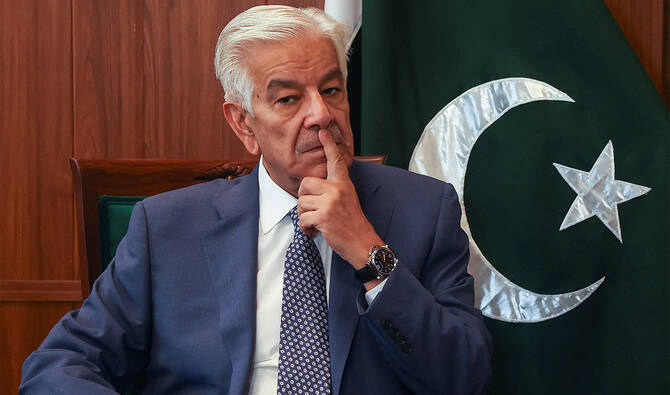
Pakistan's Defence Minister Khawaja Muhammad Asif gestures during an interview with Reuters in Islamabad, Pakistan, on May 8, 2025. (REUTERS/File)
Short Url
Updated 21 October 2025
Follow

Pakistan defense minister confirms airstrikes in Kabul, other cities during latest conflict with Afghanistan

  • Khawaja Asif’s remarks mark Pakistan’s first acknowledgment of airstrikes carried out during this month’s border conflict
  • Ceasefire brokered in Doha ended a week of deadly clashes ahead of new talks between the two sides in Istanbul on Oct. 25

ISLAMABAD: Pakistan’s Defense Minister Khawaja Asif has confirmed for the first time that the country carried out airstrikes inside Afghanistan during a week-long conflict earlier this month, saying the operations targeted militants of the Tehreek-e-Taliban Pakistan (TTP) in Kabul and other cities.

The latest crisis began when two explosions rocked central Kabul and an airstrike hit a market in eastern Afghanistan, days after 11 Pakistani soldiers were killed in a TTP attack. The Afghan government blamed Pakistan for the strikes, saying civilians had been killed — a charge Islamabad neither confirmed nor denied — before Kabul launched retaliatory cross-border raids that killed at least 23 Pakistani soldiers.

Pakistan responded last Wednesday with attacks across the border, including airstrikes in Kabul and Kandahar, Afghanistan’s two largest cities. Hours later, both countries entered an initial 48-hour ceasefire to defuse tensions.

When that truce expired on Friday, Afghanistan said new Pakistani airstrikes killed 17 people, including three Afghan cricketers. Pakistan denied killing civilians and said the operations had targeted militants. Throughout the fighting, the Pakistani military did not confirm air raids, saying only that it had responded to attacks by Afghan forces and allied militants on its border posts.

A new ceasefire was announced Sunday after talks in Doha, bringing respite from the worst flare-up of tensions between the neighbors in years.

“They [TTP] are housed over there, nobody can deny that,” Asif told Arab News in an interview on Monday. “And their leadership is there and that is why we went after them when there were strikes in Kabul last week and a couple of other cities.”

His remarks mark the first public acknowledgment by a senior Pakistani official of cross-border airstrikes that Afghanistan has repeatedly condemned as violations of its sovereignty. Until now, Islamabad had referred only to “counter-terrorism operations” or fighting with Afghan forces and affiliated militants like the TTP near the frontier.

Asif said an understanding was reached in Doha that Türkiye and Qatar would act as guarantors to ensure the TTP no longer used Afghan soil for attacks in Pakistan. The two sides are scheduled to meet again in Istanbul on Oct. 25 for follow-up discussions.

“The mechanism of this arrangement will be decided over there, how to monitor the activities of the TTP in Afghanistan,” Asif said.

Pakistan is grappling with a renewed wave of militancy since 2021, when the Afghan Taliban returned to power in Afghanistan and attacks by the TTP and its affiliates sharply increased. 

Islamabad has been demanding that Kabul rein in militants it says operate from havens in Afghanistan. The government in Afghanistan denies this. 


Pakistan forms committee to negotiate financial advisory services for Islamabad airport privatization

Updated 18 February 2026
Follow

Pakistan forms committee to negotiate financial advisory services for Islamabad airport privatization

  • Committee to engage Asian Development Bank to negotiate terms of financial advisory services agreement, says privatization ministry
  • Inaugurated in 2018, Islamabad airport has faced criticism over construction delays, poor facilities and operational inefficiencies

ISLAMABAD: Pakistan’s Privatization Ministry announced on Wednesday that it has formed a committee to engage the Asian Development Bank (ADB) to negotiate a potential financial advisory services agreement for the privatization of Islamabad International Airport.

The Islamabad International Airport, inaugurated in 2018 at a cost of over $1 billion, has faced criticism over construction delays, poor facilities, and operational inefficiencies.

The Negotiation Committee formed by the Privatization Commission will engage with the ADB to negotiate the terms of a potential Financial Advisory Services Agreement (FASA) for the airport’s privatization, the ministry said. 

“The Negotiation Committee has been mandated to undertake negotiations and submit its recommendations to the Board for consideration and approval, in line with the applicable regulatory framework,” the Privatization Ministry said in a statement. 

The ministry said Islamabad airport operations will be outsourced under a concession model through an open and competitive process to enhance its operational efficiency and improve service delivery standards. 

Pakistan has recently sought to privatize or outsource management of several state-run enterprises under conditions agreed with the International Monetary Fund (IMF) as part of a $7 billion bailout approved in September last year.

Islamabad hopes outsourcing airport operations will bring operational expertise, enhance passenger experience and restore confidence in the aviation sector.

In December 2025, Pakistan’s government successfully privatized its national flag carrier Pakistan International Airlines (PIA), selling 75 percent of its stakes to a consortium led by the Arif Habib Group. 

The group secured a 75 percent stake in the PIA for Rs135 billion ($482 million) after several rounds of bidding, valuing the airline at Rs180 billion ($643 million).

Pakistan’s Finance Minister Muhammad Aurangzeb said this week the government has handed over 26 state-owned enterprises to the Privatization Commission.