

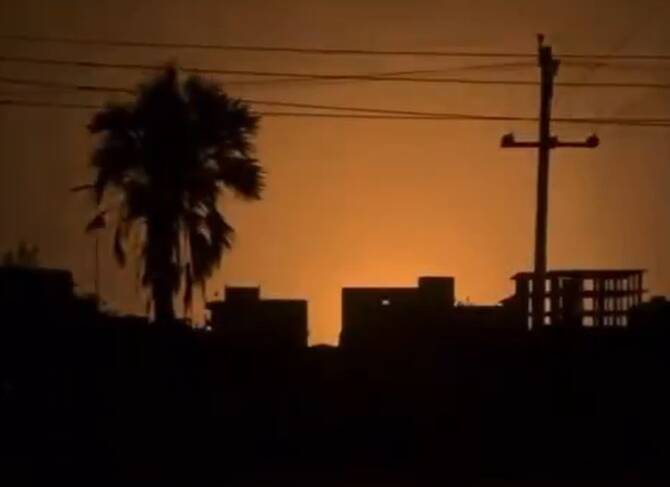
Drone attack hits Khartoum airport area ahead of reopening: witnesses

1 / 2
Residents of Sudan's besieged city of el Fasher react as they try to protect themselves from drones and shells after intensifying attacks on civilian infrastructure. (Reuters)
2 / 2
A drone attack struck the vicinity of Khartoum International Airport early Tuesday, witnesses said, one day before the army-backed government was due to reopen the facility for domestic flights for the first time in over two years. (X/@SudanTribune_EN)
Short Url
Updated 21 October 2025
Follow

Drone attack hits Khartoum airport area ahead of reopening: witnesses

  • The airport has been shut since fighting erupted in April 2023
  • Witnesses heard the sounds of drones in central and southern Khartoum and sounds of explosions in the airport area

KHARTOUM: A drone attack struck the vicinity of Khartoum International Airport early Tuesday, witnesses said, one day before the army-backed government was due to reopen the facility for domestic flights for the first time in over two years.
The airport has been shut since fighting erupted in April 2023 between the Sudanese army and the paramilitary Rapid Support Forces (RSF), leaving vital infrastructure across the capital heavily damaged.

Witnesses told AFP they heard the sounds of drones in central and southern Khartoum and sounds of explosions in the airport area from 4 am until 6 am local time (0200-0400 GMT).
One eyewitness in the Al-Azhari neighborhood in southern Khartoum said he “heard the sound of an explosion and then a drone passed overhead.”
A resident in central Khartoum said he was woken “at 4 am to the sound of drones in the sky. Shortly after, we heard loud explosions in the direction of the airport.”
On Monday, Sudan’s Civil Aviation Authority had said the airport would reopen on Wednesday, with domestic flights resuming gradually after technical and operational preparations were completed.
Khartoum has remained relatively calm since the army reclaimed control earlier this year, but drone attacks have continued, with the RSF repeatedly accused of targeting military and civilian infrastructure.
Another eyewitness also told AFP that “drones bombed northern Omdurman,” part of greater Khartoum, early Tuesday, an area known to host some of Sudan’s largest military installations.
“I saw three drones heading north toward Wadi Sayedna (military) base and I heard the sound of explosions,” they said.
There was no immediate claim of responsibility for the strikes and no information on casualties or damage was released.
Tuesday’s strike marks the third drone attack on the capital in a week. Last week, drones targeted Khartoum on two consecutive days, including strikes on two army bases in the city’s northwest. A military official said most of the drones were intercepted.
Following the army’s counteroffensive and recapture of Khartoum, more than 800,000 people have returned to the capital.
The army-aligned government has since launched a wide-ranging reconstruction campaign and is moving officials back from the Red Sea city of Port Sudan, where they had operated during the conflict.
Large parts of Khartoum, however, remain in ruins, with millions still experiencing frequent blackouts linked to RSF drone activity.
The most intense violence meanwhile is now concentrated in the west, where RSF forces have surrounded El-Fasher, the last major city in Darfur not under their control.
The paramilitary force has tried to seize the city for over 18 months, making it the most strategically critical front of the war.
The UN warned on Monday of escalating violence in North and West Darfur, with drone strikes and ground clashes reported across both regions.
The wider war in Sudan has killed tens of thousands, displaced nearly 12 million and created the world’s largest displacement and hunger crises.


Abbas reiterates opposition to displacement of Palestinians

Russian President Vladimir Putin with Palestinian President Mahmoud Abbas at the Senate Palace of the Kremlin in Moscow. (AP)
Updated 23 January 2026
Follow

Abbas reiterates opposition to displacement of Palestinians

  • During Moscow talks, president calls for immediate halt to Israeli acts of terror
  • Historically, Russia has supported and stood by the Palestinian people at political and diplomatic levels

MOSCOW: The Palestinian National Authority’s President Mahmoud Abbas has reiterated his opposition to all attempts to displace Palestinian people from their land.

Speaking with Russian President Vladimir Putin at the presidential palace in Moscow, Abbas was reported by the Kremlin’s official website as saying that “the Palestinian people are holding on to their land, and we categorically oppose attempts by the Americans and Israelis to expatriate Palestinians beyond Palestinian territory.” 
He said the Palestinian people “will not abandon their land, whatever the cost.” Abbas stressed the need to fully implement US President Donald Trump’s peace plan, leading to the withdrawal of occupation forces and the launch of the reconstruction process.
He emphasized that the Palestinian Authority would assume a central role in administering the Gaza Strip, and that the enclave and the West Bank constituted two parts of a single territorial unit, with a unified and undifferentiated system of civilian institutions.
He stressed the need for an immediate halt to “Israeli settler colonialism and Israeli acts of terror in the West Bank, including Jerusalem, along with the release of withheld Palestinian funds and the cessation of all measures that undermined the Palestinian Authority and the two-state solution.”
He reaffirmed his commitment to continue the struggle for the realization of the Palestinian people’s right to self-determination and of their right to a fully sovereign, independent state based on the borders of June 4, 1967, with East Jerusalem as its capital, while living in security and peace with neighbors.
He told Putin: “What we need is peace, and we hope that with your help and support, we can achieve it — a peace built on the basis of international legal resolutions, decisions of the United Nations, and the principles established following the wars of 1967 and 1973.
“East Jerusalem remains the capital of Palestine, and we know that Russia has always supported — indeed, was the first to support — Palestine, maintaining a firm stance in support of our people.”
Abbas thanked his Russian counterpart for Moscow’s support and commended the bilateral “bonds of friendship” between both countries. He added: “We are friends of Russia and the Russian people. For over 50 years our nations have been bound by a strong friendship that has developed over the decades and continues on the correct path. Russia is a great friend and a nation upon which we rely in many spheres.
“Historically, Russia has supported and stood by the Palestinian people at political and diplomatic levels. Your economic and financial support is both significant in scale and crucial in importance.”
Abbas emphasized moving forward with the implementation of a comprehensive national reform program aimed at consolidating the rule of law, strengthening the principles of good governance, transparency, and accountability, and ensuring the separation of powers.
Putin affirmed Moscow’s “principled and consistent approach” to the Palestinian question.
He said: “We believe that only the establishment and full functioning of the Palestinian state can lead to a lasting settlement of the Middle East conflict.”