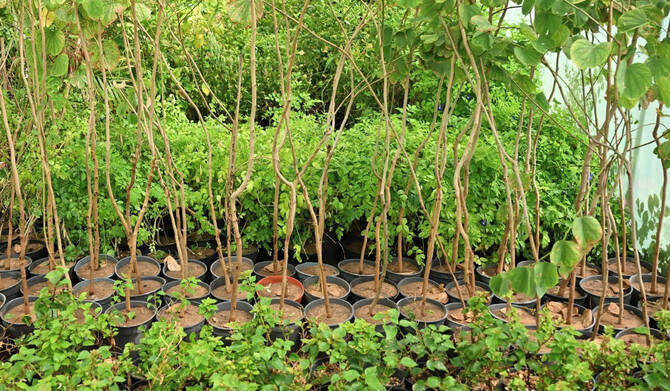
More than 14,000 trees, seedlings planted in Qassim

1 / 3
The initiative has been taken to 19 schools as part of an environmental awareness program, planting 340 trees on school grounds. (SPA)
2 / 3
The initiative has been taken to 19 schools as part of an environmental awareness program, planting 340 trees on school grounds. (SPA)
3 / 3
The initiative has been taken to 19 schools as part of an environmental awareness program, planting 340 trees on school grounds. (SPA)
Short Url
Updated 19 October 2025
Follow

More than 14,000 trees, seedlings planted in Qassim

  • Supporting nursery development and expansion, the ministry has planted 6,000 seedlings in its nurseries and distributed 3,780 to citizens and participating entities

RIYADH: The 16th phase of the Green Qassim Land initiative, launched by Qassim Gov. Prince Faisal bin Mishaal, is underway as part of the broader Saudi Green Initiative to enhance vegetation and promote environmental sustainability.

The Qassim branch of the Ministry of Environment, Water and Agriculture has planted about 4,760 trees in Buraidah and other localities, along with holding an educational workshop on the safe disposal of agricultural waste.

The initiative has been taken to 19 schools as part of an environmental awareness program, planting 340 trees on school grounds, the Saudi Press Agency reported on Sunday.

Supporting nursery development and expansion, the ministry has planted 6,000 seedlings in its nurseries and distributed 3,780 to citizens and participating entities.

The Qassim Municipality works to enhance vegetation, increase awareness, initiate volunteer programs, promote a tree-planting culture, and run campaigns to prevent pollution and harmful practices.

These efforts aim to improve the quality of life, achieve environmental sustainability, and expand green spaces, in line with Saudi Vision 2030.


Najran farmers find sugarcane cultivation viable, promising lucrative economic returns

Updated 26 min 53 sec ago
Follow

Najran farmers find sugarcane cultivation viable, promising lucrative economic returns

  • Mountain regions in Najran have a temperate climate and abundant water resources, suitable for sugarcane production

NAJRAN: Farmers in Saudi Arabia’s southwestern region of Najran are finding that sugarcane production is a viable enterprise, the Saudi Press Agency reported.

One farmer, Ibrahim Shakwan, confirmed to SPA the success of his 7.3-hectare sugarcane farm and noted “growing regional interest due to its high productivity and lucrative economic returns.”

Najran was chosen as a trial area for sugarcane production owing to the temperate climate, diverse soils, and abundant water resources in its mountainous parts. The experiment is in line with Saudi Vision 2030, which calls for enhancing food security and self-sufficiency.

Other regions in the Kingdom’s southwest, such as Jazan, Asir and Baha, have features similar to Najran.

Sugarcane is easily propagated via cuttings that yield a high number of plantable pieces. (SPA)

Sugarcane is easily propagated via cuttings that yield a high number of plantable segments. Planting occurs primarily in the summer, although seedlings can be planted year round. 

Effective cultivation methods include selecting disease-resistant varieties, proper soil preparation, and balanced irrigation and fertilization, according to the report.

The crop is harvested about eight months after planting, with fertilization ending three months before and irrigation ceasing 20 days prior to harvest to boost sugar concentration and improve juice quality, which is rich in natural sugars, vitamins, and minerals.

Several countries in the Middle East have long been growing sugarcane, with Egypt and Iran the key producers. 

Botanists believe sugarcane was first cultivated 10,000 years ago in what is now New Guinea in the southwest Pacific Ocean, where the environment is humid, according to an article titled Sugar Please published in the Aramcoworld magazine in 2012.