Three dead, dozens missing in boat capsizes off Italy with Pakistanis, Africans aboard

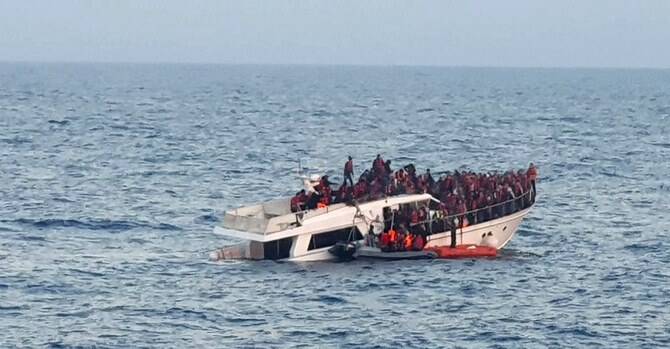
A handout photo provided by the Lebanese Army on December 31, 2022, shows a sinking migrant boat in Mediterranean waters. (LEBANESE ARMY WEBSITE / AFP)
Short Url
Updated 19 October 2025
Follow

Three dead, dozens missing in boat capsizes off Italy with Pakistanis, Africans aboard

  • More than 32,700 migrants have died attempting to cross the Mediterranean since 2014, including an estimated one in five who were children
  • Two migrants were found dead, 14 others in critical condition when Italian police intercepted boat with 85 Pakistani, Eritrean and Somali nationals

MILAN: A migrant boat carrying around 35 people sailing from Libya capsized in the central Mediterranean leaving one confirmed dead and two dozen missing, UNICEF country coordinator for Italy said on Sunday.

The rescue operation was carried out on Friday off the coast of Italy’s Lampedusa island by the Italian Coast Guard, which saved 11 migrants, including four children traveling alone, and recovered the body of a pregnant woman, UNICEF’s Nicola Dell’Arciprete said.

The survivors and the body were brought to Lampedusa, while the remaining passengers remain unaccounted for.

The boat capsized after two days at sea, Dell’Arciprete said.

In a separate event, on Sunday two migrants were found dead and 14 others were in critical condition when Italian tax police intercepted a boat with 85 people on board from Pakistan, Eritrea and Somalia, the AGI news agency reported.

The 14 migrants in need of assistance and the two bodies were transferred onto two Coast Guard units 16 nautical miles off the Lampedusa coast and brought ashore to be transferred to hospitals, AGI said.

More than 32,700 migrants have died attempting to cross the Mediterranean since 2014, including an estimated one in five who were children, according to data from United Nations agencies, Dell’Arciprete said.

Flavio Di Giacomo, a spokesperson for the United Nations’ International Organization for Migration, on Saturday said on social media platform X that at least 916 migrants had died in the central Mediterranean so far in 2025.


Pakistan, global crypto exchange discuss modernizing digital payments, creating job prospects 

Updated 05 December 2025
Follow

Pakistan, global crypto exchange discuss modernizing digital payments, creating job prospects 

  • Pakistani officials, Binance team discuss coordination between Islamabad, local banks and global exchanges
  • Pakistan has attempted to tap into growing crypto market to curb illicit transactions, improve oversight

ISLAMABAD: Pakistan’s finance officials and the team of a global cryptocurrency exchange on Friday held discussions aimed at modernizing the country’s digital payments system and building local talent pipelines to meet rising demand for blockchain and Web3 skills, the finance ministry said.

The development took place during a high-level meeting between Finance Minister Muhammad Aurangzeb, Pakistan Virtual Assets Regulatory Authority (PVARA) Chairman Bilal bin Saqib, domestic bank presidents and a Binance team led by Global CEO Richard Teng. The meeting was held to advance work on Pakistan’s National Digital Asset Framework, a regulatory setup to govern Pakistan’s digital assets.

Pakistan has been moving to regulate its fast-growing crypto and digital assets market by bringing virtual asset service providers (VASPs) under a formal licensing regime. Officials say the push is aimed at curbing illicit transactions, improving oversight, and encouraging innovation in blockchain-based financial services.

“Participants reviewed opportunities to modernize Pakistan’s digital payments landscape, noting that blockchain-based systems could significantly reduce costs from the country’s $38 billion annual remittance flows,” the finance ministry said in a statement. 

“Discussions also emphasized building local talent pipelines to meet rising global demand for blockchain and Web3 skills, creating high-value employment prospects for Pakistani youth.”

Blockchain is a type of digital database that is shared, transparent and tamper-resistant. Instead of being stored on one computer, the data is kept on a distributed network of computers, making it very hard to alter or hack.

Web3 refers to the next generation of the Internet built using blockchain, focusing on giving users more control over their data, identity and digital assets rather than big tech companies controlling it.

Participants of the meeting also discussed sovereign debt tokenization, which is the process of converting a country’s debt such as government bonds, into digital tokens on a blockchain, the ministry said. 

Aurangzeb called for close coordination between the government, domestic banks and global exchanges to modernize Pakistan’s payment landscape.

Participants of the meeting also discussed considering a “time-bound amnesty” to encourage users to move assets onto regulated platforms, stressing the need for stronger verifications and a risk-mitigation system.

Pakistan has attempted in recent months to tap into the country’s growing crypto market, crack down on money laundering and terror financing, and promote responsible innovation — a move analysts say could bring an estimated $25 billion in virtual assets into the tax net.

In September, Islamabad invited international crypto exchanges and other VASPs to apply for licenses to operate in the country, a step aimed at formalizing and regulating its fast-growing digital market.