GENEVA: Swiss families priced out of Geneva and forced to live just across the border in France are reeling from another blow: their children are now being elbowed out of Genevan schools.
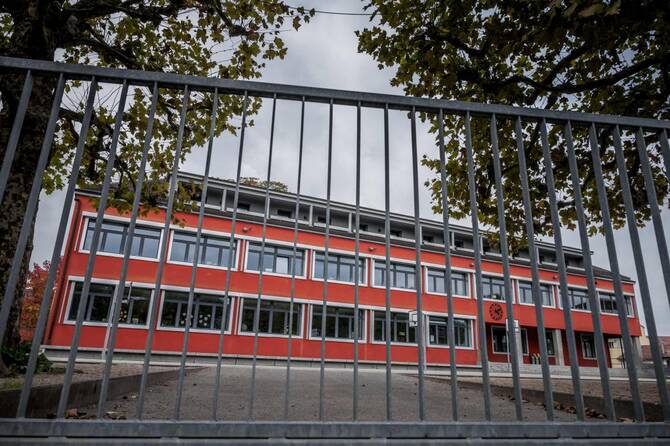
The Geneva authorities’ decision to bar pupils who live in the Swiss city’s surrounding French suburbs and villages has left parents angry, children worried, and French municipalities fuming at having to absorb more than 2,000 extra kids into their classrooms.
“We’ve become second-class Swiss citizens,” lamented Joana, a 35-year-old mother of two, declining to give her surname for professional reasons.
Like many cross-border commuters, Joana, who works in health care, left Geneva due to the lack of affordable housing.
“We agreed to leave our sub-standard home in the city center to move to the countryside – but crossing the border was conditional on access to Swiss schools,” she said.
Home to numerous international institutions, Geneva is one of the most expensive cities in the world to live in.
Its position is geographically curious: the Swiss city is almost entirely surrounded by France. Nowhere in the Geneva canton is more than 5.5 kilometers from the French border.
Around 115,000 people work in Geneva but live across the border, where the cost of living is cheaper.
‘We’re not happy’
The French village of Bossey is home to cross-border workers, many of them Swiss nationals who cannot afford to live in Geneva.
Its mayor, Jean-Luc Pecorini, can see the border from his office, less than 100 meters away on the other side of the highway.
“We’re not happy,” he said, evoking a sentiment shared by other French mayors.
He called Geneva’s decision – taken in June and coming into force at the start of the next school year in September 2026 – “abrupt.”
Opening a new classroom would cost around €80,000 ($93,000), he explained.
A source with knowledge of the figures, who did not want to be identified, said around 2,500 pupils would initially be affected, followed by “a steady stream of students” who would otherwise have gone to Swiss schools later on.
While some are French, 80 percent of those affected are Swiss.
The financial consequences for France are estimated at around €60 million in schooling and infrastructure costs, plus another €15 million a year thereafter, the source said.
Geneva’s demographic growth
Geneva is refusing to budge, citing demographic pressure and a shortage of school places.
The change represents “a saving of just over 27 million Swiss francs ($34 million) over four years,” the Genevan authorities said.
Roberto Balsa, a 47-year-old cross-border IT worker, said the news was “very brutal” for his seven-year-old daughter.
Some parents have filed legal appeals in Geneva, while others have signed an online petition.
Emmanuel, a father of four affected by the decision, who did not want to give his surname, called Geneva’s attitude “discriminatory,” noting that so-called “frontalier” workers like himself pay their taxes in Switzerland, with only a third remitted to France.
France’s Auvergne-Rhone-Alpes regional prefecture said that French authorities “can no longer accept” Geneva shifting the impact of its problems onto neighboring France “without any real consideration of the financial impact.”
By kicking out pupils, most of whom are Swiss and intend to work in Switzerland, “Geneva is exporting the burden of schooling to France, while our schools are already under severe pressure in terms of capacity,” it said.


![]()

Border order: Geneva schools kick out Swiss kids living in France
Short Url
https://arab.news/n86sb
Border order: Geneva schools kick out Swiss kids living in France
- Home to numerous international institutions, Geneva is one of the most expensive cities in the world to live in
- Around 115,000 people work in Geneva but live across the border, where the cost of living is cheaper


Latest updates


© 2026 SAUDI RESEARCH & PUBLISHING COMPANY, All Rights Reserved And subject to Terms of Use Agreement.