Pakistan, Afghanistan reach ceasefire agreement in Doha after fierce clashes

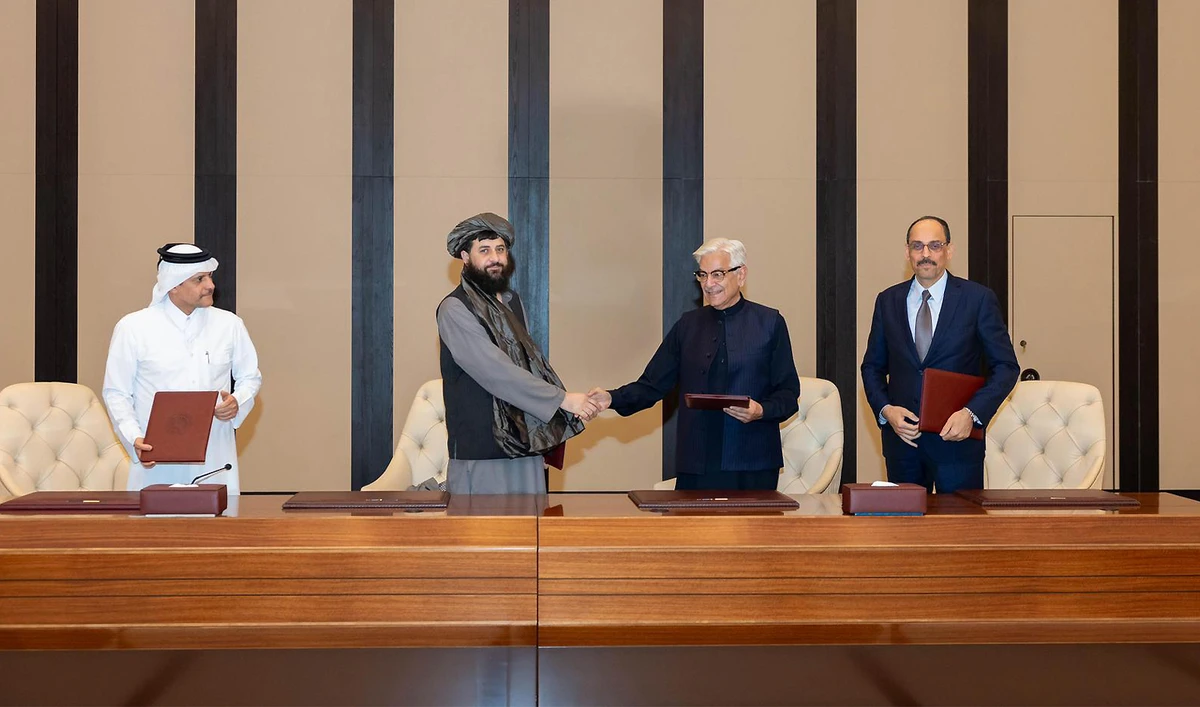
The picture shared by Qatar's Ministry of Foreign Affairs on October 19, 2025, shows Pakistani Defense Minister Khawaja Muhammad Asif (second right) shaking hand with Afghan government offiicial in Doha, Qatar. (Ministry of Foreign Affairs, Qatar)
Short Url
Updated 19 October 2025
Follow

Pakistan, Afghanistan reach ceasefire agreement in Doha after fierce clashes

  • Days of fierce clashes between Pakistan, Afghanistan left dozens dead in both countries, increased tensions
  • Both countries’ delegations will meet in Istanbul on Oct. 25 for detailed talks, says Pakistan’s defense minister

ISLAMABAD: Pakistan’s Defense Minister Khawaja Muhammad Asif announced on Sunday that Islamabad had reached a ceasefire agreement with Kabul in Doha, after days of fierce clashes between the two sides left dozens dead and increased tensions between the neighbors. 

Asif was leading a Pakistani delegation in Doha on Saturday for talks with Afghanistan after days of fierce battles between the two countries along their long and porous border, which led to the deaths of dozens of people on both sides. Pakistan also carried out airstrikes in Kandahar and Kabul before the two sides reached an uneasy truce that opened the window for bilateral talks arranged by Qatar.

Pakistan has long accused Afghanistan of sheltering militant groups like the Tehreek-e-Taliban Pakistan (TTP) and the separatist Baloch Liberation Army (BLA) and facilitating their attacks against its civilians and security forces. Kabul denies the allegation, though it has become a key sticking point between the two countries and has led more serious skirmishes than ever before.

“A ceasefire agreement has been reached between Pakistan and Afghanistan,” Asif wrote on social media platform X on Sunday. 

“The series of terrorist activities from Afghanistan on Pakistani soil will cease immediately. Both neighboring countries will respect each other’s territory — Alhamdulillah.”

The minister said delegations from Afghanistan and Pakistan will meet again in Istanbul on Oct. 25 in which detailed discussions will take place. Asif thanked Qatar and Turkiye for their mediation efforts. 

The development was also confirmed by Qatar’s foreign ministry in a statement, which said both Pakistan and Afghanistan have agreed to an “immediate ceasefire” after the Doha talks on Saturday. 

“During the negotiations, the two sides agreed to an immediate ceasefire and the establishment of mechanisms to consolidate lasting peace and stability between the two countries,” it said. 

Afghan government spokesperson Zabihullah Mujahid said the two sides had reaffirmed their commitment to peace, mutual respect and maintaining strong neighborly relations. He said both sides are committed to resolving their disputes through dialogue.

“It has been decided that neither country will undertake any hostile actions against the other, nor will they support groups carrying out attacks against the Government of Pakistan,” Mujahid wrote on X. 

He said both nations will refrain from targeting each other’s security forces, civilians or critical infrastructure. 

Tensions rose sharply on Friday when a militant attack on a Pakistani security compound in the northwestern Khyber Pakhtunkhwa province bordering Afghanistan killed at least seven soldiers. The attack elicited airstrikes from the authorities in Islamabad in an Afghan border town against the Hafiz Gul Bahadar group. 

The Afghanistan Cricket Board told AFP that three players who were in the region for a tournament were killed by the airstrikes, revising down an earlier toll of eight.

Afghanistan withdrew from the Twenty20 international tri-series in Pakistan next month in response, following which the Pakistan Cricket Board (PCB) announced Zimbabwe would take part in the series in its place. 

Information Minister Attaullah Tarar said on Saturday Pakistan had carried out “precision strikes” in which about 70 militants had been killed.

“All speculations and assertions being made regarding targeting of civilians are false and meant to generate support for terrorist groups operating from inside Afghanistan,” he added.

Bangladesh requests Pakistan to play T20 World Cup match against India on Feb. 15

Updated 8 sec ago
Follow

Bangladesh requests Pakistan to play T20 World Cup match against India on Feb. 15

  • Islamabad announced boycotting the Feb. 15 match in Colombo to protest the ICC’s exclusion of Bangladesh from the T20 World Cup
  • ’We are deeply moved by Pakistan’s efforts to go above and beyond in supporting Bangladesh during this period,’ the BCB chief says

ISLAMABAD: The Bangladesh Cricket Board (BCB) on Monday formally requested Pakistan to play its scheduled T20 World Cup match against arch-rival India on Feb. 15, following Islamabad’s decision to boycott the high-profile fixture.

Islamabad announced boycotting the Feb. 15 Pakistan-India match in Colombo to protest the International Cricket Council’s (ICC) exclusion of Bangladesh from the T20 World Cup, following Dhaka’s decision to not play matches in India owing to security fears.

On Sunday, ICC Deputy Chairman Imran Khwaja arrived in Lahore for talks with PCB officials and BCB President Aminul Islam as the sport’s governing body strived to save the high-stakes T20 World Cup encounter.

In a statement, the BCB thanked the PCB, ICC and all others for their positive roles in trying to “overcome recent challenges,” particularly thanking PCB Chairman Mohsin Naqvi and Pakistani cricket fans for demonstrating “exemplary sportsmanship and solidarity.”

“We are deeply moved by Pakistan’s efforts to go above and beyond in supporting Bangladesh during this period. Long may our brotherhood flourish,” BCB President Islam said in a statement.

“Following my short visit to Pakistan yesterday and given the forthcoming outcomes of our discussions, I request Pakistan to play the ICC T20 World Cup game on 15 February against India for the benefit of the entire cricket ecosystem.”

The dispute stemmed from the ICC’s decision to replace Bangladesh with Scotland last month after Bangladesh refused to play tournament matches in India. Dhaka’s decision followed the removal of Mustafizur Rahman from the Indian Premier League (IPL). He was bought for $1 million by the IPL’s Kolkata Knight Riders, but on Jan. 3 the Board of Control for Cricket in India (BCCI) ordered Kolkata to release Mustafizur without a public explanation but amid regional tensions.

Pakistani cricket authorities subsequently announced boycotting the match against India at R. Premadasa Stadium in Colombo on Feb. 15. An India-Pakistan fixture is the sport’s most lucrative asset, generating a massive share of global broadcasting and sponsorship revenue.

The PCB has remained defiant amid reports of potential sanctions. On Saturday, it rejected claims by Indian media that it had initiated a dialogue with the ICC to find a way out of the standoff.

The standoff highlights the growing friction within the sport’s governance, with Pakistan accusing India’s cricket board of influencing the ICC’s decisions. India generates the largest share of cricket’s commercial revenue and hence enjoys considerable influence over the sport. Critics argue that this financial contribution translates into decisive leverage within the ICC.

A large part of that revenue comes from the Indian Premier League (IPL), the sport’s most lucrative T20 cricket competition, which is run by the Board of Control for Cricket in India (BCCI). Between 2024 and 2027, the IPL is projected to earn $1.15 billion, nearly 39 percent of the ICC’s total annual revenue, according to international media reports.