Pakistan PM, Malaysian counterpart discuss Gaza peace plan, seek unhindered aid flow

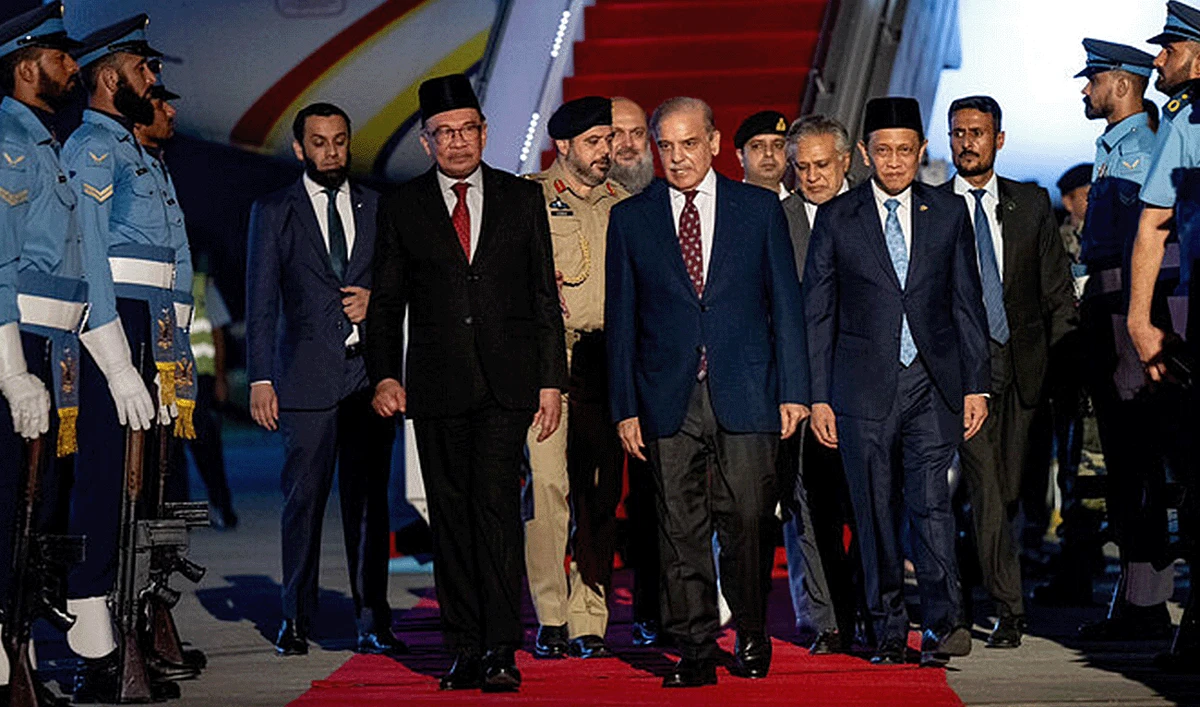
PM Shehbaz Sharif (center right) welcomes his Malaysian counterpart Dato' Seri Anwar Ibrahim (center left) as he arrives in Islamabad, Pakistan, on October 2, 2024. (@anwaribrahim/X)
Short Url
Updated 18 October 2025
Follow

Pakistan PM, Malaysian counterpart discuss Gaza peace plan, seek unhindered aid flow

  • Shehbaz Sharif briefs Anwar Ibrahim on his participation in the Gaza ceasefire signing in Egypt
  • Malaysia’s leader offers to help ease Pakistan-Afghanistan tensions and discusses bilateral ties

ISLAMABAD: Prime Minister Shehbaz Sharif and his Malaysian counterpart Anwar Ibrahim discussed the Gaza Peace Plan in a telephone call on Saturday, expressing hope for an end to the suffering of the Palestinian people and a smoother flow of humanitarian aid amid efforts to secure lasting peace.

Sharif attended a summit in New York with leaders from eight Muslim-majority nations and US President Donald Trump in September to discuss the situation in Gaza before the peace plan was formally unveiled. The 20-point plan envisages a phased implementation beginning with a ceasefire and the release of Israeli hostages held by Hamas.

The Pakistani leader also took part in the signing ceremony of the ceasefire deal in Sharm-el-Sheikh, Egypt, earlier this month, underlining Islamabad’s diplomatic commitment to international peace efforts.

“Prime Minister Shehbaz Sharif briefed Prime Minister Anwar Ibrahim on his participation in the signing ceremony of the Gaza Peace Agreement in Sharm-el-Sheikh," said an official statement released by his office after the phone call.

"While welcoming this peace effort, both leaders expressed hope that it would help bring an immediate end to the suffering of the Palestinian people, ensure unhindered humanitarian access to Gaza and pave the way for lasting peace and stability in the region,” it added.

Sharif raised concerns about militant violence emanating from Afghan soil during the phone call while highlighting his country’s interest in maintaining peace and stability in the region.

Malaysia’s leader also offered to play a constructive role in reducing tensions between the two neighboring countries, said the statement.

The call followed Sharif’s three-day visit to Malaysia in early October, where he and Ibrahim announced a $200 million halal-meat trade quota and pledged enhanced cooperation in the digital economy, agriculture and education.

Both countries described the visit as a renewed effort to expand economic and strategic ties between the two Muslim nations.

Sharif thanked the leadership and people of Malaysia for the warm hospitality during the Kuala Lumpur visit while expressing satisfaction over the trajectory of bilateral relations between both countries.


Pakistan mulls 'Super App' for public services, document verification in major technology push

Updated 15 February 2026
Follow

Pakistan mulls 'Super App' for public services, document verification in major technology push

  • Pakistan has been urging technology adoption in public, private sectors as it seeks to become a key tech player globally
  • The country this month launched the Indus AI Week to harness technology for productivity, skills development and innovation

KARACHI: Pakistan is planning to launch a “Super App” to deliver public services and enable digital document verification, the country's information technology (IT) minister said on Sunday, amid a major push for technology adoption in public and private sectors.

Pakistan, a country of 240 million people, seeks to become a key participant in the global tech economy, amid growing interest from governments in the Global South to harness advanced technologies for productivity, skills development and innovation.

The country's information and communications technology (ICT) exports hit a record $437 million in Dec. last year, according to IT Minister Shaza Fatima Khawaja. This constituted a 23% increase month on month and a 26% increase year on year.

Pakistan's technology sector is also advancing in artificial intelligence (AI) and cloud computing, marked by the launch of Pakistan’s first sovereign AI cloud in November, designed to keep sensitive data domestic and support growth in the broader digital ecosystem.

“In developed countries, citizens can access all government services from a mobile phone,” Fatima said, announcing plans for the Super App at an event in Karachi where more than 7,000 students had gathered for an AI training entrance test as part of the ‘Indus AI Week.’

“We will strive to provide similar facilities in the coming years.”

Khawaja said the app will reduce the need for in-person visits to government offices such as the National Database and Registration Authority (NADRA) and the Higher Education Commission (HEC).

The Indus AI Week initiative, which ran from Feb. 9 till Feb. 15. was aimed at positioning Pakistan as a key future participant in the global AI revolution, according to the IT minister.

At the opening of the weeklong initiative, Prime Minister Shehbaz Sharif announced that Pakistan would invest $1 billion in AI by 2030 to modernize the South Asian nation’s digital economy.

“These initiatives aim to strengthen national AI infrastructure and make the best use of our human resource,” Khawaja said, urging young Pakistanis to become creators, inventors and innovators rather than just being the consumers of technology.