

Pakistan says defense minister in Doha to hold talks with Afghan officials to end cross-border militancy

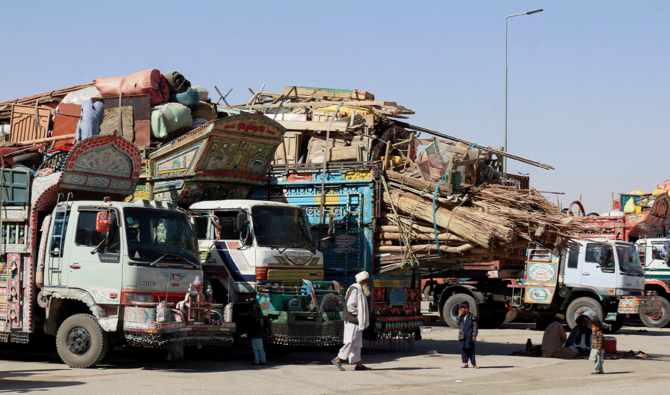
A man walks near children next to parked vehicles loaded with the belongings of Afghan citizens attempting to return to their country, after Pakistan closed border crossings with Afghanistan following exchanges of fire between the nations' forces, at the border crossing in Chaman, Balochistan Province, Pakistan October 16, 2025. (Reuters/File)
Short Url
Updated 18 October 2025
Follow

Pakistan says defense minister in Doha to hold talks with Afghan officials to end cross-border militancy

  • Negotiations follow days of deadly border clashes and Pakistani airstrikes in Afghan cities of Kabul and Kandahar
  • Pakistan denies reports of civilian casualties from airstrikes, calling them propaganda to support militant groups

KARACHI: Pakistan’s Defense Minister Khawaja Asif is leading the delegation of his country to Doha to hold talks with Afghan officials today, Saturday, demanding an end to “cross-border terrorism,” said the foreign office in a statement.

The development comes after days of fierce battles between the two neighbors along their long and porous border, which led to the deaths of dozens of people on both sides, with Pakistan carrying out airstrikes in Kandahar and Kabul before the two sides reached an uneasy truce that opened the window for bilateral talks arranged by Qatar.

Pakistan has long accused Afghanistan of sheltering militant groups like the Tehreek-e-Taliban Pakistan (TTP) and the separatist Baloch Liberation Army (BLA) and facilitating their attacks against its civilians and security forces. Kabul denies the allegation, though it has become a key sticking point between the two countries and has led more serious skirmishes than ever before.

“A high-level delegation from Pakistan, led by our Minister of Defense, will hold discussions with representatives of the Afghan Taliban in Doha today,” the foreign office said in a social media post. “The talks will focus on immediate measures to end cross-border terrorism against Pakistan emanating from Afghanistan and restore peace and stability along the Pak-Afghan border.”

“Pakistan does not seek escalation but urges the Afghan Taliban authorities to honor their commitments to the international community and address Pakistan’s legitimate security concerns by taking verifiable action against terrorist entities,” it added.

The foreign office also appreciated Qatar’s mediation efforts, adding it hoped the discussions would lead to peace and stability in the neighborhood.

Only a day earlier, there was a militant attack on a Pakistani security compound in the northwest that killed at least seven soldiers, eliciting airstrikes from the authorities in Islamabad in an Afghan border town against the Hafiz Gul Bahadar group involved in the suicide bombing and gun attack at a military camp.

The Afghanistan Cricket Board told AFP that three players who were in the region for a tournament were killed by Friday’s airstrikes, revising down an earlier toll of eight.

However, Information Minister Attaullah Tarar said on Saturday Pakistan had carried out “precision strikes” in which about 70 militants had been killed.

“All speculations and assertions being made regarding targeting of civilians are false and meant to generate support for terrorist groups operating from inside Afghanistan,” he added.

Security sources said that the Doha talks were held to convey a single point to the Afghan administration, which is to stop supporting “terrorism inside Pakistan.”

A day earlier, United States President Donald Trump offered to help end hostilities between Pakistan and Afghanistan.

“I do understand that Pakistan attacked or there is an attack going on with Afghanistan,” he said in a meeting with the Ukrainian president Volodymyr Zelensky at the White House.

“That’s an easy one for me to solve if I have to solve it. In the meantime, I have to run the USA. But I love solving wars.”
Pakistani security forces also said on Saturday they had conducted a successful intelligence-based operation in Mughal

Kot sector of Bannu in Khyber Pakhtunkhwa, killing two militants.

They added that heavy weapons had also been recovered from the militants belonging to the TTP.


Pakistan terms climate change, demographic pressures as ‘pressing existential risks’

Updated 06 December 2025
Follow

Pakistan terms climate change, demographic pressures as ‘pressing existential risks’

  • Pakistan has suffered frequent climate change-induced disasters, including floods this year that killed over 1,000
  • Pakistan finmin highlights stabilization measures at Doha Forum, discusses economic cooperation with Qatar 

ISLAMABAD: Pakistan’s Finance Minister Muhammad Aurangzeb on Saturday described climate change and demographic pressures as “pressing existential risks” facing the country, calling for urgent climate financing. 

The finance minister was speaking as a member of a high-level panel at the 23rd edition of the Doha Forum, which is being held from Dec. 6–7 in the Qatari capital. Aurangzeb was invited as a speaker on the discussion titled: ‘Global Trade Tensions: Economic Impact and Policy Responses in MENA.’

“He reaffirmed that while Pakistan remained vigilant in the face of geopolitical uncertainty, the more pressing existential risks were climate change and demographic pressures,” the Finance Division said. 

Pakistan has suffered repeated climate disasters in recent years, most notably the 2022 super-floods that submerged one-third of the country, displaced millions and caused an estimated $30 billion in losses. 

This year’s floods killed over 1,000 people and caused at least $2.9 billion in damages to agriculture and infrastructure. Scientists say Pakistan remains among the world’s most climate-vulnerable nations despite contributing less than 1 percent of global greenhouse-gas emissions.

Aurangzeb has previously said climate change and Pakistan’s fast-rising population are the only two factors that can hinder the South Asian country’s efforts to become a $3 trillion economy in the future. 

The finance minister noted that this year’s floods in Pakistan had shaved at least 0.5 percent off GDP growth, calling for urgent climate financing and investment in resilient infrastructure. 

When asked about Pakistan’s fiscal resilience and capability to absorb external shocks, Aurangzeb said Islamabad had rebuilt fiscal buffers. He pointed out that both the primary fiscal balance and current account had returned to surplus, supported significantly by strong remittance inflows of $18–20 billion annually from the Middle East and North Africa (MENA) and Gulf Cooperation Council (GCC) regions. 

Separately, Aurangzeb met his Qatari counterpart Ali Bin Ahmed Al Kuwari to discuss bilateral cooperation. 

“Both sides reaffirmed their commitment to strengthening economic ties, particularly by maximizing opportunities created through the newly concluded GCC–Pakistan Free Trade Agreement, expanding trade flows, and deepening energy cooperation, including long-term LNG collaboration,” the finance ministry said. 

The two also discussed collaboration on digital infrastructure, skills development and regulatory reform. They agreed to establish structured mechanisms to continue joint work in trade diversification, technology, climate resilience, and investment facilitation, the finance ministry said.