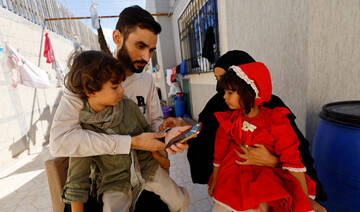
GENEVA: The United Nations cautioned Friday it would take time to reverse the famine in the Gaza Strip, saying all crossings needed to be opened to “flood Gaza with food.”
The UN’s World Food Programme said it had been able to move close to 3,000 tons of food supplies into the war-shattered Palestinian territory since the US-brokered ceasefire between Israel and Hamas took hold.
“It’s going to take some time to scale back the famine” declared by the UN in late August, WFP spokeswoman Abeer Etefa told a media briefing in Geneva.
“The ceasefire has opened a narrow window of opportunity. WFP is moving very quickly and swiftly to scale up food assistance and reach families who have endured months of blockade, displacement and hunger.”
Etefa said WFP had five food distribution points up and running across the Gaza Strip, mostly in the south, but wanted to get to 145.
She said the WFP had been able to use the Kerem Shalom and Kissufim crossings in recent days.
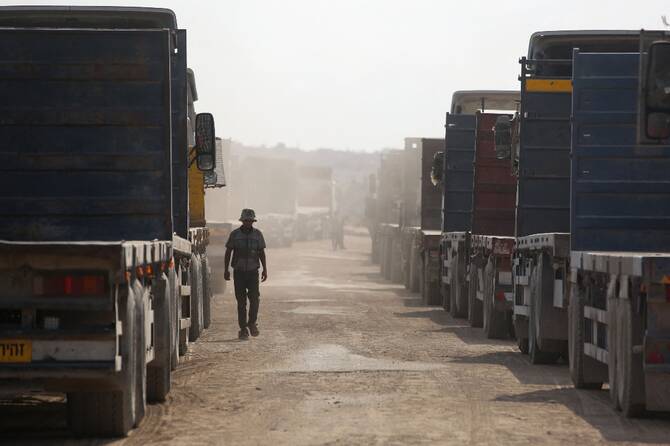
From Saturday until Wednesday, around 230 trucks with 2,800 tons of food supplies crossed into Gaza, said Etefa.
The spokeswoman said 57 trucks in two convoys, carrying wheat flour and nutrition supplies, crossed in on Thursday and reached WFP’s warehouses intact, ready for distribution.
“We’re still below what we need but we’re getting there,” she said.
As of Wednesday, nine bakeries were running, with WFP working on getting 30 going throughout the Gaza Strip.
“Bread is extremely important. The smell of fresh bread in Gaza is more than nourishment: it’s a signal that life is returning,” said Etefa.
She called for all land crossings into the Palestinian territory to be opened up “so that we can flood Gaza with food supplies.”
“The faster we can move aid in, the more lives we can reach quickly,” she added.
WFP is starting its distribution of nutrition supplies in Gaza City.
“We are trying to push back on famine, especially for families returning home in the north of Gaza,” said Etefa.
WFP’s plan is to scale up to reach 1.6 million people inside Gaza over the next three months.

UN says will ‘take some time’ to scale back Gaza famine
https://arab.news/n7amp
UN says will ‘take some time’ to scale back Gaza famine
- The UN’s World Food Programme said it had been able to move close to 3,000 tons of food supplies into the war-shattered Palestinian territory since the US brokered ceasefire between Israel and Hamas took hold
- The spokeswoman said 57 trucks in two convoys, carrying wheat flour and nutrition supplies, crossed in on Thursday and reached WFP’s warehouses intact, ready for distribution
Israeli airstrike on a Palestinian refugee camp in Lebanon kills 13 people, Lebanese ministry says
- Hamas condemned the attack in a statement saying the strike hit a sports playground and denying that it was a training compound
- Lebanon’s Health Ministry has reported more than 270 people killed and around 850 wounded by Israeli military actions since the ceasefire
SIDON, Lebanon: An Israeli airstrike on a Palestinian refugee camp in southern Lebanon on Tuesday killed 13 people and wounded several others, state media and government officials said. It was the deadliest strike on Lebanon since a ceasefire in the Israel-Hezbollah war a year ago.
The drone strike hit a car in the parking lot of a mosque in the Ein el-Hilweh refugee camp on the outskirts of the coastal city of Sidon, the state-run National News Agency said. The Lebanese Health Ministry said 13 people were killed and several others wounded in the airstrike, without giving further details.
Hamas fighters in the area prevented journalists from reaching the scene, as ambulances rushed to evacuate the wounded and the dead.
The Israeli military said it struck a Hamas training compound that was being used to prepare an attack against Israel and its army. It added that the Israeli army would continue to act against Hamas wherever the group operates.
Hamas condemned the attack in a statement saying the strike hit a sports playground and denying that it was a training compound.
Over the past two years, Israeli airstrikes on Lebanon have killed scores of officials from the militant Hezbollah group as well as Palestinian factions such as Hamas.
Saleh Arouri, the deputy political head of Hamas and a founder of the group’s military wing, was killed in a drone strike on a southern suburb of Beirut on Jan. 2, 2024. Several other Hamas officials have been killed in strikes since then.
Hamas led the Oct. 7, 2023 attack on southern Israel that killed about 1,200 people. That sparked Israel’s offensive on the Gaza Strip that killed tens of thousands of Palestinians, according to the Gaza Health Ministry.
A day after the Israel-Hamas war started, Hezbollah began firing rockets toward Israeli posts along the border. Israel responded with shelling and airstrikes in Lebanon, and the two sides became locked in an escalating conflict that became a full-blown war in late September 2024.
That war, the most recent of several conflicts involving Hezbollah over the past four decades, killed more than 4,000 people in Lebanon, including hundreds of civilians, and caused an estimated $11 billion worth of destruction, according to the World Bank. In Israel, 127 people died, including 80 soldiers.
The war ended in late November 2024 with a US-brokered ceasefire. Since then, Israel has carried out scores of airstrikes in Lebanon, saying that Hezbollah is trying to rebuild its capabilities.
Lebanon’s Health Ministry has reported more than 270 people killed and around 850 wounded by Israeli military actions since the ceasefire.