

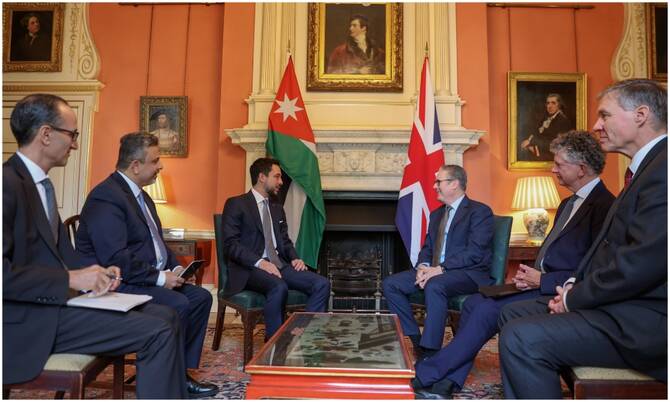
Jordan’s crown prince commends UK prime minister for official recognition of Palestinian statehood

Jordan’s ambassador to the UK, Manar Dabbas; the director of the Office of the Crown Prince, Zaid Baqain; and the UK’s national security adviser, Jonathan Powell, also attended the meeting. (Petra)
Short Url
Updated 16 October 2025
Follow

Jordan’s crown prince commends UK prime minister for official recognition of Palestinian statehood

  • Crown Prince Hussein and Keir Starmer discuss latest developments in the Middle East during meeting at 10 Downing Street on Thursday
  • Crown prince emphasizes need for full implementation of Gaza ceasefire deal between Hamas and Israel, and unrestricted deliveries of humanitarian aid to territory

LONDON: Crown Prince Hussein of Jordan praised UK Prime Minister Keir Starmer on Thursday for the British government’s recent decision to officially recognize Palestinian statehood.

During their meeting at No. 10 Downing Street, the crown prince stressed the need to support the Palestinian people in their efforts to secure their rights and establish an independent state.

Regarding the latest developments in Gaza, the crown prince highlighted the need to ensure full implementation of the ceasefire deal between Hamas and Israel, as well as unrestricted deliveries of humanitarian aid to the territory.

Starmer and Crown Prince Hussein also discussed the latest developments in the wider Middle East, and the latter called for joint efforts to restore regional stability to be stepped up, the Jordan News Agency reported.

The UK government announced its recognition of the State of Palestine in the run-up to the UN General Assembly in September. Several other Western countries took a similar step around that time, including France, Canada and Australia.

Jordan’s ambassador to the UK, Manar Dabbas; the director of the Office of the Crown Prince, Zaid Baqain; and the UK’s national security adviser, Jonathan Powell, also attended the meeting.


More than 100 Palestinians detained in West Bank since start of Ramadan, including women, children

Updated 5 sec ago
Follow

More than 100 Palestinians detained in West Bank since start of Ramadan, including women, children

  • Arrests by Israelis accompanied by extensive field interrogation

RAMALLAH: Israeli forces have detained more than 100 Palestinians from the West Bank since the beginning of the holy month of Ramadan, including women, children, and former prisoners, the Palestinian Prisoner’s Society reported on Sunday.

The organization said the detentions coincided with Israel’s announcement of the intensification of such actions during Ramadan, with recent settler attacks providing cover for widespread detentions across most West Bank governorates, including Jerusalem. Many detainees from Jerusalem have been barred from entering Al-Aqsa Mosque.

A statement pointed out that arrests by Israelis are accompanied by extensive field interrogation which often targets all sections of Palestinian society.

Documented violations accompanying detentions include severe beatings, organized terror campaigns against detainees and their families, destruction and looting of homes, confiscation of vehicles, money and gold, demolition of family homes, use of family members as hostages, employment of prisoners as human shields, and extrajudicial executions.

The society stressed that Israel exploits detention campaigns to expand settlement activity in the West Bank, with settlers serving as a key tool to impose a new reality.

The Palestinian Detainees Affairs Commission has revealed harrowing details of the abuses faced by Palestinian prisoner Mohammed Wajih Mahamid from Jenin during his incarceration in Israeli prisons.

The commission said that on Nov. 15, 2023, Mahamid was severely beaten on his right knee with a baton used by prison guards, causing a serious injury that left him unable to walk without crutches.

He was beaten again on the same knee on March 29, 2025, resulting in severe swelling which was later confirmed to be a fracture. Despite his condition, the prison authorities only provided painkillers and refused to transfer him to hospital, maintaining a policy of deliberate medical neglect.

The commission stressed that these abuses reflected the harsh reality faced by Palestinian detainees, who are deprived of basic human rights, medical treatment and care.